Laser and saline tattoo removal solve the same problem in opposite directions. Laser breaks pigment down where it sits so the body can clear it; saline draws pigment up and out through a controlled wound that scabs and lifts. Laser suits most body tattoos. Saline is mainly used for shallow cosmetic tattoos. Neither is universally better.
Two methods, two completely different mechanisms
Laser is the established standard for most body tattoos; saline has a narrow, legitimate role — chiefly for shallow cosmetic tattoos like microbladed brows, where laser's interaction with certain pigments can be unpredictable. Anyone calling one method universally "safer" is selling a method, not assessing your tattoo. Our laser tattoo removal begins with an assessment of the ink itself.
How each one actually works
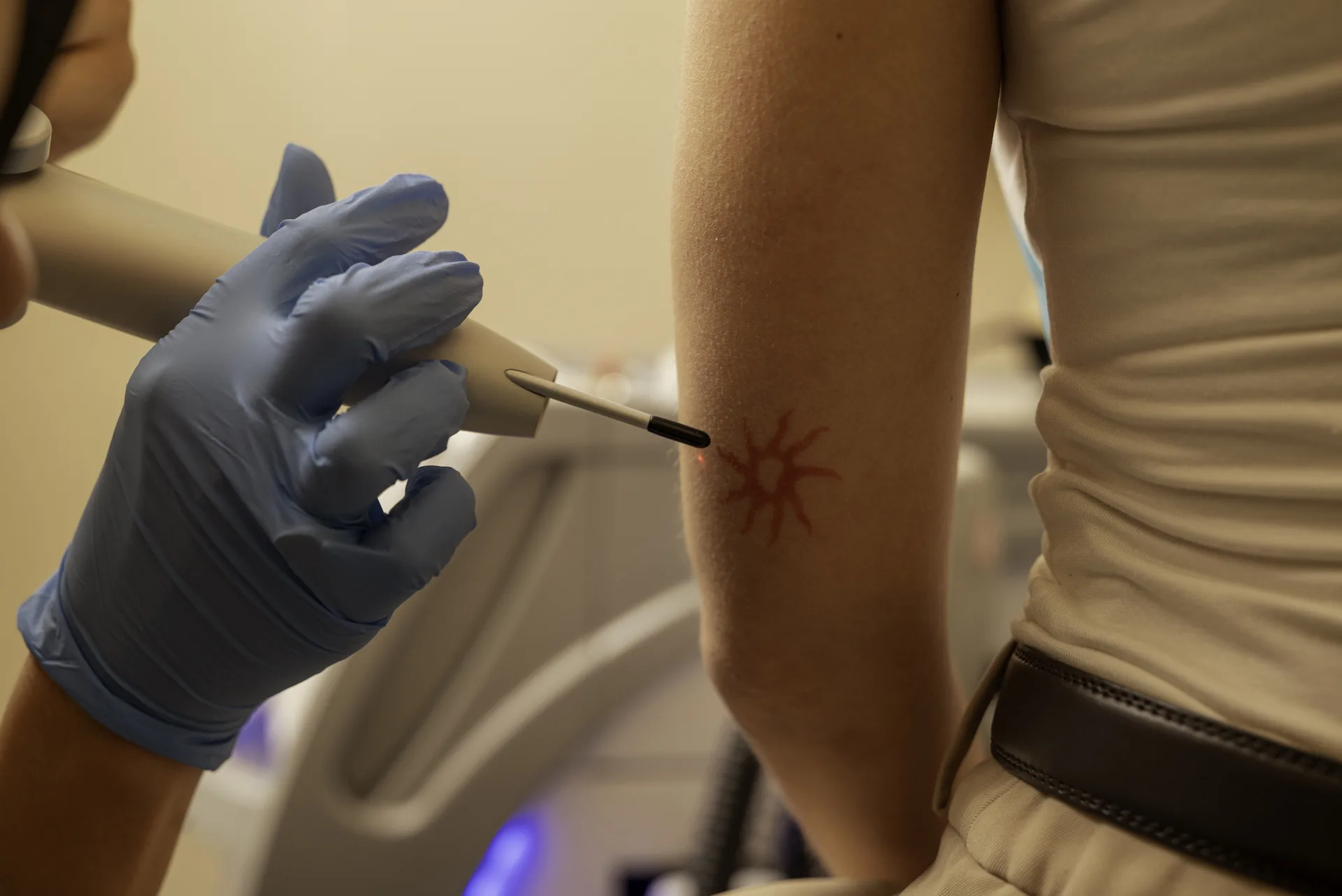
Laser sends short pulses of light into the skin; pigment absorbs the energy and shatters into particles the immune system clears over weeks. The skin surface is largely left intact. Sessions are spaced six to eight weeks apart. Our laser tattoo removal guide covers the process in full.
Saline works on the surface — the skin is opened and worked with concentrated saline; osmosis draws pigment up to form a scab that lifts and carries ink out as it heals. Slower per area, demands disciplined aftercare, works best on shallow, recent cosmetic tattoos.
The five-axis comparison
Depth of ink: laser reaches deep body-tattoo pigment; saline only shallow ink.
Pigment behaviour: laser is highly effective on black/dark blue, limited on whites and some cosmetic pinks; saline is pigment-agnostic since it lifts ink physically. Difficult colours are covered in our coloured tattoo removal guidance.
Skin trauma: laser leaves the surface largely intact; saline creates an open wound each session.
Sessions: both need multiple visits, but laser body removal is typically a longer course.
Best use: laser for most body tattoos; saline for shallow cosmetic tattoos where laser pigment interaction is a concern. We use a Q-switched laser; our PicoWay alternative page compares it with picosecond devices.
Why cosmetic tattoos are the real decision point
Some cosmetic pigments — titanium dioxide and iron oxides among them — can darken under laser (paradoxical darkening). This is why saline has kept its place. A patch test is a genuine decision gate, not a formality; if a brow pigment darkens or behaves unpredictably, that tells us laser is the wrong tool.
What it costs at DWL
We deliver laser removal and lightening; we don't offer saline in-house and will refer you elsewhere if saline is the better route. Laser tattoo removal is from £750 per course of up to 10 appointments. The patch test is free. 0% APR finance over 12 months via Tabeo is available, subject to status. See our tattoo removal cost guide for detail.
Frequently asked questions
Is laser or saline better? Neither universally — depends on your specific tattoo.
Is saline safer than laser? Not as a rule; saline creates an open wound each session.
Which is better for eyebrow tattoo removal? Often saline, since some cosmetic pigments can darken under laser — decided by patch test.
Can saline remove a large body tattoo? In practice, no.
Does DWL offer saline removal? No, but we refer to a reputable practitioner if that's the better route.
Book an assessment
Dental & Wellness London, 222 Essex Road, Islington, London N1 3AP. Call 020 8127 4567 or WhatsApp +44 7974 910222.
Reviewed by the DWL laser team under Dr Vishal Patel · BDS, MSc Aesthetic & Restorative Dentistry · GDC 103127. Last reviewed 5 June 2026.