Dental treatments at Dental & Wellness London
Cosmetic, orthodontic, restorative, general, biological — the full dental clinical range delivered by a multi-disciplinary team led by a dentist with twenty years inside the face.
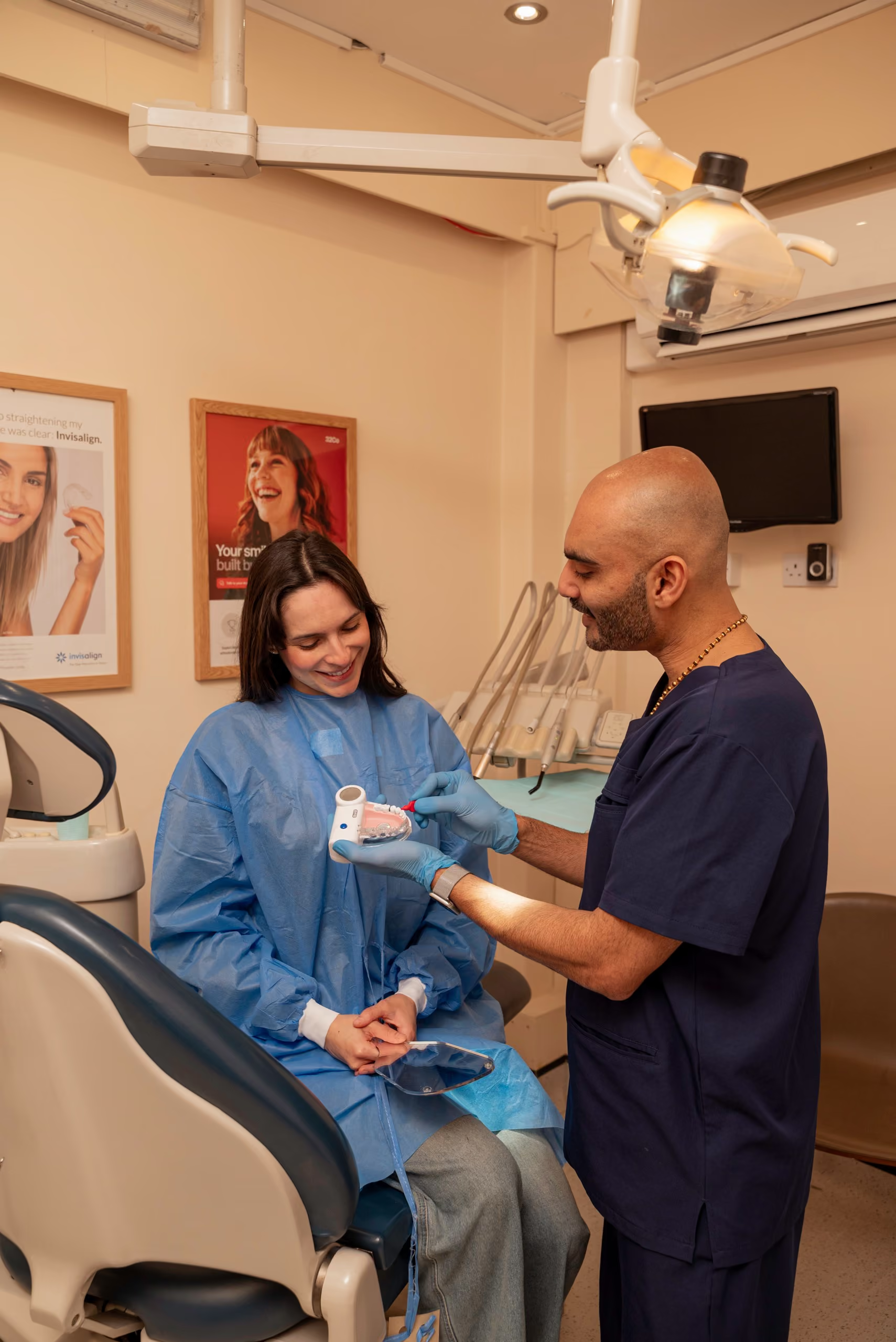
This page lists every dental treatment we offer and links to the page for each one. The practice has provided private dental care on Essex Road since 2010, led by Principal Dentist Dr Vishal Patel (BDS, MSc Aesthetic & Restorative Dentistry, GDC 103127, Invisalign Diamond II provider), with implants placed by Dr Rishil Patel. CQC registered. 4.7★ from 300+ Google reviews. New patients start with a dental examination (£65).
What makes Dental & Wellness London different?
Choose a treatment below to read who it suits, how it works, what it costs and how to book. General and preventive care, Invisalign and teeth straightening, implants and tooth replacement, cosmetic dentistry and emergency care each have their own page. Where a dental problem has a wider cause, such as night-time clenching or stress, the same team can involve our skin and wellness practitioners without a separate referral.
Long appointments, no rush
A dental examination here is 30 minutes, with a full risk assessment. Hygiene appointments are 30 minutes, with longer work split across two visits rather than rushed. You leave understanding what we found, what we'd recommend, and why. No five-minute upsells.
Diamond-level technical credentials
Dr Vishal Patel holds an MSc in Aesthetic & Restorative Dentistry from the University of Manchester, is an AACD member and an Invisalign Diamond II provider. Implants are assessed and placed by Dr Rishil Patel, BDS (Hons) King's College London, MClinDent Implantology, MJDF (GDC 154292). Real depth across the disciplines that matter.
The whole-health angle
Your jaw connects to your nervous system. Your gums connect to your gut. Your smile affects how you feel about yourself. Alongside the dental team we have an Ayurvedic practitioner, a nutritional therapist and a somatic coach, under one roof. We look at what is driving the symptom, not just protect the tooth.
Honest case selection
We tell patients what they need, not what we'd profit most from. We decline cases. We refer out. We recommend the conservative option more often than the expensive one. It's why our reviews say "no upsell" repeatedly. It's also why our patients tend to stay for years.
Implants & Restorative
General & Hygiene
Browse by treatment
Sleep & Airway
Holistic Dentistry
What to expect at the consultation
The first visit is about us understanding you, not selling you a treatment. You'll spend most of it talking, not lying back in the chair. Here's the honest version.
Book a consultationConverstion firstWhat you'd like to address. Past dental history. What you've tried. What you'd specifically like to avoid.
ExaminationSoft tissues, gums, teeth, occlusion, jaw joints. We look for what brought you in — and what you didn't mention.
Records and scansPhotographs, intra-oral scan, radiographs if clinically indicated. Everything is shared with you on screen.
Honest optionsWhat we'd recommend. What we'd decline. What you could reasonably do nothing about. The price of each option, written down.
No pressureYou leave with the plan in writing and time to think. Most patients book back within 7-14 days. Some don't book back at all. That's fine.
Starting prices, written down
All starting prices include consultation and digital records. 0% APR finance is available from £52/month on most treatments. Final price is given in writing before any work begins — no hidden fees, no upsell at the chair.
Whatever you book, you leave the consultation with a written plan, all costs visible, and time to consider. No pressure, no countdown timers, no offer-stacking. If a cheaper or more conservative option will work as well, we'll say so.
The Dental Wellness Journal
Evidence-based insight from our clinical team — written for patients, not professionals.
VIEW ALL ARTICLES → Orthodontics
How Much Does Invisalign Cost in the UK? 2026 Prices
Invisalign cost in the UK explained, with our Islington prices: Express from £1,500, Moderate £3,400 and Unlimited £4,500–£4,900.
Read Article → Orthodontics
Invisalign Results: What to Realistically Expect by Case
What results does Invisalign give? A Diamond II provider on realistic outcomes by case complexity, the four factors that affect them, and the limits.
Read Article → Orthodontics
Invisalign for Teens — a parent's honest guide
Invisalign for teenagers: when it suits, the compliance question, cost from £1,500 to £4,900, and when fixed braces are the better answer.
Read Article →Explore dental treatments
Frequently
asked questions
Wellness dentistry combines traditional dental care with whole-body health — treating the mouth as a window to overall wellbeing.
View all FAQs →Can I be seen quickly with wisdom tooth pain?
Yes. Call early in the day and we will try to see you the same day for a dental problem assessment (£75). We are open Monday to Friday, 8am to 7pm (Tuesday from 9am), by appointment. If you have swelling that is spreading, difficulty swallowing or breathing, or a high temperature, seek urgent medical care straight away.
Who removes wisdom teeth at your clinic?
Wisdom teeth are removed by Dr Rishil Patel (GDC 154292), who trained in oral and maxillofacial surgery at Barts and The London and holds an MClinDent in Implantology. Where a tooth lies very close to the nerve or needs hospital-based care, we refer to a specialist oral surgeon and explain why.
What is a dry socket, and how can I avoid one?
A dry socket happens when the blood clot in the socket is lost too early, leaving the bone exposed. It causes a throbbing ache that usually starts two to four days after the extraction. To protect the clot, avoid smoking, straws, spitting and vigorous rinsing for the first few days, then rinse gently with warm salt water. If the pain gets worse rather than better, contact us and we will see you.
How long does recovery take after wisdom tooth removal?
Most people are through the worst within a week. Expect mild bleeding on the first day, swelling and jaw stiffness peaking on days two and three, and a gradual return to normal eating by days four to seven. The socket itself takes several weeks to fill in. Surgical removal of an impacted lower tooth can take a little longer to settle than a simple extraction.
Does wisdom tooth removal hurt?
The procedure is carried out under local anaesthetic, so you should feel pressure and movement but not sharp pain. Soreness and swelling usually peak on the second or third day and are managed with ordinary painkillers and cold packs. If you are anxious, tell us at your assessment and we will talk through the options, including sedation.
Does every wisdom tooth need to be removed?
No. A healthy wisdom tooth that has come through straight and can be cleaned is usually best left in place and checked at your routine examinations. We recommend removal when there is a clear reason: repeated gum infection (pericoronitis), decay in the wisdom tooth or the tooth in front, a cyst, or damage to the neighbouring tooth or gum.
How much does wisdom tooth removal cost in Islington?
Every wisdom tooth is different, so we quote in writing after assessment, once an X-ray shows the position of the tooth and its roots. A dental problem assessment is £75 (or £65 as part of a routine examination), and X-rays are £18 each where needed. A fully erupted tooth costs less to remove than an impacted one that needs minor surgery. 0% APR finance over 12 months via Tabeo is available, subject to status.
Are there affordable dental implants near Angel?
Our clinic is at 222 Essex Road, N1 3AP, a 15 to 20 minute walk from Angel. A single implant is from £2,200, including the implant and crown, the implant consultation is free for a limited number of patients only, and 0% APR finance over 12 months via Tabeo is available, subject to status. Every plan is quoted in writing, so you know the full cost before you commit.
How much does a dental implant cost in London?
A complete single implant in London, including the crown, usually costs about £2,000 to £3,500. TreatCompare's 2026 survey of more than 1,100 UK practices found a median of £2,000 in Central London and £2,400 in Greater London, and notes that the lowest quotes often cover the implant placement only. At Dental & Wellness London, a single implant is from £2,200, including the implant and crown, and the implant consultation is free for a limited number of patients only.
How experienced is the clinic with Invisalign?
Dr Vishal Patel has around 20 years in practice and over 50,000 patient appointments behind him, and the clinic has been on Essex Road since 2010. Invisalign here is planned as part of long-term smile design and oral health, not as a quick straightening course, and Dr Patel reviews every case himself from the first scan to the final retainer check.
Should adults choose Invisalign or braces?
It depends on the movement your teeth need and how you live. Invisalign is removable and discreet, but only works if the aligners are worn 20 to 22 hours a day. Fixed ceramic braces, or Six Month Smiles cosmetic braces for front-tooth alignment, can suit people who would rather not manage aligners. We offer all three and compare them against your scan at a free consultation. Complex skeletal cases are referred to a specialist orthodontist.
How much is Invisalign in London?
Across London, Invisalign usually costs between about £1,400 and £4,400. TreatCompare's 2026 price survey found a median of £2,900 in Central London and £2,800 in Greater London. At Dental & Wellness London in Islington, Invisalign Express is from £1,500, Moderate £3,400 and Unlimited £4,500–£4,900, and the consultation with an iTero scan is free. When comparing quotes, check whether refinements and retainers are included.
Is there a dentist for teeth whitening near Angel?
Yes. Dental & Wellness London is at 222 Essex Road, Islington, N1 3AP, a 15 to 20 minute walk from Angel station and two minutes from Essex Road station. Whitening starts with a £65 dental examination; one method is £450 and the combined in-chair and home plan is £780.
Is teeth whitening at the dentist safe?
Yes, when a dentist checks your teeth and gums first and supervises the course. In the UK, gels stronger than 0.1% hydrogen peroxide (up to 6%) may only be provided by a registered dental professional after an examination. The usual side effects, temporary sensitivity and mild gum irritation, settle within days. Salon and online whitening with stronger gels is illegal and carries more risk.
Which teeth whitening systems do you use?
We use Philips Zoom for in-chair, light-activated whitening, and Enlighten and Opalescence gels. Dr Vishal Patel chooses the system for each patient based on sensitivity, the type of staining and whether in-chair, home or combined treatment suits best. Every option is dentist-supervised and stays within the UK legal limit of 6% hydrogen peroxide.
Can I spread the cost of one-arch Invisalign?
Yes. We offer 0% APR finance over 12 months via Tabeo, subject to status, on Express, Moderate and Unlimited. The total and monthly amount are set out in writing with your treatment plan, so you can take it home and consider it before booking. There is no pressure to decide at the consultation.
Can single-arch Invisalign fix an overbite?
Rarely. An overbite is a relationship between the upper and lower teeth, so correcting it usually means moving both arches, sometimes with small elastics. Treating one arch alone can leave the teeth meeting awkwardly. If your scan shows a bite problem, we will recommend a both-arch plan and explain why.
Why might one arch need the same plan as two?
Plans follow the amount and type of movement, not the number of arches. A single arch with significant crowding or several rotated teeth can need as many aligners as a simple case treating both arches. That is why some one-arch cases sit on Moderate rather than Express. Your ClinCheck shows exactly what is planned.
Is it worth only straightening my top teeth?
It can be, when the upper teeth are the only concern and the bite is already good. If the lower teeth are also crowded, or the upper teeth would need to move in a way that affects the bite, treating both arches usually gives a more stable and balanced result. We explain which applies after your scan.
How much does single arch Invisalign cost?
Yes. At Dental & Wellness London, Invisalign Express for a single arch is from £1,500, or about £125 a month over 12 months at 0% APR via Tabeo, subject to status. Both arches on Express are £2,200, and cases needing more movement sit on Moderate at £3,400. The consultation, iTero scan and ClinCheck preview are free, and the plan and fee are confirmed in writing afterwards.
Can I get Invisalign on just my bottom teeth?
Yes, if the concern is confined to the lower arch and your bite is sound. Lower front crowding is one of the most common single-arch cases we see. We scan both arches at the free consultation, because moving the lower teeth changes how they meet the upper teeth, and we only recommend one arch when the bite allows it.
Can mercury fillings cause symptoms I cannot explain?
Population research has not established sound amalgam fillings as a cause of general symptoms or illness, and we will not attribute unexplained symptoms to your fillings in order to recommend a procedure. If you feel unwell, please see your GP. We can give you an honest view of what your fillings do and do not explain.
Are you an IAOMT-certified dentist?
We apply the IAOMT's SMART precautions as our technical standard, and we are careful not to claim more than that. What protects you in the chair is the set of precautions actually used on the day, so we explain each one before treatment. We would encourage you to ask any clinic exactly which measures it uses.
What replaces a mercury filling?
Composite resin for most small and medium cavities, usually in one visit. Ceramic inlays or onlays where a larger area of a back tooth needs rebuilding, and crowns where the tooth is weak or cracked. The choice is made tooth by tooth by Dr Vishal Patel, based on bite forces and how much healthy tooth remains.
Is it safe to remove amalgam fillings during pregnancy?
Mainstream guidance is to avoid elective dental work, including non-urgent amalgam removal, during pregnancy and breastfeeding, and we follow it. If a filling is failing and needs attention while you are expecting, we manage it conservatively and plan anything elective for later. Please tell us if you are pregnant or planning a pregnancy.
Do you recommend removing all mercury fillings?
No, not as a blanket rule. We replace fillings that are failing or clinically indicated, and we support informed personal preference. We do not advise removing sound, functioning fillings for general-health reasons, in line with mainstream dental evidence, and we will tell you so plainly at your examination.
What is the SMART protocol?
The Safe Mercury Amalgam Removal Technique, published by the International Academy of Oral Medicine and Toxicology. It sets out precautions for removing amalgam: rubber-dam isolation, high-volume suction, water cooling, sectioning the filling in pieces, air filtration and protective coverings. We apply these precautions whenever we remove an amalgam at our Islington clinic.
How much does safe amalgam removal cost?
It depends on the number and size of fillings and what replaces each one, so we give a written, itemised quote after a £65 examination. Composite replacements are quoted in writing; ceramic inlays are £750, onlays £850 and crowns £950 to £1,200. 0% APR finance over 12 months via Tabeo is available, subject to status.
Where can I get partial dentures in north London?
We make partial dentures at 222 Essex Road, Islington, London N1 3AP, about two minutes from Essex Road station and one stop from Highbury & Islington. The 38, 56, 73, 341 and 476 buses stop nearby, and Angel is 15–20 minutes' walk. We are open Monday to Friday, 8am to 7pm (Tuesday from 9am), by appointment.
Are dentures cheaper than implants?
Yes, in the short term. A flexible single-tooth denture is from £750, while a single implant is from £2,200 including the crown. Implants preserve bone and feel fixed, but need surgery and healing time. A denture can also be a sound interim step while you plan an implant with our implant dentist, Dr Rishil Patel.
Can I whiten my teeth if I have sensitive teeth?
Usually, yes, with care. Sensitivity is a reason to plan rather than to avoid whitening. We look for the cause first, such as gum recession, grinding or acid wear, then use a lower-strength or desensitising gel and adjust wear time. Many sensitive patients whiten comfortably at home with custom trays, which allow the pace to be slowed if needed.
How long do dentures last?
With good care, a flexible partial denture typically lasts several years and a cobalt chrome denture often longer, though results vary. The gum and bone beneath a gap change slowly, so a denture may need relining to restore its fit or eventually replacing. We check the fit at your routine examinations and advise when an adjustment is due.
Is it legal to have teeth whitening at a salon?
In the UK, tooth whitening is a dental procedure. Gels containing more than 0.1% hydrogen peroxide can only be provided by, or on the prescription of, a registered dental professional after an examination. Salon treatments using stronger gels are operating outside the law, and they cannot check whether your gums, enamel and existing dental work are suitable.
Do partial dentures damage your natural teeth?
Not if they are well designed and well cared for. Clasps place some extra load on the teeth they grip, and plaque can collect around them, which raises the risk of decay and gum disease. We design clasps and rests to spread forces, and regular hygiene visits (30 minutes, £85) and check-ups protect the supporting teeth.
Will whitening work on crowns, veneers or fillings?
No. Peroxide whitens natural tooth structure only and has no effect on porcelain, composite or other dental work. If restorations are visible, we assess them before you start, because whitening the surrounding teeth can make them look darker. Sometimes the best sequence is to whiten first, wait around two weeks, then replace older restorations to match.
How long do teeth whitening results last?
Most patients keep a good result for one to three years, depending on how much coffee, tea, red wine and tobacco they have. Whitening gives you a lighter starting point rather than stopping new stain. Because you keep your custom trays, maintaining the shade is usually a few nights of top-up gel rather than repeating the whole treatment.
Can a denture replace one missing tooth?
Yes. A one tooth denture is a common, non-surgical way to fill a single gap without preparing the neighbouring teeth. We usually make it in a flexible material from £750, and it can be fitted in one appointment once records are complete. If an implant or bridge would serve you better, we explain why before you decide.
Does teeth whitening hurt?
Whitening itself is not painful, but some people notice temporary sensitivity, often brief twinges, during the course or for a day or two afterwards. We reduce this by controlling gel strength and wear time, using a desensitising formulation where needed and protecting the gums. If your teeth are already sensitive, tell us at assessment so we can adapt the plan.
What is the best type of partial denture?
It depends on the gap. A flexible denture with gum-coloured clasps suits a single tooth or a small gap and is light and discreet. A cobalt chrome framework suits several missing teeth: it is thinner, stronger and more stable. Temporary acrylic dentures are useful while gums heal. We recommend the design that suits your teeth, gums and bite.
Is in-chair or home teeth whitening better?
In-chair whitening gives a fast, supervised head-start; home whitening with custom trays is gentler, more even and easy to top up. Used together, they give the most predictable and lasting result for most people. Either works well alone if it is planned around your teeth. We recommend the approach at assessment, once we know why your teeth are the colour they are.
How much does teeth whitening cost in London?
At Dental & Wellness London in Islington, one method of professional whitening (in-chair or custom take-home trays) is £450, and the combined plan is £780, after a £65 dental examination. For comparison, TreatCompare's 2026 price survey of 352 Central London practices found a median of about £400, with in-chair whitening typically £350–£700, dentist-supplied home trays £250–£450 and combined plans £400–£800. Check whether a quote includes the examination, trays and a review.
How much do dentures cost in London?
At Dental & Wellness London in Islington, a flexible single-tooth partial denture is from £750 and a cobalt chrome partial denture is from £1,600. Larger and complete dentures are quoted in writing after assessment. Every plan starts with a dental examination (£65), and 0% APR finance over 12 months via Tabeo is available, subject to status.
Where can I get teeth straightening near Islington?
Our practice is at 222 Essex Road, Islington, London N1 3AP, two minutes from Essex Road station and one stop from Highbury & Islington. Buses 38, 56, 73, 341 and 476 stop nearby, and Angel is a 15–20 minute walk. Many patients cycle or use Lime and Forest e-bikes. We are open Monday to Friday, 8am to 7pm (Tuesday from 9am), by appointment.
Is the clinic accessible?
Yes. The clinic is on the ground floor and is wheelchair accessible. If you have particular needs, such as extra time, a carer attending or anxiety about dental treatment, let us know when you book and we will plan the appointment around them. We are open Monday to Friday, 8am to 7pm (Tuesday from 9am), by appointment only.
Do you treat teenagers?
We assess teenagers and treat suitable cases with aligners, with a parent present at consultation. Whether aligners or fixed braces suit a teenager depends partly on how reliably they will be worn, which we discuss openly. Where growth modification or a complex bite is involved, we refer to a specialist orthodontist. NHS orthodontics may be available to under-18s who meet clinical criteria.
Can I pay for private dental treatment in instalments?
Yes. We offer 0% APR finance over 12 months via Tabeo, subject to status, for larger treatment such as Invisalign, implants and veneers. Your treatment is quoted in writing first, so you know the full cost before deciding whether to spread it. Routine examinations and hygiene visits are paid on the day.
Does teeth straightening hurt?
Most people feel pressure or tenderness for a day or two after each new aligner or adjustment, which settles with time. Aligners avoid the cheek and lip irritation that brackets and wires can cause. Simple pain relief is rarely needed beyond the first few days. Persistent pain is not normal, and we would want to see you if it occurs.
Do clear aligners work as well as braces?
For mild to moderate crowding, spacing and many bite corrections, aligners such as Invisalign work as well as fixed braces when they are worn around 22 hours a day. Fixed braces still have the edge for severe rotations, extraction cases and skeletal discrepancies. We tell you at consultation which category your teeth fall into, and refer where a specialist is the better choice.
Is adult teeth straightening worth it?
For many adults it is, because aligned teeth are easier to clean, wear more evenly and often look more balanced. It is worth it when the plan is sound and retention is taken seriously. It is not worth it if the gums are unhealthy or the result cannot be held. A free consultation tells you which applies to you before you spend anything.
What is the quickest way to straighten teeth?
For small irregularities of the front teeth, a short aligner course such as Invisalign Express, or Six Month Smiles, can finish in months rather than years. Speed should follow the biology, though; forcing movement risks the roots and gums. Where a quick cosmetic change is all that is needed, composite bonding may disguise the irregularity without moving teeth at all.
Do you see patients from outside Islington?
Yes. Many patients travel from across north London, including Highbury, Hackney, Stoke Newington and the City, and some come further for orthodontic and cosmetic treatment. We are at 222 Essex Road, N1 3AP, two minutes from Essex Road station, with buses 38, 56, 73, 341 and 476 stopping nearby.
How much does teeth straightening cost in the UK?
It depends on the system and the complexity of the case. At Dental & Wellness London, Invisalign Express is from £1,500, Moderate £3,400 and Unlimited £4,500–£4,900. Spark aligners and Six Month Smiles are quoted in writing after assessment. The orthodontic consultation, with an iTero scan and ClinCheck preview, is free, and 0% APR finance over 12 months via Tabeo is available, subject to status.
Where can I get teeth bonding in Islington?
Our clinic is at 222 Essex Road, Islington, London N1 3AP, two minutes from Essex Road station and on the 38, 56, 73, 341 and 476 bus routes. Appointments are Monday to Friday, 8am to 7pm (Tuesday from 9am). Local patients can find more on our composite bonding Islington page.
Is teeth bonding reversible?
In most cases, yes. Bonding is added to the enamel rather than replacing it, and usually needs little or no drilling, so it can normally be polished away later. That is one of its main advantages over porcelain veneers, which usually need some enamel preparation. We explain clearly beforehand if your case needs any shaping of the tooth.
How do I choose a good private dental clinic in London?
Check who will treat you and their GDC registration, whether you will get an itemised written plan, how long appointments are, and how complications and complaints are handled. Read reviews over several years. A good clinic explains options including doing nothing, and refers to a specialist when that serves you better.
Can bonding fix a chipped front tooth?
Yes. Bonding is usually the simplest way to repair a chipped front tooth, rebuilding the missing piece in matched composite in a single visit. If chips keep happening, we look for grinding or a bite problem first, because bonding under heavy force can chip again. Large or painful chips need a clinical assessment before any cosmetic repair.
How long does teeth bonding take?
A single tooth usually takes under an hour, including shade matching, layering and polishing. Several teeth are treated in one longer appointment, often two to three hours for six front teeth. Most patients need no anaesthetic. Before that, a 30-minute consultation confirms whether bonding suits you and whether hygiene or whitening should come first.
Are orthodontic consultations free?
Yes. Consultations for orthodontics, including Invisalign, are free and include an iTero scan and, where appropriate, a ClinCheck preview of the planned tooth movement. Dr Vishal Patel is an Invisalign Diamond II provider. Invisalign is from £1,500 for Express, £3,400 for Moderate and £4,500 to £4,900 for Unlimited.
Is teeth bonding the same as composite bonding?
Composite bonding is one form of teeth bonding. "Teeth bonding" is the umbrella term covering edge bonding, composite bonding and composite veneers, which all use the same resin and adhesive technique but cover different amounts of the tooth. Our composite bonding page covers the most common form in detail.
How much does teeth bonding cost?
At Dental & Wellness London, teeth bonding is £175 per tooth for simple work, including edge bonding, and £350 per tooth for complex work. Composite veneers, which cover the whole front of the tooth, are £350–£500 per tooth. The consultation is £65, and 0% APR finance over 12 months via Tabeo is available, subject to status.
What is dental bonding?
Dental bonding is a cosmetic treatment in which tooth-coloured composite resin is attached to the surface of a tooth with an adhesive, then sculpted, hardened with a curing light and polished. It is used to repair chips, close small gaps, reshape edges and cover discolouration. It is usually done in one visit with little or no drilling.
How long does a custom sports mouthguard last?
Adults typically replace a guard every one to three years, depending on how often and how hard it is used. Teenagers often need one every six to twelve months. Replace a guard sooner if it splits, thins, becomes loose or tight, or after treatment that changes the shape of the teeth. Bring it to your check-ups so we can assess it.
What should I do if a tooth is knocked out playing sport?
For an adult tooth, hold it by the crown, rinse it briefly in milk or cold water if dirty, and try to put it back in the socket, biting on a clean cloth. If you cannot, keep it in milk and see a dentist immediately; the first hour matters. Never replant a baby tooth. Call 020 8127 4567 and we will advise on the next step.
Do you make custom mouthguards for children?
Yes. We make guards for junior players in colts rugby, school hockey and martial arts. Because children's teeth and jaws are still changing, guards usually need replacing every six to twelve months. We check the fit at routine children's examinations, which are £45, and advise when a new guard is needed. Our clinic is at 222 Essex Road, N1 3AP.
Is composite bonding reversible?
Largely, yes. Because composite is bonded onto the enamel and usually needs little or no drilling, it can normally be polished away later, leaving the natural tooth broadly as it was. A small amount of enamel shaping is occasionally needed to blend an edge, and we always explain this before treatment so you can decide with the full picture.
How long does composite bonding last?
Composite bonding typically lasts around five to seven years before it needs refinement, and often longer with good care. Refinement is usually a polish or small repair rather than a full redo. Grinding, nail-biting and staining drinks shorten its life; a night guard, regular hygiene visits and an occasional polish help it last. Results vary between patients.
How much does composite bonding cost in London?
At Dental & Wellness London, composite bonding is £175 per tooth for simple work, such as chips and edge bonding, and £350 per tooth for complex additions. The consultation is £65. Multi-tooth plans are priced tooth by tooth and set out in writing, and 0% APR finance over 12 months via Tabeo is available, subject to status.
Where is your clinic?
We are at 222 Essex Road, Islington, London N1 3AP, two minutes from Essex Road station. Buses 38, 56, 73, 341 and 476 stop nearby, Highbury & Islington is one stop away, and Angel is a 15–20 minute walk. Many patients cycle or use Lime and Forest e-bikes.
Will my teeth move back after clear aligners?
They can if retainers are not worn. Teeth tend to drift throughout life, so retention is a permanent part of treatment. Most patients wear a removable retainer at night, sometimes with a fine bonded wire behind the front teeth. Retainers are quoted in writing with your treatment plan.
What happens if I lose an aligner?
Contact us. Usually you move to the next tray early or go back to the previous one while a replacement is arranged; which is right depends on where you are in treatment. Keep your previous trays in their case for this reason, and do not go without an aligner for long, as teeth can start to move back.
Can I drink coffee with clear aligners in?
It is best not to. Hot drinks can distort the plastic, and coffee and tea stain the trays and can sit against the teeth. Take the aligners out, drink, then rinse or brush before putting them back. Plain water is the only drink we suggest with aligners in.
How long does clear aligner treatment take?
Most courses take three to eighteen months. Small front-tooth corrections may need only a few months, while crowding in both arches or bite correction takes longer. Wearing the trays for 20 to 22 hours a day keeps treatment on schedule. Your digital plan gives a realistic estimate before you start.
Which are the best clear aligners in the UK?
The best clear aligners are the ones planned and supervised properly for your case. Invisalign has the longest clinical record and the widest range of tools; Spark suits many similar cases. Both are prescribed after an in-person examination. Mail-order systems skip that step, which is where most problems begin.
How much do clear aligners cost in London?
At our clinic, Invisalign Express costs from £1,500, Moderate £3,400 and Unlimited £4,500–£4,900; Spark aligners are quoted in writing after assessment. The orthodontic consultation, with iTero scan, is free. Retainers are quoted with your plan, and 0% APR finance over 12 months is available via Tabeo, subject to status.
Do you offer dental bridges near Angel and Highbury?
Yes. We are at 222 Essex Road, Islington, London N1 3AP, two minutes from Essex Road station and one stop from Highbury & Islington. Angel is a 15–20 minute walk, and buses 38, 56, 73, 341 and 476 stop nearby. Appointments are Monday to Friday, 8am to 7pm (Tuesday from 9am).
Can a dental bridge be replaced or repaired?
Yes. If a bridge debonds it can often be re-cemented, and if it fractures or the support teeth develop problems it can be replaced. Sometimes, at that point, an implant becomes the better option. Regular check-ups help us spot problems at the margins early, when they are simpler to fix.
Will people notice I am wearing Invisalign?
From normal conversational distance, most people will not notice. The trays are clear and thin, and attachments are tooth-coloured. You may have a slight lisp for the first few days while your tongue adjusts. Many of our patients wear aligners through client meetings, presentations and weddings without others realising.
How long does it take to get a dental bridge?
A traditional bridge usually takes two appointments around two to three weeks apart: one to prepare the teeth and fit a temporary, and one to fit the final bridge. An implant-supported bridge takes longer, because the implants need three to six months to heal before the bridge is made.
Can I eat and drink with Invisalign?
You take the aligners out to eat and to drink anything other than plain water, then brush or rinse before putting them back. Hot drinks can warp the plastic, and sugary or acidic drinks trapped under the trays raise the risk of decay. Most patients settle into a routine of fewer snacks and set mealtimes within a week or two.
What does an Invisalign Diamond II provider mean?
Invisalign grades providers by the number of cases they treat, and Diamond II is one of its highest tiers. It reflects experience and volume rather than a quality award, but that experience shapes planning: knowing which movements are realistic, when refinements are likely and when another approach would serve you better.
Is a bridge or an implant better?
Neither is better for everyone. An implant leaves the neighbouring teeth untouched and helps preserve bone, but needs surgery and healing time. A bridge avoids surgery and is quicker, and suits cases where the neighbouring teeth already need crowns. We compare both against your own mouth at consultation.
Is the Invisalign consultation free?
Yes. Orthodontic consultations, including Invisalign, are free at Dental & Wellness London. Dr Vishal Patel examines your teeth and bite, takes an iTero scan and shows you a ClinCheck preview of the planned movement. If you have not had a recent check-up, we may suggest a dental examination (£65) so any decay or gum problems are treated first.
How much does Invisalign cost in London?
At our Islington clinic, Invisalign Express costs from £1,500, Moderate £3,400 and Unlimited £4,500–£4,900. The consultation, with iTero scan and ClinCheck preview, is free, and your fee is confirmed in a written plan before you commit. Retainers are quoted with the plan, and 0% APR finance over 12 months is available via Tabeo, subject to status.
Where is your holistic dental clinic in London?
We are at 222 Essex Road, Islington, London N1 3AP, two minutes from Essex Road station and one stop from Highbury & Islington. Buses 38, 56, 73, 341 and 476 stop nearby, and Angel is a 15–20 minute walk. We are open Monday to Friday, 8am to 7pm (Tuesday from 9am), by appointment.
Can a holistic dentist help with teeth grinding?
Yes, often. Grinding is commonly linked to stress and disturbed sleep, so we combine a protective appliance, such as a Davies splint at £495, with attention to habits and stress. Somatic coaching and mindfulness are available in the same Islington building for patients who want that support alongside their dental care.
What is the difference between a holistic and a biological dentist?
The terms overlap. Holistic dentistry focuses on the whole person: stress, sleep, nutrition and general health. Biological dentistry focuses on materials and technique, such as metal-free fillings and careful amalgam removal. Many clinics, including ours, offer both. Neither is a recognised specialty, so check that your dentist is GDC-registered.
Is holistic dentistry available on the NHS?
The NHS does not offer holistic dentistry as a distinct service, although NHS dentists do provide preventive advice. Dental & Wellness London is a private practice and does not provide NHS treatment. Our dental examination is £65 for 30 minutes and includes a conversation about your general health, sleep and stress.
How much does a holistic dentist cost in London?
At our Islington clinic a 30-minute dental examination with full risk assessment is £65, a 30-minute hygiene appointment is £85, and Diamond hygiene with air polish is £135. Periodontal treatment is £255. A 20-minute discovery call by phone is free, and 0% APR finance over 12 months via Tabeo is available, subject to status.
Is holistic dentistry evidence-based?
The core of it is. Prevention, minimally invasive treatment and attention to links such as gum disease and diabetes are mainstream practice. Claims that dental work cures chronic illness are not supported by good evidence. We follow NHS and professional guidance and do not claim that dental treatment causes or cures systemic disease.
What is holistic dentistry?
Holistic dentistry is dental care that treats the mouth as part of the whole person, considering stress, sleep, diet, medication and general health alongside teeth and gums. Its sensible core is prevention and conservative, explained treatment. At Dental & Wellness London in Islington we practise it as integrative dentistry, with nutritional therapy and coaching in the same building.
What types of dental bridge are there?
The main types are traditional bridges, supported by crowns on the teeth either side; cantilever bridges, supported from one side; resin-bonded (Maryland) bridges, which bond a thin wing to a neighbouring tooth; and implant-supported bridges, which rest on implants rather than natural teeth. The right type depends on your teeth, gums and bite.
Is the Invisalign consultation free?
Yes. Orthodontic consultations, including Invisalign, are free. The appointment includes an examination, an iTero scan of both arches and a ClinCheck preview of the planned movement. If aligners are not right for your case, we tell you at that visit, and there is no obligation to proceed.
Are retainers included for both arches?
Retainers for both arches are quoted in writing alongside your treatment plan, so the full cost is clear before you start. Most patients wear removable retainers at night long term, and some also have a thin fixed retainer behind the front teeth. We go through the options when you receive your plan.
How much is a dental bridge in Islington?
Bridge costs depend on the type, the number of teeth spanned and the material, so we quote in writing after assessment. The consultation is £65. For comparison, a single implant is from £2,200 including the crown. 0% APR finance over 12 months via Tabeo is available, subject to status.
Does treating both arches take longer?
Usually, because more teeth are moving and the bite is often part of the plan. Moderate dual-arch cases commonly take many months, and Unlimited cases can take eighteen months or longer. Wearing aligners for 20 to 22 hours a day, and any elastics as instructed, keeps treatment on schedule.
Is dual-arch Invisalign twice the cost of single-arch?
No. We place each case on one of three plans according to its complexity, rather than adding two arch prices together. A simple both-arch case may sit on the same plan as a more involved one-arch case. Your ClinCheck shows the planned movement, and the written plan confirms the fee.
Where can I have a bone graft assessment in Islington?
Assessments take place at Dental & Wellness London, 222 Essex Road, Islington, London N1 3AP, two minutes from Essex Road station. Buses 38, 56, 73, 341 and 476 stop nearby, and Angel is a 15–20 minute walk. Dr Rishil Patel reviews your scan and explains the options in writing.
Why do most people treat both arches?
Because the upper and lower teeth work together. If the bite needs correcting, both arches must move. Crowding in one arch is often matched in the other, and many people want the whole smile to look consistent. Treating both arches together lets us plan the alignment and the bite as one case.
Can a bone graft fail?
Yes, occasionally. Some or all of the graft may not integrate, most often because of infection, smoking or movement of the material during healing. Careful planning, treating gum disease first and avoiding smoking reduce the risk. A failed graft can often be repeated once the area has healed.
What is the dual arch Invisalign price?
At Dental & Wellness London, most cases treating both arches sit on Invisalign Moderate at £3,400 or Unlimited at £4,500–£4,900; simple ones occasionally fit Express at £2,200. The plan depends on how far the teeth need to move and whether the bite is being corrected. It is confirmed in writing after the free consultation.
Our happy patients,
in their own words
Book a consultation
If a private dental clinic in London with whole-health framing, multi-discipline integration, and an honest scope on what to do and what not to do is what you are looking for, the next step is a dental examination (£65), or a free 20-minute discovery call if you would like to talk first.
Book a consultation