Aesthetic clinic in London — dentist-led aesthetic medicine in Islington N1
A cosmetic dentist's training in vital facial structures applied to the soft tissue of the face — and why that integration changes the aesthetic-medicine conversation.
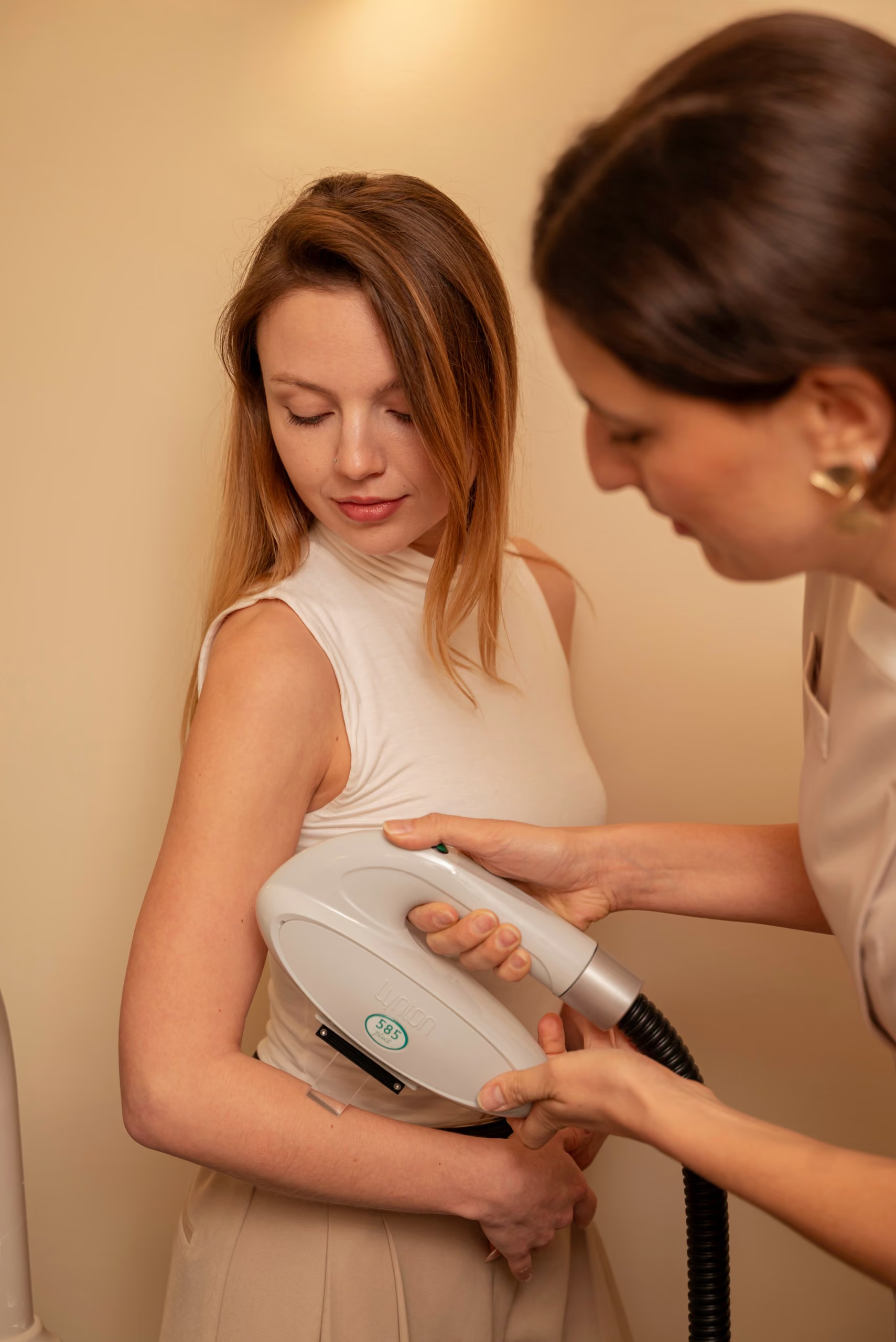
Skin and aesthetic medicine at Dental & Wellness London is delivered by Dr Vishal Patel and clinicians qualified in advanced facial aesthetics. The clinical approach is conservative — natural results, age-appropriate, planned for facial harmony rather than isolated treatment. Every plan follows UK regulation: 18+ age verification, prescriber sign-off on all prescription-only treatments, and full risk disclosure before consent. The skin and aesthetic consultation is £65, redeemable in full against treatment.
Four reasons dentists do this differently
This is the question the practice was built around, and the part of the offering most aesthetic-medicine clinics in London cannot match. The honest version of the answer:
A dentist who has spent twenty years working in the face has anatomical fluency in vital facial structures that few aesthetic injectors outside dentistry can claim. Dentistry is, structurally, surgical work in close proximity to the blood vessels, nerves, muscle function that aesthetic injection has to navigate. The oral surgery experience that comes with implant placement, the careful preparation around the inferior alveolar nerve, the sub-millimetre precision of cosmetic restorative work — these are the daily working conditions of a cosmetic dentist. They are also the precise anatomical territory aesthetic medicine acts on.
Dr Vee Patel — BDS Liverpool · MSc Aesthetic & Restorative Dentistry · Manchester · GDC 103127 — completed a Master's degree that covers both surfaces of facial aesthetics: the teeth and the soft tissue around them. The same clinician who plans cosmetic dental work plans the anti-wrinkle, dermal filler, Profhilo, and polynucleotide work that sits alongside it. Aesthetic medicine at DWL is prescribed by Dr Vishal Patel, BDS, MSc Aesthetic & Restorative Dentistry, GDC 103127 — the sole prescriber model the practice operates under.
The principle this produces is consistent across the aesthetic offering: proportionate treatment, natural aesthetics, perfect balance, and facial symmetry as the operating concepts — not "more is more". High ethics means the consultation answers "is this the right treatment?" before "how much can we book?" The patient who arrives wanting a specific named treatment is just as likely to leave with the recommendation to do something less, or nothing at all, as to leave with the booking they came for.
This integration sits inside the practice's broader whole-health dentistry philosophy — the model that treats the face as a connected anatomical and functional system rather than a series of single-discipline projects.
What this delivers, in patient terms: natural-looking results from a clinician who has been studying facial proportion their entire dental career. That positioning is not a marketing line — it is the structural advantage the dental training brings to aesthetic medicine, and the reason the practice operates as it does.
Anatomy expertise
Dentists train for five years in head-and-neck anatomy — every muscle, every vessel, every nerve. The face we treat is the face we already know cold. That depth of knowledge is the difference between a good outcome and a great one, particularly with fillers around the mouth and jaw.
Whole-face harmony
If you're considering Botox or fillers AND your smile, we plan them together. A jaw filler with a teeth grind doesn't last. Cheek volumising affects how veneers read at three feet. Our patients get one coordinated plan — not two specialists working in parallel without speaking.
Conservative philosophy
The trend in aesthetics is more — more product, more procedures, more frequency. We push the other way. Less is more, age-appropriate, deliberately under-treated rather than over-treated. The patients who come back ten years later don't look done. That's the point.
MHRA-aware, JCCP-aligned
UK aesthetic regulation tightened significantly in 2023-2025. We've operated within it from the start — proper consent, prescriber oversight, time to consider your written plan, and no offers that incentivise rushed decisions. The practitioners doing your treatment are registered, insured, and accountable.
Anti-Wrinkle Treatment
The filler offering covers the full anatomical range — cheek, jawline, tear-trough, lip enhancement — with case selection that reflects the proportionate-treatment principle. The pricing canon: dermal filler from £450 per syringe, with multi-area treatment plans quoted at consultation against the specific anatomical picture.
Dermal Fillers
The filler offering covers the full anatomical range — cheek, jawline, tear-trough, lip enhancement — with case selection that reflects the proportionate-treatment principle. The pricing canon: dermal filler from £450 per syringe, with multi-area treatment plans quoted at consultation against the specific anatomical picture.
Skin Boosters & Bio Remodelling
The filler offering covers the full anatomical range — cheek, jawline, tear-trough, lip enhancement — with case selection that reflects the proportionate-treatment principle. The pricing canon: dermal filler from £450 per syringe, with multi-area treatment plans quoted at consultation against the specific anatomical picture.
Facials & Peels
The filler offering covers the full anatomical range — cheek, jawline, tear-trough, lip enhancement — with case selection that reflects the proportionate-treatment principle. The pricing canon: dermal filler from £450 per syringe, with multi-area treatment plans quoted at consultation against the specific anatomical picture.
Laser & IPL
The filler offering covers the full anatomical range — cheek, jawline, tear-trough, lip enhancement — with case selection that reflects the proportionate-treatment principle. The pricing canon: dermal filler from £450 per syringe, with multi-area treatment plans quoted at consultation against the specific anatomical picture.
Face Contouring & Fat Reduction
The filler offering covers the full anatomical range — cheek, jawline, tear-trough, lip enhancement — with case selection that reflects the proportionate-treatment principle. The pricing canon: dermal filler from £450 per syringe, with multi-area treatment plans quoted at consultation against the specific anatomical picture.
What to expect at the consultation
The first visit is about us understanding you, not selling you a treatment. You'll spend most of it talking, not lying back in the chair. Here's the honest version.
Book free consultationConverstion firstWhat you'd like to address. Past dental history. What you've tried. What you'd specifically like to avoid.
ExaminationSoft tissues, gums, teeth, occlusion, jaw joints. We look for what brought you in — and what you didn't mention.
Records and scansPhotographs, intra-oral scan, radiographs if clinically indicated. Everything is shared with you on screen.
Honest optionsWhat we'd recommend. What we'd decline. What you could reasonably do nothing about. The price of each option, written down.
No pressureYou leave with the plan in writing and time to think. Most patients book back within 7-14 days. Some don't book back at all. That's fine.
The Dental Wellness Journal
Evidence-based insight from our clinical team — written for patients, not professionals.
VIEW ALL ARTICLES → Dental
What is composite bonding? A complete UK patient guide
What is composite bonding? A UK dentist's complete patient guide — how it works, what it fixes, cost, longevity, alternatives. By Dr Vee Patel, GDC 103127.
Read Article → Skin
SkinProfhilo vs dermal fillers — what's the actual difference?
Profhilo treats skin quality; fillers add volume. Different problems, often combined. Prescribed by Dr Vishal Patel BDS MSc GDC 103127, Islington.
Read Article → Botox Injectables
Masseter Treatment vs Jawline Filler: Which One Your Jaw Actually Needs
Masseter treatment slims a wide jaw; jawline filler adds definition. They solve opposite problems. An Islington dentist on which you need — or neither.
Read Article →Explore skin treatments
About skin at Dental Wellness London
Wellness dentistry combines traditional dental care with whole-body health — treating the mouth as a window to overall wellbeing.
View all FAQs →Can I have thread vein treatment while pregnant?
No, we do not treat during pregnancy. Thread veins that appear in pregnancy sometimes fade in the months after the birth, so it is sensible to wait and reassess.
Do you treat varicose veins?
No. Varicose veins, swollen or painful legs, skin changes or ulcers need GP assessment and referral to a vascular specialist first. We treat fine thread veins only.
Can thread veins on darker skin be treated?
Often yes, with particular care. The Lynton Nd:YAG laser is generally the more appropriate choice for darker skin, a patch test is carried out first, and if treatment is not safe for your skin we will tell you.
Is leg thread vein removal permanent?
Vessels that are successfully treated do not usually return, but the underlying tendency remains, so new thread veins can form over time. Some patients choose an occasional top-up session; results vary.
Is there any downtime after leg thread vein removal?
There is little real downtime. Expect redness and mild swelling for a day or two and possibly some bruising or darkening that fades over several weeks; avoid hot baths, saunas and strenuous exercise for 24 to 48 hours and protect treated skin from the sun.
Does laser treatment for leg thread veins hurt?
Most people describe a brief, hot snap, similar to a flicked elastic band, and the treatment head is cooled. Discomfort is short-lived and you can return to normal activities the same day.
How many sessions will I need for leg thread veins?
Usually 2 to 4 sessions, spaced 6 to 8 weeks apart so treated veins can clear between visits. Fine red and blue veins respond best, and results vary from person to person.
How much does leg thread vein removal cost?
Leg thread vein treatment is £75 per session, and most people need 2 to 4 sessions. The skin and aesthetic consultation is £65, redeemable in full against treatment, and the patch test is free where needed.
Can I have thread vein removal while pregnant?
No. We postpone treatment until after pregnancy and breastfeeding. Some vessels that appear in pregnancy fade on their own afterwards.
Can laser help thread veins caused by rosacea?
It can reduce visible vessels and some background redness, but it does not cure rosacea. We combine treatment with advice on triggers and sun protection, and suggest GP or dermatologist care where medical treatment is needed.
Can darker skin have thread vein removal?
Often, with care. We usually favour the Lynton Nd:YAG laser, use conservative settings and patch test first, because darker skin has a higher risk of pigment change. If it is not safe, we will say so.
Is thread vein removal permanent?
A vessel that has been closed does not usually reopen, but new thread veins can form with sun exposure, flushing or rosacea. Some people return for occasional maintenance.
Is there downtime after facial thread vein treatment?
Very little. The skin is usually pink and slightly swollen for a day or two, and occasional light bruising settles within one to two weeks. Daily SPF 50 is essential afterwards.
Does thread vein removal hurt?
Most people describe each pulse as a warm flash or a quick snap against the skin. It is usually manageable without numbing, and the device cools the skin as it works.
How many sessions does facial thread vein removal take?
Many people need 1 to 3 sessions, about four weeks apart. Small red vessels can clear in one; wider redness or rosacea usually needs a short course, and results vary.
How much does thread vein removal cost in London?
Prices vary by clinic. At Dental & Wellness London, Islington, facial thread vein removal is from £80 per session, and the skin consultation is £65, redeemable in full against treatment.
Can I have bonding or whitening after alignment?
Often, yes. Aligning the teeth first frequently means less tooth needs to be added or altered afterwards, and whitening or composite bonding can then refine shape and shade. We plan the order at consultation so that each step supports the next, rather than treating them in isolation.
Do I need retainers after Six Month Smiles or Invisalign?
Yes. Teeth tend to drift back after any orthodontic treatment, and short-term treatments are no exception. After either option we fit retainers and explain how long to wear them. Long-term retention is what keeps the result stable, so it is planned before treatment begins rather than added at the end.
Is Six Month Smiles a type of brace?
Yes. The classic system uses tooth-coloured brackets and wires bonded to the front teeth, so it is a fixed brace, simply limited in scope and designed to be discreet. Because it cannot be removed, it requires careful cleaning around the brackets and some caution with very hard or sticky foods.
Is Six Month Smiles cheaper than Invisalign?
Not necessarily. At DWL, Invisalign Express is £2,200, Moderate £3,400 and Unlimited £4,500 to £4,900. Six Month Smiles is quoted in writing after assessment. For a genuine front-teeth case the difference is often modest, so we suggest choosing on what the treatment does rather than on price alone.
Will Six Month Smiles fix my bite?
No. It is designed for cosmetic alignment of the front teeth. If your bite was healthy before treatment, it should remain so. If it needed correcting, Six Month Smiles will not have done that, which is exactly why we assess the bite carefully before recommending either system.
Why is Six Month Smiles quicker than Invisalign?
Because it treats less. Six Month Smiles concentrates on the front teeth and does not set out to change the bite, so there is less movement to achieve. Comprehensive Invisalign takes longer because it may be correcting how the whole bite meets. For a minor front-teeth case, Invisalign can also be relatively short.
Should I have Six Month Smiles or Invisalign?
It depends on what your bite needs. If the concern is purely the alignment of the front teeth and your bite is healthy, Six Month Smiles can be appropriate. If the bite needs correcting, or teeth further back need to move, Invisalign is usually the better choice. We decide after examining your teeth, not by recommending one system by default.
How much do Profhilo and fillers cost in Islington?
At our Essex Road clinic Profhilo is £350 per session or £625 for the two-session course. Filler is priced by area: lip filler from £200 for 0.5ml, tear trough from £250, jawline £300 for 1ml, and other areas from £350. The £65 skin and aesthetic consultation is redeemable in full against treatment.
Who carries out the treatment at DWL?
Dr Vishal Patel, BDS, MSc Aesthetic and Restorative Dentistry, GDC 103127, assesses, plans and administers all aesthetic injectable treatment at the clinic. He has around ten years in facial aesthetics, with cadaver-based facial anatomy training and IBSA training in Profhilo. Every plan starts with a consultation, and there is no obligation to proceed.
Can filler be reversed if I do not like it?
Hyaluronic acid filler can usually be dissolved with an enzyme called hyaluronidase. At DWL hyaluronidase dissolving is £180. We see it as a safety measure rather than a routine fix, which is why we prefer to place less filler, review at two weeks, and add more only if it is clearly needed.
Is Profhilo a filler?
No. Profhilo is sometimes described as an injectable moisturiser or skin booster. It contains a high concentration of hyaluronic acid that disperses through the skin rather than holding a shape. It will not lift a cheek or define a jawline. If you are comparing it with other skin boosters, our polynucleotides comparison may also help.
Which looks more natural?
Profhilo does not change face shape, so its effect is inherently subtle: people tend to say you look well rather than different. Filler can look entirely natural when it is used conservatively for real volume loss. It tends to look unnatural when it is overused or placed without a clear indication, which is an assessment issue rather than a product one.
Which lasts longer, Profhilo or filler?
Filler usually lasts longer per treatment, typically six to eighteen months depending on the product and the area treated. Profhilo is generally maintained around every six months after the initial two sessions. The two are not really competing on longevity, because they do different jobs; the better question is which concern you are trying to address.
Can I have Profhilo and filler together?
Yes, and for many people a combined plan is the honest answer. We usually begin with Profhilo so the skin is in better condition, then add a conservative amount of filler only where volume is genuinely missing. Sequencing and spacing are agreed at consultation, and you are never committed to both because you started with one.
What is the difference between Profhilo and dermal fillers?
Profhilo improves the quality of the skin itself: hydration, firmness and texture across a wider area, without changing the shape of the face. Dermal fillers restore volume in a defined place, such as the cheeks, lips, chin or jawline. Both are made from hyaluronic acid, but they are formulated to behave very differently once injected, so they answer different questions.
Is there downtime with either treatment?
Onda usually has little or no downtime; temporary redness, warmth or tenderness settles quickly. Radiofrequency microneedling typically involves a few days of redness, swelling and fine pinpoint marks after each session. Our laser tightening options vary by setting, and we explain the expected recovery before you book.
How many Onda sessions will I need, and what does it cost?
Most people have a course of four sessions, a few weeks apart, though some areas need more. Onda is £300 per session, or £1,020 for a course of four, including an online personal training session. We confirm the plan and the full cost in writing after your consultation.
Is Onda a weight-loss treatment?
No. Onda reduces fat volume in a specific area; it does not meaningfully change your weight and is not a substitute for diet, movement or medical weight management. It works best when your weight is stable and the concern is a defined area that has not responded to those things.
Can Onda tighten skin?
Onda can give a mild tightening effect and may improve the dimpled texture of cellulite, but it is primarily a fat-reduction treatment. Where loose skin is the main concern, a dedicated skin-tightening treatment is usually more appropriate, and we will recommend that instead of more Onda sessions.
Which one do I need?
It depends on the concern. If it is a stubborn pocket of fat and the skin over it is reasonably firm, Onda is the relevant conversation. If it is loose, crepey or textured skin, a skin-tightening plan is. Many people have a little of both, which we assess at a skin and aesthetic consultation (£65, redeemable against treatment).
Do you offer Morpheus8?
No. For skin laxity and texture we use laser lift and tighten (from £195), laser skin tightening (from £225), microneedling (from £160) and Profhilo (£350), often in combination. Morpheus8 is a legitimate, widely used treatment; we simply cover those concerns with the options we already use and know well.
Do Onda and Morpheus8 do the same thing?
No. Onda uses microwave energy to reduce defined pockets of body fat. Morpheus8 uses radiofrequency microneedling to remodel collagen in the skin, for laxity, texture and scarring. They are compared because both use heat and both appear under "body contouring", but they treat different concerns and work on different tissue layers.
Can Onda tighten loose skin?
Onda can give a mild tightening effect and may improve the dimpled texture of cellulite, but it is primarily a fat-reduction treatment. If loose skin is your main concern, a dedicated skin-tightening approach is usually more appropriate, and we will say so at consultation rather than sell you the wrong course.
Who carries out Onda at the clinic?
Every course begins with an assessment with Dr Vishal Patel, who trained with Lynton Lasers in Onda and plans each treatment. Onda is a device treatment rather than a prescription medicine, but careful case selection still matters: we check your medical history, the area and the type of tissue before recommending it.
When will I see results, and how long do they last?
The treated fat cells are cleared gradually, so change builds over the weeks following each session and across the course. Cleared fat cells do not return, but the remaining cells can still enlarge with weight gain, which is why steady eating and activity patterns matter for lasting results.
Does Onda hurt, and is there downtime?
Most patients describe a building warmth with brief moments of more intense heat, and the skin is cooled throughout. There is usually little or no downtime; temporary redness, warmth or tenderness in the area is normal and settles. Most people return to normal activity the same day.
How many Onda sessions will I need, and what does it cost?
Most people have a course of four sessions, a few weeks apart, though some areas need more. Onda is £300 per session, or £1,020 for a course of four, which includes an online personal training session. We confirm the plan and the full cost in writing after your consultation.
Is Onda as effective as CoolSculpting?
Broadly, yes. Both produce a gradual, moderate reduction in fat in the treated area, and both need several weeks before the change is visible. The mechanisms differ, heat against cold, and individual results vary with the area, the amount of fat and how stable your weight is afterwards.
Why do you offer Onda rather than CoolSculpting?
Because of paradoxical adipose hyperplasia, a rare complication of cold-based fat reduction in which the treated area enlarges rather than shrinks. It does not resolve on its own and is usually corrected surgically. Onda works by heat, so that specific risk does not apply. This is a clinical judgement for our practice, not a claim that CoolSculpting is unsafe.
Is Onda a weight-loss treatment?
No. Onda reduces fat volume in a specific treated area; it does not meaningfully change your weight and is not a substitute for diet, movement or medical weight management. It is a contouring treatment for defined pockets that persist despite those things, and it works best when your weight is stable.
Can I switch to Invisalign if the Inman Aligner does not give the result I want?
Yes. Inman treatment is self-contained, and Invisalign can follow if more movement turns out to be needed. We review progress, discuss the options openly and only proceed with further treatment if it is genuinely warranted for your teeth. A new scan and plan would be needed first.
Will I need a retainer after the Inman Aligner?
Yes. Teeth that have been moved quickly are especially prone to drifting back, so a retainer is part of treatment, not an optional extra. The same applies after Invisalign. We fit retainers at the end of treatment and explain how often to wear them over the long term.
Does the Inman Aligner hurt?
Most patients describe firm pressure rather than pain, particularly in the first few days as the springs begin to work. Speech can feel different until the tongue adapts to the appliance. Invisalign usually causes a day or two of tightness with each new aligner. Ordinary pain relief is generally enough for either.
Is the Inman Aligner cheaper than Invisalign?
Not always. At DWL, Invisalign Express is £2,200, Moderate £3,400 and Unlimited £4,500 to £4,900, and Inman treatment is quoted in writing after assessment. For a minor front-teeth case the difference is often modest, so the decision should rest on suitability rather than price.
How long does Inman Aligner treatment take?
For suitable cases, treatment is often around six to sixteen weeks, depending on how much movement is needed and how consistently the appliance is worn. Invisalign for a comparable minor case may take a few months, while comprehensive Invisalign usually takes longer. We give you an estimated timescale for your own case at consultation.
Can the Inman Aligner fix my whole smile?
No. It treats the front teeth only and does not set out to change the bite or move the back teeth. For whole-smile alignment, or anything involving how the teeth meet, Invisalign or fixed braces are needed. We will tell you plainly if your case falls outside what the Inman Aligner can achieve.
Is the Inman Aligner better than Invisalign?
Neither is better in general; they suit different problems. The Inman Aligner is efficient for mild crowding or relapse of the front teeth. Invisalign is more versatile, can correct the bite and treat any teeth, and is more discreet. The right choice depends on what your teeth and bite need, which we establish at an examination.
How much do HydraFacial and microdermabrasion cost in Islington?
At our Essex Road clinic, HydraFacial is from £160 per session, or £800 for a course of six. Microdermabrasion is from £160 per session. The skin and aesthetic consultation is £65 and redeemable in full against treatment. Interest-free finance at 0% APR over 12 months is available on eligible plans.
Is there any downtime?
Very little for either. After HydraFacial most people return to normal activities straight away, sometimes with mild pinkness for a few hours. After microdermabrasion, mild redness or tightness for a day or two is common. For an event, we usually suggest booking microdermabrasion at least a week ahead and HydraFacial a few days ahead.
Which is better for acne-prone skin?
For congested skin with blackheads and enlarged pores, HydraFacial's extraction step is often the more useful of the two. Microdermabrasion should be avoided during active inflammatory acne. Neither is a treatment for acne itself; where acne is active or scarring, we discuss targeted options or, where appropriate, recommend seeing your GP or a dermatologist.
Can I alternate HydraFacial and microdermabrasion?
Yes, for the right skin. Some people alternate, using microdermabrasion for texture and HydraFacial for hydration and congestion. We keep sensible intervals between them so the skin is not over-exfoliated, and we adjust the plan if there is any sign of sensitivity. It is a decision made at consultation rather than a fixed package.
How often should I have each treatment?
For most people, every four to six weeks works well as maintenance for either treatment, adjusted to how the skin responds. Some people have a short course to begin with and then space sessions out. We would rather agree a realistic rhythm with you than recommend more sessions than your skin needs.
Which is gentler on sensitive skin?
HydraFacial is generally the gentler of the two, because the exfoliation is lighter and the session ends with hydrating serums. Microdermabrasion is more abrasive and can leave reactive skin red or tight for a day or two. If your skin is sensitised or prone to flushing, we assess it first and may suggest waiting until it has settled.
Is HydraFacial better than microdermabrasion?
Neither is better in the abstract. HydraFacial combines exfoliation, extraction and hydration, so it often suits dehydrated, congested or more reactive skin. Microdermabrasion is a focused physical exfoliation that suits resilient skin with rough texture. The better choice is the one that matches your skin type and goal, which is what we assess at consultation.
How do you choose the right treatment for me?
At a skin and aesthetic consultation (£65, redeemable in full against treatment), we assess where the laxity sits, how deep it is, whether volume loss or fat plays a part, your skin quality and your tolerance for downtime. The recommendation comes from that assessment, and may combine more than one treatment.
Can these treatments replace a facelift?
No. Energy-based tightening gives a modest, gradual improvement in early to moderate laxity. Where skin is markedly loose, results from any of these devices are likely to disappoint, and a surgical opinion may be more appropriate. We will tell you honestly at consultation if we think that is the case.
Is Onda a skin-tightening treatment?
Primarily, no. Onda is a microwave treatment for defined pockets of body fat. It can give a mild tightening effect on the overlying body skin and may improve the texture of cellulite, but if loose skin is your main concern, a dedicated tightening treatment is usually more appropriate.
Do you offer HIFU or radiofrequency?
No. We do not offer HIFU or a standalone radiofrequency device. For facial skin tightening we use Lynton laser tightening, with laser lift and tighten from £195 and skin tightening from £225, often alongside Profhilo. For body fat we offer Onda at £300 per session, or £1,020 for a course of four.
Which lasts longest?
None is permanent, because skin continues to age. Tightening from HIFU and radiofrequency tends to last months rather than years, and maintenance is common. With Onda, cleared fat cells do not return, but remaining cells can enlarge with weight gain. Results vary with age, skin quality and lifestyle.
Which is the most uncomfortable?
HIFU is usually the most uncomfortable, because the heat is delivered deeper in concentrated points; many people describe brief, sharp warmth. Radiofrequency and microwave treatments are generally felt as a building warmth. Comfort also depends on the area and the settings used, and we discuss this before any treatment.
Which is best for the face, and which for the body?
HIFU and radiofrequency are used mainly for facial and neck tightening: HIFU for deeper, defined areas such as the jawline, radiofrequency for broader surface tightening and texture. Microwave treatment such as Onda is a body treatment, primarily for fat reduction with a secondary skin benefit. It is not used for facial laxity.
Do I need a retainer after either treatment?
Yes. Teeth tend to move back towards their original positions throughout life, whichever appliance straightened them. After aligners this usually means a removable retainer worn at night; after fixed braces it is often a thin bonded wire behind the front teeth plus a night-time retainer. Retention is part of the plan from the start.
Are clear aligners suitable for teenagers?
Often, yes, once the relevant adult teeth have come through and if the young person is willing to wear the trays consistently. Some families prefer fixed braces for younger patients because they cannot be removed or lost. We assess each case individually and discuss the practicalities with both the patient and their parents.
Can I switch from braces to aligners part-way through?
It is occasionally possible, but rarely the best plan, because it usually means rescanning and re-planning the remaining movement. We would much rather spend time at the start choosing the approach you can see through. If treatment is genuinely not working for you, we discuss the options openly.
Which is more comfortable?
Both cause some pressure while teeth are actively moving. Aligners usually feel tight for a day or two with each new tray. Fixed braces tend to ache after adjustments, and brackets can rub the lips and cheeks until the soft tissues adapt. Most patients find either manageable with ordinary pain relief in the first days.
Which costs more?
It depends on the complexity of the case and the plan it needs. At DWL, Invisalign Express is £2,200, Moderate £3,400 and Unlimited £4,500 to £4,900. Fixed braces are quoted in writing after an orthodontic assessment, so you can compare like for like. 0% APR finance over 12 months is available.
Which is faster, aligners or braces?
For comparable cases the timescales are often similar. Minor aligner cases can finish in a few months, while comprehensive treatment with either approach commonly takes around a year or more. Aligner treatment can lengthen if trays are not worn enough, and fixed treatment can lengthen with broken brackets or missed adjustments. We give you an estimated timescale for your own case at consultation.
Are clear aligners as effective as fixed braces?
For many cases of crowding, spacing and mild to moderate bite problems, yes, provided the aligners are worn as prescribed. Fixed braces still give finer control for some complex movements, such as severe rotations or large vertical changes. Effectiveness depends on matching the appliance to the case, which is why we examine the bite before recommending either.
Can you treat hormonal acne?
We can help with skincare and in-clinic treatment, and refer you to your GP for hormonal assessment where appropriate.
How much does acne treatment cost?
At Dental & Wellness London, our acne skin peel and in-clinic acne treatment are from £160 per session, usually as a short course. Consultation £65, redeemable.
What is the most effective treatment for acne in the UK?
For mild to moderate acne, consistent skincare with proven ingredients plus in-clinic treatment such as our acne skin peel, which gives consistent, predictable results for most people. Moderate to severe acne often needs prescription treatment from your GP or a dermatologist.
Does the NHS offer treatment for acne scarring?
Rarely; scar treatment is usually considered cosmetic. Your GP can advise.
How much does it cost to get acne scars treated?
At Dental & Wellness London, microneedling is from £160, PRP £250, scar reduction from £225 and laser resurfacing from £195 per session.
What is the best treatment for acne scars in the UK?
Usually a combination matched to your scar types, such as microneedling, PRP, scar reduction and laser resurfacing.
How much does melasma laser treatment cost in the UK?
At Dental & Wellness London, melasma treatment is from £80 per session, used only in selected cases.
What is the most effective treatment for hyperpigmentation?
The one matched to its cause. A consultation identifies the type before treatment.
How much does pigmentation laser treatment cost in the UK?
Prices vary by clinic. At Dental & Wellness London, Islington, pigmentation removal is from £80 per session.
Who prescribes it?
Prescribed and administered by Dr Vishal Patel, BDS, MSc Aesthetic & Restorative Dentistry, GDC 103127, the clinic’s sole aesthetic prescriber.
How long does it last?
Usually three to four months.
How much is anti-wrinkle treatment in Islington?
From £169 at Dental & Wellness London, including a two-week refresh. Consultation £65, redeemable.
Is “Botox” the same as anti-wrinkle treatment?
“Botox” is one brand of botulinum toxin. Anti-wrinkle treatment is the general term; the product is chosen at consultation.
Where is your aesthetic clinic?
222 Essex Road, Islington, London N1 3AP, two minutes from Essex Road station.
Is the consultation free?
The aesthetic consultation is £65, redeemable in full against treatment.
Who carries out aesthetic treatments?
Prescribed and administered by Dr Vishal Patel, BDS, MSc Aesthetic & Restorative Dentistry, GDC 103127, the clinic’s sole aesthetic prescriber.
How much does neck rejuvenation cost?
It depends on your plan. Skin boosters are from £250 (Profhilo £350), laser tightening from £195 per session, neck band treatment £300, and a thread lift (PDO threads from £600 for a single area; the Korean V Lift mono-thread lift is £1,600). Consultation £65, redeemable.
Can anti-wrinkle treatment lift a saggy neck?
It can soften prominent vertical neck bands and give a subtly smoother jawline, but it does not tighten loose skin.
Can I tighten a saggy neck without surgery?
Mild to moderate laxity can improve with laser tightening, skin boosters or a thread lift. Significant loose skin is best treated surgically.
What is the best treatment for neck rejuvenation?
It depends on what is causing the change: skin boosters for crepey skin, laser tightening for mild laxity, anti-wrinkle treatment for vertical bands, or a thread lift for more lift. Most people benefit from a combination.
Is there any downtime?
Very little. Skin may look pink for a few hours, and most people carry on as normal.
How much is laser skin tightening in London?
At Dental & Wellness London, Islington, laser lift and tighten is from £195 per session. The patch test is free, and the consultation is £65, redeemable in full.
Does laser skin tightening really work?
For mild to moderate laxity, yes, gradually over a course. It will not match a surgical lift for significant laxity.
When will I see results from PRP?
Skin often looks fresher within a few weeks, and improvement builds over two to three months after a course.
Does PRP hurt?
Numbing cream is applied first, so most people feel only mild discomfort. The blood draw is like a routine blood test.
How much is a PRP facial in London?
At Dental & Wellness London, Islington, PRP is £250 per session. Most plans are three sessions. The consultation is £65, redeemable in full.
Our happy patients,
in their own words
Less is more. Calm, considered, age-appropriate.
Book a free 20-minute consultation with our team. Bring your questions, your past dental history, and any concerns you've been putting off. We'll listen first.
Book free consultation