Does IPL Hurt? Honest Answer + Numbing Protocol · DWL Islington
Reviewed By
Dr Vishal Patel
BDS Liverpool · MSc Aesthetic & Restorative Dentistry Manchester · GDC 103127 · AACD Member · Invisalign Diamond II Provider · IFAAS (International Fellowship in Advanced Aesthetic Science) · Facial anatomy & cadaver course, Dr Ali Pirayesh, University of Amsterdam · Harley Academy foundation training in injectable aesthetics · IBSA-trained (Profhilo) · NeoStrata-trained (skin peels) · Lynton Lasers trained, incl. ONDA
Last Updated
September 16, 2026
Does IPL hurt? Honest answer — sensation depends on area and skin type.
Does IPL hurt? Honest answer — sensation depends on area and skin type. Prescription-grade numbing cream available pre-treatment. Cooling tip device. What pain level to expect at DWL Islington.
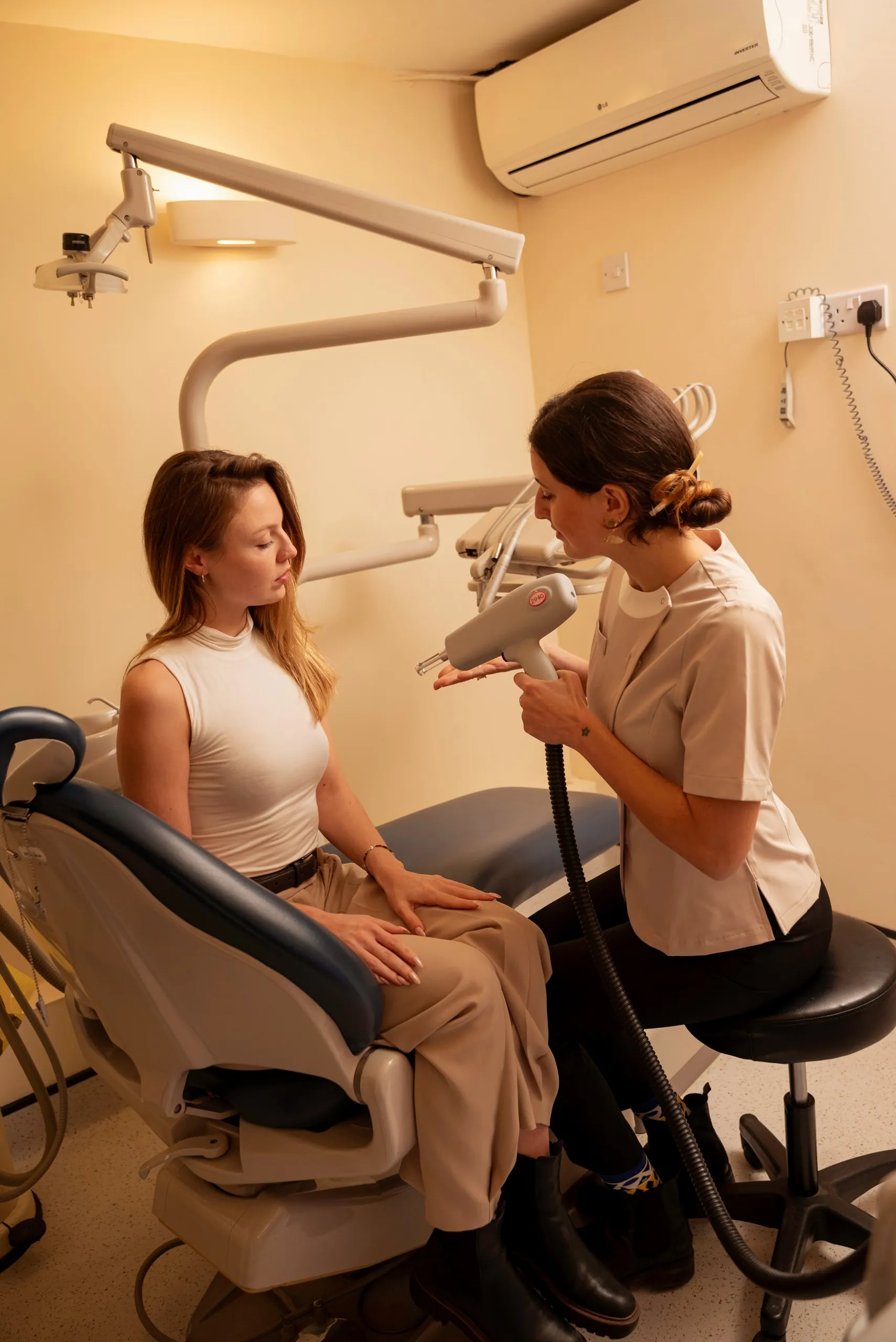
- Most areas need no numbing — sensation is a quick warm snap
- Sensitive areas (upper lip, bikini, underarm) may use topical numbing cream
- Numbing cream applied 20–30 minutes before treatment
- We adjust laser settings for comfort without compromising efficacy
For the full picture, including how this compares with the alternatives, see our guide to IPL photofacial.
What IPL actually feels like
The honest answer to 'does IPL hurt' is: it's uncomfortable rather than painful for most patients, and the sensation varies more by treatment area and individual sensitivity than by the device itself.
The mechanism: IPL delivers a brief pulse of light energy that converts to heat at the target tissue (melanin in hair removal, haemoglobin in vascular treatment, pigment cells in photofacial work). The sensation you feel is that brief heat spike. It lasts a fraction of a second per pulse. Patients typically describe it as:
- A quick elastic-band snap
- A warm pinprick
- A hot grain of sand briefly landing on the skin
- A static electricity zap
The Lynton platform we use at DWL has integrated cooling on the handpiece — chilled sapphire contact tip — which significantly reduces the sensation versus older IPL devices without cooling.
Sensation by treatment area
Not all body areas feel IPL the same way. Sensitivity is determined by nerve density, skin thickness, and proximity to bone:
Most sensitive (offered topical numbing as standard):
- Upper lip
- Chin
- Bikini line
- Brazilian / inner thigh
- Underarms
- Areola
Moderately sensitive (numbing optional):
- Cheeks
- Jawline
- Neck
- Lower leg shin
- Knees
Least sensitive (numbing rarely needed):
- Forearms
- Thighs (back and outer)
- Calves (back)
- Back
- Stomach
For a Brazilian or extended bikini IPL session we strongly recommend topical numbing. For a simple upper-lip IPL or photofacial session, numbing is typically optional.
Skin-type effects on sensation
Darker skin types (Fitzpatrick III+) often perceive more sensation per pulse because more surface melanin absorbs more light energy, producing more heat at the surface. This is also why darker skin requires more careful device selection (Nd:YAG laser may be preferable to IPL for Fitzpatrick V-VI).
Lighter skin types (Fitzpatrick I-II) typically tolerate IPL with less discomfort because surface melanin doesn't compete for light absorption — energy reaches the target tissue more efficiently.
Fine fair hair feels less than coarse dark hair (less hair melanin to absorb light, less heat generated at the follicle).
Our pain-management protocol at DWL
Topical numbing cream
For sensitive areas or sensitive patients, we offer prescription-grade topical numbing cream applied 30-45 minutes before treatment.
- Product: Typically lidocaine-based topical anaesthetic (e.g. LMX4 or compounded prescription preparations)
- Application: Generous layer covered with cling-film occlusion; activates over 30-45 minutes
- Effect: Significant reduction in pulse sensation — most patients describe a 50-60% reduction in perceived intensity
- Cost: Included in session price for sensitive-area treatments at DWL
- Caution: Topical lidocaine creams have absorption considerations — we don't apply over very large body surface areas in a single session, and pregnancy is a contraindication for some preparations. We assess individually.
Integrated cooling
The Lynton platform's chilled sapphire contact tip cools the skin surface immediately before and during each pulse. This:
- Reduces surface temperature spike
- Diminishes pulse sensation
- Provides ongoing comfort across the treatment area
- Reduces post-treatment redness duration
Integrated cooling alone (without topical numbing) is often sufficient for less-sensitive areas.
Paced sessions
For sensitive areas or anxious patients, we pace the session — slower pulse rate, breaks between zones, opportunity to pause and reassess. We don't push patients through discomfort.
Pre-session protocol
- Avoid caffeine 2 hours before (caffeine increases pain perception in many patients)
- Avoid alcohol the night before
- Arrive hydrated (improves general pain tolerance)
- Tell the clinician about menstrual cycle timing — pain perception is elevated around menses for many patients
- Avoid sun exposure 2 weeks before (sunburned skin is much more sensitive to IPL)
Post-session comfort
- Cool compresses 10-15 minutes
- Aloe vera gel cooling effect
- Over-the-counter paracetamol if needed (avoid ibuprofen for 24 hours — anti-inflammatory may slightly reduce treatment efficacy)
What if I can't tolerate the sensation
We stop. We reassess settings. We discuss whether the treatment is right for you, or whether a different modality (laser at different wavelength, or non-light treatment entirely) better suits your case.
We don't push patients through significant discomfort. About 1 in 30 patients arriving for IPL discover at first session that their tolerance is low enough that we move them to a different approach. That's a clinical decision — not a failure.
The topical numbing protocol resolves most tolerance issues. If even with numbing the sensation is intolerable, that's important diagnostic information.
Pregnancy and pain medication
Pregnancy is a contraindication for IPL at DWL — we don't treat during pregnancy regardless of pain considerations. Some topical lidocaine preparations have additional pregnancy cautions which compounds the contraindication.
Post-treatment pain medication: paracetamol is generally safe; we recommend avoiding ibuprofen for 24 hours after IPL (the anti-inflammatory action may slightly reduce treatment efficacy, though clinical evidence on this is limited).
What we won't claim
We don't market IPL as 'painless' because that would be misleading. Patient experience varies; saying 'painless' creates expectation mismatch that erodes trust.
We describe IPL as well-tolerated by most patients with appropriate pain management, and uncomfortable rather than painful in most cases. This is the honest scope.
If you're nervous about IPL discomfort, we encourage you to book a consultation first — we can demonstrate a test pulse so you experience the sensation before committing to a course.
Our happy patients,
in their own words
Transparent pricing
Prices are set out below. Your written plan confirms the fee before any treatment begins.
Questions
people ask
If your question isn't answered here, call reception on 020 8127 4567 or email reception.
How painful is IPL on a scale of 1-10?
Most patients rate IPL at 3-5/10 without numbing on sensitive areas, and 1-2/10 with topical numbing or on less-sensitive areas. We assess and adjust per patient.
What is the most painful area to have IPL?
Upper lip, bikini line, and underarms are the most sensitive areas due to nerve density and skin thickness. Brazilian IPL sessions specifically benefit from topical numbing cream.
What is the least painful area to have IPL?
Larger areas with thicker skin and lower nerve density — back, thighs, forearms, and stomach. Numbing rarely needed for these areas thanks to the chilled sapphire cooling tip on our Lynton platform.
What numbing cream do you use for IPL?
Prescription-grade topical lidocaine preparations, typically LMX4 (lidocaine 4%) or compounded versions for more sensitive areas. Applied 30-45 minutes pre-treatment, included in session price at DWL for sensitive-area treatments.
How long does numbing cream take to work before IPL?
30-45 minutes from application with cling-film occlusion. We typically apply numbing as soon as you arrive, then complete pre-session consultation during the activation window.
Does the IPL device have cooling built in?
Yes. The Lynton platform has a chilled sapphire contact tip that cools the skin surface immediately before and during each pulse, reducing both pulse sensation and post-treatment redness.
What if I can't tolerate the IPL sensation?
We stop, reassess settings, and discuss alternatives. About 1 in 30 patients discover their tolerance is too low even with numbing — a signal that a different modality may better suit your case. We don't push patients through significant discomfort.
Can I take painkillers before IPL?
Paracetamol is fine. Avoid ibuprofen and aspirin for 24 hours before and after IPL, as the anti-inflammatory action may slightly reduce treatment efficacy. Avoid caffeine 2 hours before, as it increases pain perception.