IPL vs BBL (BroadBand Light) · Honest Comparison · DWL Islington
Reviewed By
Dr Vishal Patel
BDS Liverpool · MSc Aesthetic & Restorative Dentistry Manchester · GDC 103127 · AACD Member · Invisalign Diamond II Provider · IFAAS (International Fellowship in Advanced Aesthetic Science) · Facial anatomy & cadaver course, Dr Ali Pirayesh, University of Amsterdam · Harley Academy foundation training in injectable aesthetics · IBSA-trained (Profhilo) · NeoStrata-trained (skin peels) · Lynton Lasers trained, incl. ONDA
Last Updated
September 16, 2026
IPL vs BBL — same technology category, different brand-name device.
IPL vs BBL — same technology category, different brand-name device. What the actual differences are, what DWL uses (Lynton IPL — UK-built, clinically equivalent), and how to choose. London clinic.
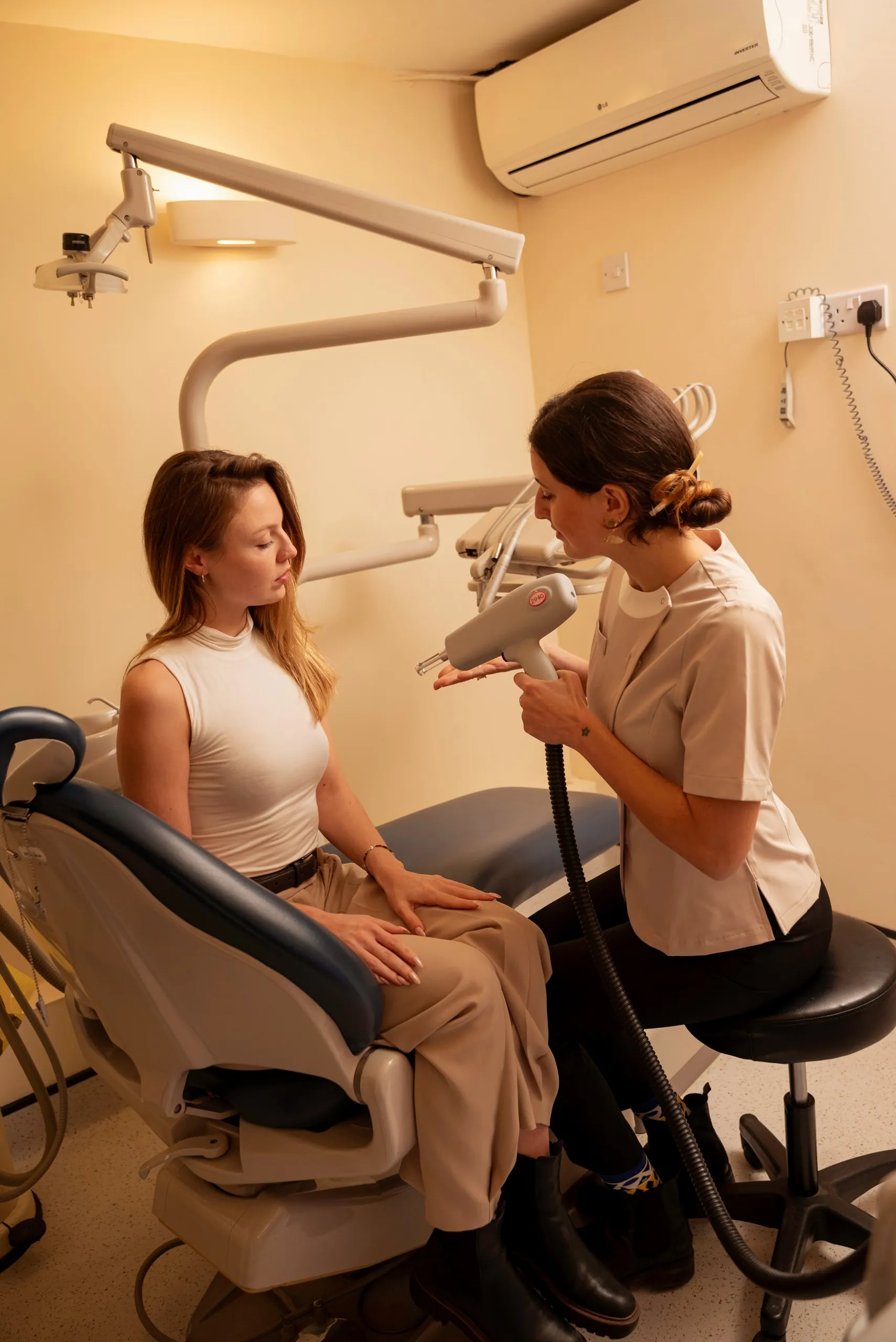
- IPL is a broad-spectrum light-based technology, not a single laser wavelength
- Broadband light targets multiple chromophores — useful across hair, pigmentation, redness
- Less specific than laser — more sessions typically needed for equivalent hair-removal results
- We select the right technology per concern rather than defaulting to one device
If you are still weighing up your options, our overview of IPL photofacial brings them together in one place.
The straight answer, first
IPL and BBL are not different technologies. They are different brands of the same technology category.
IPL (Intense Pulsed Light) is the generic technology category — broad-spectrum filtered light, multi-vendor (Lynton, Lumenis, Cynosure, Cutera, others), widely adopted in UK clinics, well-evidenced.
BBL (BroadBand Light) is a registered trademark of Sciton, a US medical-device manufacturer. BBL is Sciton's refined IPL platform — proprietary filters, premium marketing, US-developed.
The relationship is similar to 'Hoover' and 'vacuum cleaner', or 'Photoshop' and 'photo-editing software'. BBL is a brand within the IPL category, not a separate technology category.
This page exists because patient marketing increasingly mixes these terms, and patients arriving at DWL ask 'do you do BBL?' wanting a clear answer.
What DWL uses
We use the Lynton IPL platform — UK-manufactured (Lynton is a Manchester-based medical-device company), MHRA-registered, evidenced for the indications we treat (vascular IPL for rosacea/thread veins, IPL photofacial for skin rejuvenation, IPL hair removal for Fitzpatrick I-III).
Lynton's IPL platform is clinically equivalent to Sciton BBL for the indications we treat. We chose Lynton for:
- UK manufacture and UK clinical support
- Established UK clinical evidence base
- Reliable platform with strong service infrastructure
- Cost-efficiency that we pass to patients: an IPL photofacial with us is £180
Neither platform is universally 'better.' Both deliver good clinical outcomes when matched to indication and operated by trained clinicians.
Where the differences actually sit
Filter range and protocols
BBL has proprietary filters tuned to Sciton's specific protocol library (Forever Young BBL, Forever Bare BBL, Forever Clear BBL — Sciton marketing names for specific protocol applications). Lynton IPL has its own filter range supporting the same clinical indications via different protocol naming.
In the hands of a trained clinician, both platforms achieve clinical equivalence for vascular work, photofacial rejuvenation, and hair removal in appropriate skin types.
Marketing positioning
BBL is marketed in the US heavily as a premium platform with 'younger-looking skin' positioning. Sciton's marketing includes specific protocol names (Forever Young BBL) that have entered patient vocabulary.
Lynton's marketing is more clinical-direct, less consumer-facing. UK patients researching aesthetic clinics often hear 'BBL' through US-derived content (YouTube, Instagram, US dermatology blogs) and then ask UK clinics about it.
Clinical evidence
Both platforms have peer-reviewed clinical evidence for their indications. Neither has substantively better outcomes data for the indications we treat. Sciton has invested heavily in BBL-branded research; that doesn't make BBL technically superior — it makes it better marketed.
Cost
We do not offer BBL. An IPL photofacial with our Lynton IPL is £180 per session, and facial vessels start from £80, with the full course quoted in writing after your free patch test.
This cost difference does not correlate with outcome difference in our clinical experience.
When BBL specifically might be specified
Some clinics build their marketing identity around BBL specifically (the Sciton brand). For patients who specifically want BBL by name, those clinics deliver it.
For patients whose underlying need is the clinical indication (rosacea management, photofacial rejuvenation, hair removal) and who don't have a brand preference, Lynton IPL delivers clinically equivalent outcomes at lower per-session cost.
There's no scenario at DWL where we'd recommend a patient seek out BBL specifically over our Lynton IPL for the indications we treat. If a patient has a strong preference for the BBL brand, we'd suggest they consult a Sciton-equipped clinic — that's not a knock on our platform, it's respect for patient preference.
When neither IPL nor BBL is the right choice
For some indications, laser is better than either IPL or BBL:
- Tattoo removal — needs a laser, not IPL/BBL; we use a Q-switched laser
- Deeper pigmentation — may need Q-switched laser
- Darker skin hair removal (Fitzpatrick V-VI) — Nd:YAG laser preferred over IPL/BBL; we use the Lynton Nd:YAG laser
- Acne scarring (atrophic) — fractional laser or microneedling, not IPL/BBL
Device choice should match indication, not the other way around. See our IPL vs laser comparison for the technology-level breakdown.
The marketing language to be sceptical of
When researching IPL or BBL providers, some marketing language is worth scrutinising:
- 'BBL HERO' / 'Forever Young BBL' — Sciton protocol marketing. Not universally available even at BBL clinics; depends on which Sciton platform the clinic has.
- 'Photofacial reversal of skin ageing' — overstates outcomes. IPL/BBL refines and refreshes; it doesn't reverse ageing.
- 'Painless light therapy' — misleading; IPL/BBL is generally well-tolerated with good cooling and optional numbing, but not painless. See our IPL pain protocol.
- 'Single-treatment transformation' — overpromise. Most indications need 3-5 sessions for visible improvement.
We describe outcomes in honest terms because misleading patients on technology equivalence or treatment outcomes degrades trust. Refinement, not transformation. Management of conditions like rosacea, not cure.
Our happy patients,
in their own words
Transparent pricing
Prices are set out below. Your written plan confirms the fee before any treatment begins.
| Service | Price |
|---|---|
| Single session photofacial (Lynton IPL) | £180 |
| Facial vessels | from £80 |
| Single session hair removal (by area) | £45–£295 |
| Patch test | Free |
Questions
people ask
If your question isn't answered here, call reception on 020 8127 4567 or email reception.
Is BBL better than IPL?
They're the same technology category — broad-spectrum filtered light. BBL is Sciton's branded version of IPL; Lynton IPL is a UK-manufactured platform we use at DWL. Both deliver clinically equivalent outcomes for the indications we treat.
Is BBL more expensive than IPL?
Typically yes. BBL sessions in UK clinics run £200-£350. Lynton IPL at DWL from £180. The cost difference reflects Sciton's premium brand positioning, not clinical outcome differences.
Does DWL offer BBL?
We use Lynton IPL — UK-manufactured, MHRA-registered, clinically equivalent to Sciton BBL for the indications we treat. For patients with a strong BBL brand preference, we'd suggest a Sciton-equipped clinic.
Why does DWL use IPL instead of BBL?
Lynton is UK-manufactured with strong UK clinical support, costs less per session, and delivers clinically equivalent outcomes for vascular work, photofacial rejuvenation, and hair removal.
Which is better for rosacea — IPL or BBL?
Both work well for vascular indications. Vascular IPL is well-established for rosacea management. Whether you choose IPL or BBL, clinically equivalent results are achievable — consultation quality and clinician experience matter more than device brand.
Which is better for photofacial — IPL or BBL?
Both are appropriate for photofacial protocols. Sciton has marketed BBL heavily for photofacial indications. Lynton IPL delivers equivalent clinical outcomes via different protocol naming.
Is IPL or BBL safer?
Both are safe when used correctly by trained clinicians. Skin-type matching matters more than IPL vs BBL specifically. As general information, a longer-wavelength Nd:YAG laser (1064nm) is often preferred for darker skin types; at DWL we use the Lynton Nd:YAG laser (1064nm) for darker skin or Lynton IPL, chosen by your skin type at assessment.
What does the evidence say about IPL vs BBL?
Peer-reviewed clinical evidence supports both platforms for their indicated uses. Neither has demonstrably better outcomes data for the indications we treat — Sciton has simply invested heavily in BBL-branded research.