To stop snoring, first find your cause. Side-sleeping helps back-sleepers, clearing a blocked nose helps nasal snorers, and avoiding alcohol before bed helps most people. For persistent snoring, a custom anti-snoring appliance made by a dentist is the most effective dental option. If you have pauses in breathing or daytime sleepiness, see your GP first.
Most snoring advice sells you a product before it understands your cause
Search "how to stop snoring" and you are met with a wall of gadgets — sprays, pillows, clips, mouthpieces — each promising to be the answer. Almost none of them ask the only question that matters first: why do you, specifically, snore? Snoring is not one problem with one fix. It is a symptom with at least four common drivers, and the right solution for a back-sleeper is the wrong solution for someone whose nose is blocked, which is the wrong solution again for the person whose lower jaw sits a little far back.
We see this constantly in clinic. Someone arrives having spent a hundred pounds on devices that didn't work — not because the devices were fraudulent, but because they were aimed at a cause that wasn't theirs. So this guide does the unglamorous thing first. It explains the mechanism, helps you find your own cause, then walks the honest hierarchy of solutions from the ones that cost nothing up to the custom device that genuinely earns its place. And it is blunt about the one finding that changes all the priorities: if anyone has ever seen you stop breathing in your sleep, no gadget on this page is your answer yet.
The mechanism — why tissue vibrates
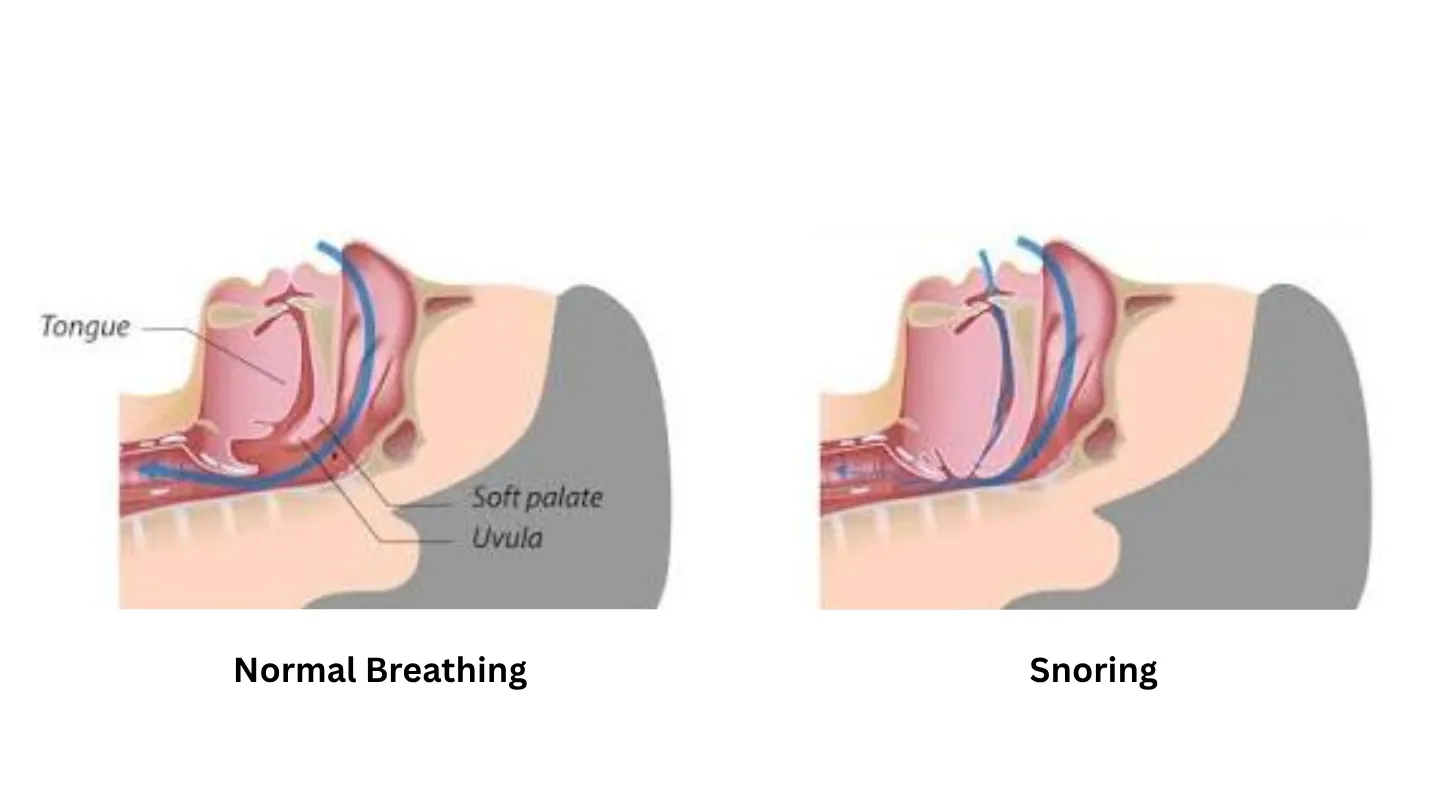
The sound itself is simple physics. When you fall asleep, the muscles holding your airway open relax. As air moves past the soft, floppy tissues at the back of the throat — the soft palate, the uvula, the base of the tongue — those tissues flutter. That flutter is the snore. The narrower the airway, the faster air has to rush through it, and the louder the vibration.
So every cause of snoring is really a cause of airway narrowing. That reframe is the key to the whole guide: fix what narrows your airway, and the noise has nothing left to do.
The four-driver framework
Across the people we assess, persistent snoring almost always traces to one of four drivers — usually a combination of two or three.
Position. Lying on your back lets gravity pull the tongue and soft palate toward the throat wall. Back-sleeping is the single most common reason an otherwise quiet sleeper snores, and many people snore in no other position.
Nose. A blocked nose — from a cold, allergies, a deviated septum, or polyps — forces mouth breathing, which dries the throat and changes airflow in a way that makes vibration far more likely. Mouth breathing and snoring travel together.
Soft tissue. Excess weight around the neck narrows the airway from the outside, which is why weight gain often brings new snoring and modest loss often quietens it. Alcohol and sedatives relax the throat more deeply than natural sleep — a glass of wine in the evening is one of the most reliable ways to turn a quiet sleeper into a snorer for a night. Smoking inflames and swells the lining.
Structure. A lower jaw that sits further back, a long soft palate, large tonsils, or a thick tongue base all reduce the space at the back of the throat. These are anatomical, not lifestyle — and they explain why some slim, sober, side-sleeping people still snore. Age tightens the picture further: throat tone falls through the forties and fifties, which is when snoring so often begins.
The encouraging part is that combinations are easier to unpick than single fixed causes. Move any one driver — the wine, the blocked nose, the back-sleeping — and you may drop below the threshold where the tissue vibrates at all.
The honest hierarchy of solutions
The mistake is to start at the expensive end. The right order is cheapest and least invasive first, because for a meaningful share of snorers, the simple changes are enough on their own.
Tier one — the changes that cost nothing
None of these are guaranteed for everyone, but each shifts the odds, and together they resolve a surprising number of cases.
Change your sleeping position. Side-sleeping keeps the tongue from falling back. The old "tennis ball method" — sewing a ball into the back of a sleep shirt so rolling onto your back becomes uncomfortable — looks crude but retrains position over a few weeks. A wedge pillow that raises the head of the bed helps by reducing the backward pull on the tongue.
Address your nose. If congestion is part of the picture, treating it directly often helps the snoring more than anything aimed at the throat. Saline rinses, treating allergies, nasal strips that hold the nostrils open, and resolving a deviated septum with an ENT surgeon all matter. A free-breathing nose is the foundation of quiet sleep.
Rethink alcohol timing. You don't have to stop drinking — but avoiding alcohol in the three to four hours before bed makes a clear difference for most people. Test it for a week and judge for yourself.
The smaller levers. Modest, sustainable weight loss reduces neck tissue. Stopping smoking reduces throat inflammation within weeks. A regular sleep routine avoids the over-tiredness that deepens sleep and slackens the throat. Staying hydrated keeps the soft palate's secretions thin rather than sticky. Each is a small lever; pulled together, they move the needle.
If you work through these honestly for a few weeks and the snoring persists — particularly if it is loud, nightly, and disturbing a partner — it is reasonable to move to a fitted solution. But if anyone has ever noticed you stop breathing, gasp, or choke in your sleep, skip straight to the sleep apnoea section now, because that reorders everything.
Tier two — the device that earns its place
The most effective dental treatment for snoring is a mandibular advancement device, usually shortened to MAD. It is a custom appliance, a little like a slim sports mouthguard, worn over the upper and lower teeth at night. Its job is simple: it holds the lower jaw a few millimetres forward of its resting position, which pulls the tongue base and the soft tissues of the throat forward with it, opening the airway so the tissue has no slack to vibrate.
For mild-to-moderate snoring, well-made MADs are over 80% effective at reducing or eliminating the noise. They are the most evidence-supported snoring treatment a dentist can provide, and for many couples they are the difference between separate bedrooms and shared sleep.
There is an important distinction sold under similar names.
Boil-and-bite devices are bought online or from a pharmacy, softened in hot water, and bitten into for a rough impression. They are inexpensive — typically £20 to £60 — and for occasional snoring they are a reasonable first test. But they are bulky, fit only approximately, wear out quickly, and a poor fit can strain the jaw joint or move teeth over time. They are a trial, not an answer.
Custom-made MADs are built by a dentist from precise impressions and a record of your bite. They fit accurately, last for years, are far more comfortable, and — crucially — can be adjusted. The amount the jaw is advanced is fine-tuned over follow-up appointments to the point where snoring stops without straining the jaw, a process a boil-and-bite device cannot offer. A custom device is not right for everyone: you need a reasonable number of healthy teeth to anchor it, healthy gums, and a jaw joint without significant existing dysfunction. Anyone with notable jaw-joint pain or TMJ disorder needs that assessed first, because advancing the jaw can aggravate an already irritated joint — exactly the kind of question we raise before fitting, not after. In the first weeks some people notice morning jaw stiffness, more saliva or slight dryness, and a temporary change in how the teeth meet on waking; these usually settle, and ongoing review is what keeps long-term tooth movement in check.
Tier three — surgery, rarely and last
Surgery is rarely the first answer and for good reason: it is irreversible, recovery can be uncomfortable, and results are mixed and sometimes fade over years. These are decisions for an ENT surgeon, not a dentist. Nasal surgery — correcting a deviated septum or reducing enlarged turbinates — is often the most worthwhile because it fixes a clear structural cause. Tonsil or adenoid removal resolves snoring driven by crowding, common in children. Soft-palate procedures stiffen or trim the palate to reduce vibration, with variable results, reserved for selected cases. Hypoglossal nerve stimulation, an implanted device that holds the tongue forward, is for selected moderate-to-severe apnoea patients who cannot tolerate CPAP. The honest summary: for most snorers, lifestyle change and a custom oral device resolve the great majority of cases without going near an operating theatre.
The one finding that changes everything: sleep apnoea
Read this section carefully even if you came here only for the noise.
Snoring is sometimes harmless — a social nuisance and nothing more. But snoring can also be the audible sign of obstructive sleep apnoea (OSA), a genuine medical condition in which the airway doesn't just narrow but repeatedly collapses and closes during sleep. Each time it closes, breathing stops for several seconds or longer, oxygen dips, and the brain briefly rouses you to reopen the airway — often without you ever knowing you woke. This can happen dozens or hundreds of times a night. Untreated, it is linked in documented research to high blood pressure, heart disease, stroke, type 2 diabetes, and the daytime exhaustion behind a meaningful share of road accidents.
The warning signs that snoring may be apnoea rather than simple snoring:
- Loud snoring on most nights
- Pauses in breathing, gasping or choking noticed by a partner
- Waking unrefreshed, or feeling sleepy during the day despite a full night in bed
- Morning headaches or a dry mouth on waking
If several ring true, the right next step is not a dentist and not a gadget — it is a sleep study, usually arranged through your GP or a sleep physician and increasingly done at home with a small overnight monitor. Only a sleep study can confirm apnoea and grade its severity. For moderate-to-severe apnoea the gold-standard treatment is a CPAP machine, which keeps the airway open with a gentle flow of air. For milder apnoea, or for people who cannot tolerate CPAP, a custom mandibular advancement device prescribed alongside a sleep physician can be an effective alternative. Sleep apnoea is diagnosed and managed by your GP or a sleep physician; at Dental & Wellness London we provide anti-snoring devices for simple snoring only.
We say this plainly because it matters: a dental device should never be used to silence the snoring of undiagnosed sleep apnoea. Quietening the noise without treating the breathing removes the warning sign and leaves the danger in place. We are not authorised to diagnose or treat sleep apnoea as a medical condition, and we don't pretend otherwise — we work alongside sleep-medicine specialists, not in place of them. Suspected apnoea is referred for proper medical diagnosis first, every time. That is part of what honest scope means: we say no to fitting a device when the right answer is a sleep study.

Anti-snoring products: a frank buyer's guide
The shelves are full of anti-snoring products. Some rest on reasonable principles; many do not. Matched to the four-driver framework, the pattern is clear: nasal products help nasal snorers, positional products help back-sleepers, and the soft-palate-and-tongue snoring behind most chronic cases responds best to a properly fitted device.
Nasal strips and dilators genuinely help if your snoring is nasal in origin — cheap, harmless, worth a try if the nose is the issue, useless if it isn't. Anti-snoring pillows mostly work by discouraging back-sleeping: low risk, modest benefit. Mouth tape has become popular online; the principle of encouraging nasal breathing is reasonable for some but is not safe for anyone with undiagnosed sleep apnoea or significant nasal blockage, and the evidence is thin. Throat sprays and lubricant strips have weak evidence and brief effect — largely a waste of money. Tongue-retaining devices can work but most people find them uncomfortable and abandon them. Positional trainers that buzz when you roll onto your back are effective and low-risk for genuine back-sleepers. Smartphone recording apps are genuinely useful — not as treatment, but to understand your pattern and, importantly, to catch the gasping and silent pauses that suggest apnoea. A recording is a good thing to bring to an appointment.
How we approach snoring at DWL
We treat snoring as an airway and whole-person question, not a noise to be muffled. The jaw, the airway, the nervous system, and sleep quality are connected, and a good assessment looks at all of them.
Assessment first, always. Before any device, we take a proper history — how you sleep, what your partner has noticed, your nasal breathing, your jaw-joint health, and any signs pointing toward apnoea rather than simple snoring. If apnoea is a possibility, you are referred for a sleep study before anything else. This is non-negotiable and the most important part of the visit. You can read more about our sleep dentistry and snoring care and our companion guide on whether anti-snoring devices work.
The jaw–airway connection. Because we assess the jaw joint properly, we can spot when snoring sits alongside clenching, jaw tension, or a backward-set lower jaw. In younger patients and in orthodontic planning, this is where airway thinking connects to our wider work — our approach to clear aligners considers arch expansion where possible and the airway and breathing benefits that follow, not only the appearance of the teeth. As an Invisalign Diamond II Provider in the top 1% of UK Invisalign providers, with twenty years in practice, we take a long-term smile view and design with your future in mind. The relationship between jaw position and the airway is explored further in our piece on sleep apnoea and jaw position.
Whole-health framing. Poor sleep and a dysregulated nervous system feed each other. Where chronic stress, clenching, and disturbed sleep travel together, our integrative model can bring in nervous-system regulation and somatic support alongside the dental device rather than treating the mouth in isolation. We are transparent about what a device can and cannot do, and we say no often to over-treatment — sometimes the honest answer is a lifestyle change, a referral, or simply reassurance.
What it costs to start. A snoring and airway assessment is a calm, practical first step — a full history, a jaw and airway check, and an onward sleep-study referral where apnoea is a possibility. A custom adjustable device is fitted only when it is the right answer for you, with the precise figure confirmed in writing after assessment rather than quoted blind. We will always tell you when a free change — your position, your nose, your evening glass of wine — is likely to do the job before any device is needed.

Frequently asked questions
Is snoring dangerous, or just annoying?
Often it is simply a noise — a social nuisance with no health consequence. But snoring can be the audible sign of obstructive sleep apnoea, where breathing repeatedly stops during sleep, a genuine medical condition linked to heart disease, high blood pressure, and stroke. The deciding factors are whether the snoring is loud and nightly, whether anyone has seen you stop breathing or gasp, and whether you wake unrefreshed and sleepy by day. If any apply, it is worth investigating with a sleep study rather than ignoring.
What is the single most effective way to stop snoring?
There is no universal answer, because it depends on your cause. For back-sleepers, staying off the back can be enough. For nasal snorers, clearing the nose helps most. For the soft-palate and tongue snoring behind most chronic cases, a custom mandibular advancement device is the most effective dental treatment — over 80% effective for mild-to-moderate snoring. The most reliable approach is to identify your own cause first rather than buying a product at random.
Do anti-snoring mouthpieces from the pharmacy work?
Boil-and-bite mouthpieces can reduce snoring for some people and are a reasonable inexpensive trial. But they are bulky, fit only approximately, wear out quickly, and a poor fit can strain the jaw or move teeth. They are a test, not a long-term solution. A custom device made by a dentist fits accurately, lasts for years, can be adjusted to the right position, and comes after a check that your jaw joint and teeth are suitable.
Why do I only snore when I've had a drink?
Alcohol relaxes the throat muscles more deeply than natural sleep, so the airway narrows further and the tissues vibrate more easily. The same happens with sleeping tablets and some sedatives. Avoiding alcohol in the three to four hours before bed often makes a clear difference. If you snore heavily even without alcohol, look at the other causes too.
When should I see a doctor about snoring?
See your GP or a sleep physician if your snoring is loud and happens most nights, if a partner has noticed you stop breathing, gasp, or choke in your sleep, or if you feel excessively sleepy during the day despite a full night in bed. These point toward possible sleep apnoea, which needs a sleep study to diagnose. The daytime tiredness and the breathing pauses are the parts genuinely worth acting on.
Talk to us about snoring
If snoring is disturbing your sleep or your partner's, a snoring and airway assessment is a practical first step. We take a full history, check your jaw and airway, refer for a sleep study where apnoea is a possibility, and fit a custom adjustable device only when it is the right answer for you.
Call 020 8127 4567 or WhatsApp +44 7974 910222 (8am–7pm). Appointments Monday–Friday 8am–7pm by appointment (no Saturday, no walk-in) at 222 Essex Road, Islington, London N1 3AP. Rated 4.7★ across 300+ reviews.
Reviewed by Dr Vishal Patel · BDS Liverpool · MSc Aesthetic & Restorative Dentistry (Manchester) · GDC 103127 · Invisalign Diamond II Provider · AACD Member · and Dr Reena Sohal · BDS Liverpool · Diploma Advanced General Dental Practice (Birmingham) · Diploma Ayurvedic Therapist (Ayurveda Pura, London) · GDC 104355. This article is general information, not a diagnosis; suspected sleep apnoea should be assessed by a sleep physician. Last reviewed 2026-06-04.