Setting expectations before you start
We see this every week: a patient arrives having watched a run of mewing videos, holds up someone's eight-week jawline transformation, and asks whether they'll get the same. The honest answer: it depends overwhelmingly on how old you are, and the most dramatic results you've seen usually aren't what they appear to be.
Proper tongue posture — what "mewing" describes — is a real clinical concept with real benefits, and we teach it. But the gap between what mewing actually does and what viral results imply is wide. Understanding what to realistically expect means practising for the right reasons.
What "mewing results" actually means
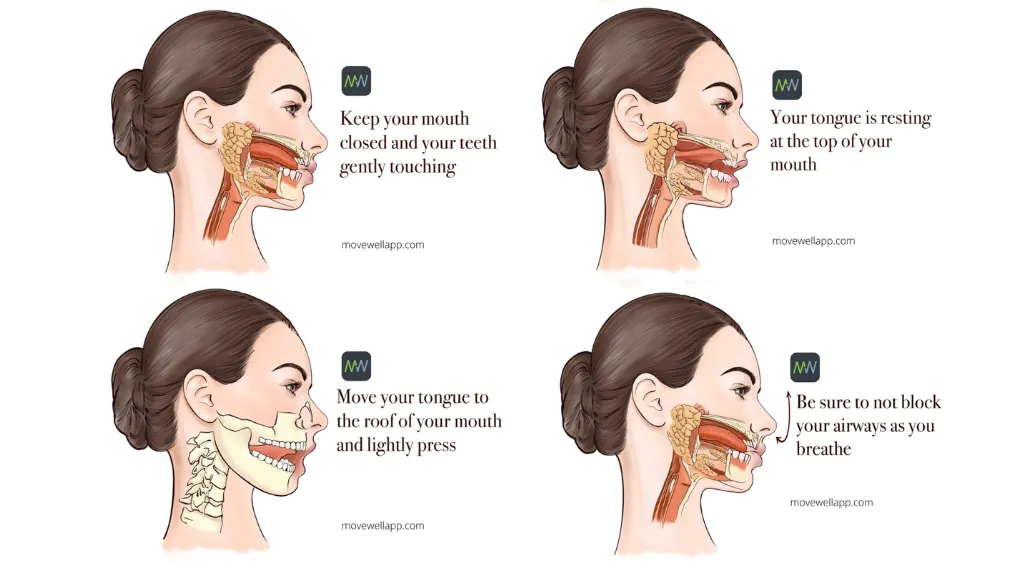
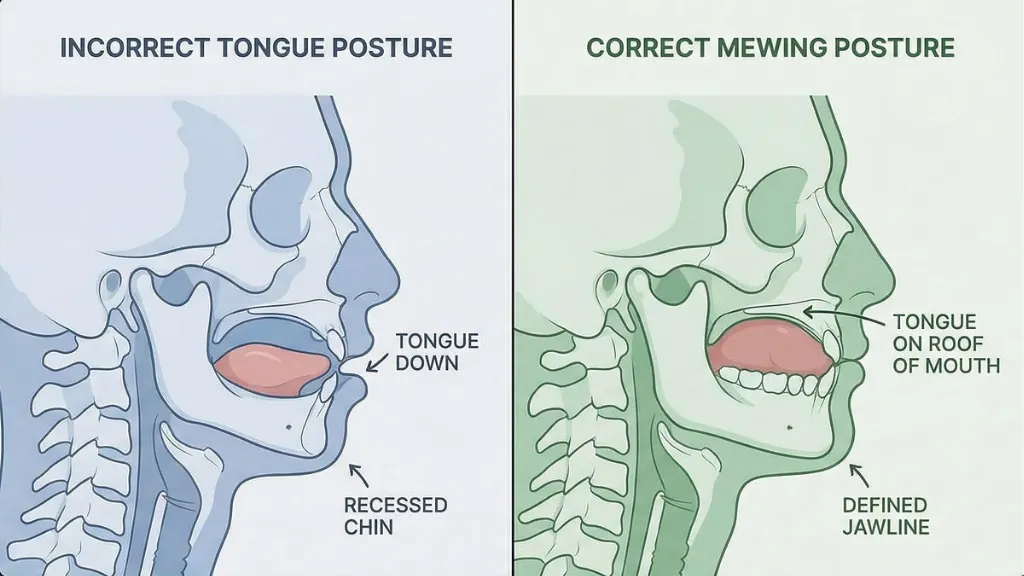
"Mewing," named after orthodontists John and Mike Mew, is holding the tongue broadly against the roof of the mouth — body against the palate, tip just behind the upper front teeth, lips lightly closed, nasal breathing — as a sustained resting posture. The claimed "results" fall into two categories the content tends to blur: functional (better nasal breathing, more resting tone, better orthodontic stability) and aesthetic (a more defined jawline, lifted cheekbones, midface projection). These aren't the same thing, and conflating them is the most common reason people end up disappointed.
Mewing results by age — the distinction that changes everything
In children and teenagers, the facial skeleton is still growing, and the forces a tongue places on a developing palate genuinely matter. Decades of clinical observation link mouth breathing and low tongue posture with narrow arches, crowded teeth, and a more retruded jaw. For a child, addressing tongue posture, nasal breathing and airway obstruction early is a legitimate, evidence-aligned intervention. Results here can be structural because the structure is still forming.
In adults, the bones are fused and remodel far more slowly. What you can reliably change is muscle tone, breathing pattern, and resting tongue position — not trivial, and worth having. What you cannot reliably change is your underlying bone structure. The fair clinical summary: in adults, facial change from mewing is plausible but unproven, and where real, small and slow.
So when you read "mewing results," always ask: results in whom? A teenager's result and a 35-year-old's are different biological events. Most viral before-and-afters don't tell you the age; see our realistic adult mewing results for what to look for.
A realistic mewing results timeline
Days to a couple of weeks: awareness. You notice where your tongue rests and catch it when it drops. No visible change, but the habit forms.
Weeks to a few months: the resting posture becomes more automatic, nasal breathing improves, and tongue muscle endurance builds. People often report sleeping and breathing better here — the real, defensible benefit.
One to two years: if any visible facial change occurs in an adult, this is the timescale — usually subtle, noticeable in side-by-side photos under identical conditions rather than remarked on by others. Many adults see no measurable facial change and still benefit functionally — a normal, successful outcome.
If a source promises a transformed jawline in six to eight weeks as an adult, treat it as marketing, not biology.
How to tell a real mewing result from a fake one
Weight change. Losing facial fat sharpens a jawline far faster and more dramatically than posture work — many "mewing" results are weight-loss results.
Camera angle, lighting, posture. Chin tilted down then lifted, hard overhead lighting, jaw clenched for the photo — these can manufacture a "transformation" between two pictures taken minutes apart.
Age and maturation. A teenager's face changes substantially over a year or two regardless of tongue posture.
Undisclosed treatment. Orthodontics, jaw surgery, filler, masseter work, buccal fat removal — any can be quietly responsible for a result credited to mewing.
A genuinely informative before-and-after uses identical lighting, angle, distance and a neutral face in both shots, discloses age and timescale, and rules out weight change and treatment. Almost none do. Photograph your own progress under fixed, repeatable conditions instead.
What you should actually train mewing for
Train it for airway function — resting the tongue on the palate is coupled to nasal breathing and a more open airway, particularly at night. Train it for bite stability — proper tongue posture lowers relapse rate after braces or aligners. Train it for resting muscle tone — a real, achievable adult change. If a sharper jawline arrives on top of those, treat it as a bonus you didn't bank on.
When mewing is not the answer
If your tongue simply won't stay against the palate however much you practise, you may have a tongue-tie physically restricting it — a conversation for assessment, not more practice. A persistent tongue thrust on swallowing is myofunctional therapy territory with a trained practitioner, not a video routine.
The boundary we hold most firmly: if low tongue posture and mouth breathing come with snoring, daytime exhaustion, morning headaches, or witnessed breathing pauses at night, the question is no longer cosmetic. Those can signal sleep-disordered breathing, and the first step is your GP, who can arrange a sleep study. Dental treatment works alongside that medical pathway, never in place of it — we are dentists, not sleep-medicine specialists, and we're careful about that line.
One popular shortcut deserves a flag: mouth taping at night to force nasal breathing is not safe for everyone and is specifically contraindicated where sleep apnoea or nasal obstruction is suspected. Conscious daytime nose breathing carries none of that risk and does most of the work anyway.
Where this fits at Dental & Wellness London
Tongue posture, airway, jaw position, bite and sleep are connected, and we assess them together rather than treating mewing as a standalone fix — considered, conservative, never rushed. A consultation is £65, and a free 20-minute discovery call is available for new-patient enquiries. Where the picture warrants it we refer to trained myofunctional therapists.
FAQs
Does mewing actually work?
For airway function, resting muscle tone and orthodontic stability — yes, with reasonable support. For visibly reshaping an adult face, the evidence is limited and largely anecdotal. In children and teenagers, the case for structural influence is much stronger.
How long does mewing take to show results?
Awareness in days to weeks. Functional benefits build over weeks to months. Any visible facial change in adults, where it happens, is reported over one to two years and usually subtle.
Can adults get mewing results?
Reliably: better nasal breathing, muscle tone and bite stability. Facial or jawline change is plausible but unproven, and where it occurs is small and slow.
Why am I not seeing mewing results?
Most often because the expectation was aesthetic and the realistic adult benefit is functional, or the timescale was too short. Breathing and sleeping better after months of practice is a successful result even without a visibly changed jawline.
Is mewing safe?
Resting your tongue lightly on the palate and breathing through your nose is safe. Forceful clenching is not advisable, and mouth taping at night is contraindicated where sleep apnoea or nasal obstruction is suspected.
Is it too late to start as an adult?
No — you can improve airway function, muscle tone and bite stability at any age. What changes with age is the ceiling on bony facial change, far lower for adults than for a growing child.