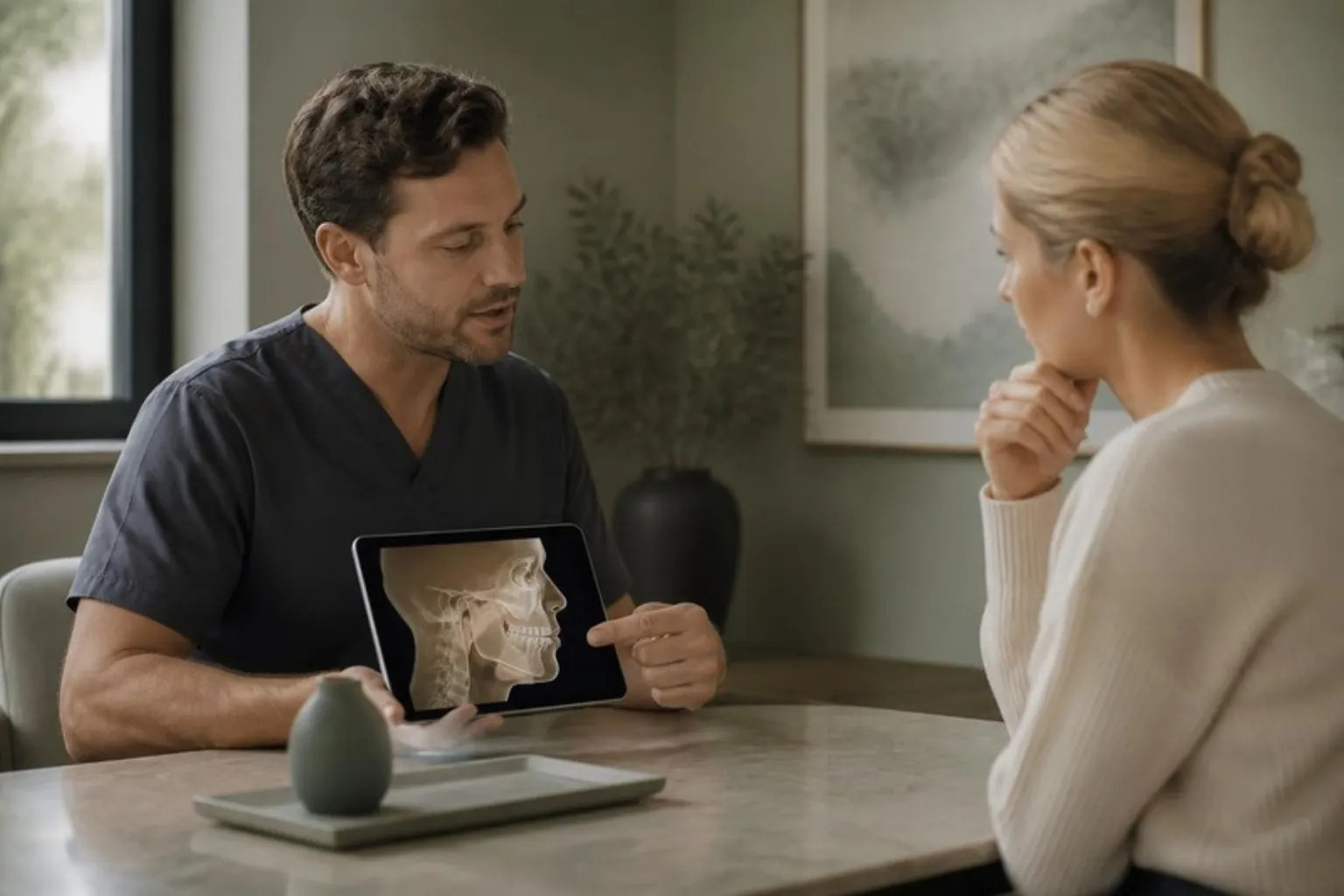
Search "airway dentistry" and you meet two unhelpful extremes. On one side, dismissal — a niche idea, fringe, marketing dressed up as biology. On the other, the opposite oversell — pages implying that the right dental approach can fix your sleep, your posture, your energy, and your face. Neither is true, and patients deserve better than to choose between them. The honest version sits in between, and it is genuinely useful once the hype is stripped out.
I use the airway lens in everyday dentistry. It does not mean I have a machine called an airway. It means that when I assess a bite, I also notice whether someone breathes through their mouth, how the tongue sits, whether the upper arch is narrow and high, and whether the teeth are crowded in a way that hints at how the jaws grew. This is how your teeth support your smile read in three dimensions rather than two — and it shapes a long-term smile view rather than a quick cosmetic one. It is one strand of our wider approach to whole-health dentistry. Our page on biological dentistry covers a related part of this approach.
What airway dentistry actually is
A definition first, because the term is used loosely.
Airway dentistry is the practice of considering breathing and jaw development as part of dental assessment and planning — not just the surfaces of the teeth. It rests on a simple, well-supported observation: the shape of the jaws and the position of the teeth are influenced, during growth, by how a child breathes and where the tongue rests. A child who breathes through the mouth for years, often because the nose is blocked, tends to hold the jaw open and the tongue low. The upper arch, which is partly shaped by the tongue pressing against it, can grow narrow and high instead of broad. Narrow arches leave less room for teeth, which is one reason crowded teeth appear.
That much is mainstream developmental biology, not a fringe claim. Where airway dentistry adds value is in noticing it — flagging a narrow palate or a mouth-breathing pattern early, and in children, working with the growth that is still happening rather than waiting to extract teeth later. The philosophy here aligns with arch expansion where possible and a non-extraction method: where biology allows, widen the space and let the teeth fit, rather than removing healthy teeth to force a narrow arch to work.
What airway dentistry is not is a separate medical specialty that treats breathing disorders. It is a lens a dentist applies, and a set of referrals a good dentist knows to make.
Where it may help — and the word "may" is doing real work
I will be precise about claims, because this is exactly where the field loses its credibility.
In children, the case is strongest. Spotting a narrow arch, a persistent mouth-breathing habit, or a tongue-tie early — while the face is still growing — creates the opportunity to guide development. Arch expansion in a growing child can create room and may support a broader smile and easier nasal breathing. None of this is guaranteed, and it works alongside the right medical input — an ENT assessment if the nose is blocked, for example — not in place of it. But the window of growth is real, and using it is sound, future-minded care: we design with your future in mind rather than for the photograph today. We explain the link between mouth breathing and jaw development in more detail on its own page.
In adults, the honest position is more modest. The bones have finished growing; we cannot reshape an adult skeleton with dental treatment, and any page that implies otherwise is misleading you. What the airway lens still offers an adult is better planning. Knowing that someone breathes through their mouth, clenches at night, or has a narrow arch changes how I approach orthodontics and Invisalign treatment — favouring expansion and non-extraction where the biomechanics genuinely allow, thinking about how the result will function and age, not only how it looks. That is optimal function and long-term functional outcomes treated as part of the cosmetic decision, not an afterthought.
What it will not do, in adults or children, is treat a breathing disorder. Which brings us to the most important boundary on this page.
The boundary that matters most: airway dentistry is not sleep medicine
This is the line I will not blur. Snoring and disturbed sleep can have many causes, and obstructive sleep apnoea is a medical condition that requires medical diagnosis and management. Dental & Wellness London does not diagnose or treat sleep apnoea. If your sleep is broken, if you snore heavily, if a partner has noticed you stop breathing, or if you wake unrefreshed, the right first step is a medical sleep assessment — usually through your GP or a sleep clinic — not a dental appointment. Our guide on how to stop snoring explains when snoring becomes a medical question.
Where dentistry has a legitimate, limited role is in snoring: a custom mandibular advancement (anti-snoring) appliance can help some people who snore, and it works alongside, not in place of, sleep-medicine specialists. We are glad to make that device as part of a properly coordinated plan. But we will always frame it honestly — a dental device for snoring, not a treatment for a sleep disorder. Any clinic that markets airway dentistry as a cure for sleep apnoea has crossed a line that protects you.
The frameworks an airway-aware dentist actually uses
Stripped of mystique, here is what the lens looks like in a consultation.
What I look at
The width and height of the upper arch. Whether the teeth are crowded and in what pattern. How the tongue rests, and whether there is a tongue-tie restricting it. Whether someone habitually breathes through the mouth, and whether the lips seal at rest. Signs of clenching or grinding on the teeth. In children, where they are in their growth. None of these is exotic; together they tell a developmental story the teeth alone do not. For what tongue posture can and cannot do, see mewing explained by a dentist.
What I do with it
In children, early, gentle intervention where it is warranted — expansion, a referral for myofunctional therapy, or simply monitoring growth — coordinated with ENT or medical input for the nose. In adults, orthodontic planning that respects the airway lens: arch expansion where possible, non-extraction method where the biomechanics allow, and a long-term smile view that asks how the bite will function and age. Where breathing or sleep is the real concern, a referral to the right medical specialist. Sometimes the most valuable thing I do is name a pattern no one had connected and send you to the person who can actually address it.
What I refuse to claim
That dental treatment reshapes an adult face or skeleton. That straightening teeth fixes sleep apnoea. That a single appliance "opens your airway" and resolves fatigue. I say no to those claims as firmly as I say no to over-treatment — because high standards here mean honesty about limits, and patients are poorly served by promises the evidence does not support.
The team behind an integrative reading
Airway is, by nature, a cross-disciplinary lens, which is why it suits an integrative clinic. A reading might involve dental and orthodontic assessment with Dr Vishal Patel — BDS, MSc Aesthetic & Restorative Dentistry, Invisalign Diamond II provider — and, where the whole-person picture matters, the Ayurvedic perspective of Dr Reena Sohal (GDC-registered, GDC 104355), who offers Ayurvedic consultations. Where breathing, ENT, or sleep input is needed, the honest move is outward, to medical colleagues, not to keep the patient inside the clinic. The value is in connecting the dots and then routing each one to the right place.
What it costs to be assessed
An airway-aware assessment is not a separate expensive product; it is part of how we already look. At Dental & Wellness London it begins with a free 20-minute discovery call, then a dental examination (£65) where clinically needed; orthodontic and Invisalign consultations are free. If that assessment points toward orthodontics, our Invisalign treatments are Invisalign Express £2,200 · Moderate £3,400 · Unlimited £4,500–£4,900, with the plan tied to how much movement your case actually needs — and the full plan is costed in writing before anything begins. If it points toward an ENT, a sleep clinic, or myofunctional therapy delivered by a specialist, we will tell you that too, and the most useful thing we did may have cost only the consultation. We would rather send you to the right door than sell you the wrong room.
Frequently asked questions
Is airway dentistry evidence-based or pseudoscience?
Parts of it are well supported — that breathing and tongue posture influence jaw development in children is mainstream biology. The problem is overreach: claims that dental treatment fixes adult faces or cures sleep disorders go far beyond the evidence. Used as a careful lens with honest limits, it is sound. Used as a cure-all, it is not. The honesty is in keeping the two apart.
Can airway dentistry cure my sleep apnoea?
No. Sleep apnoea is a medical condition that needs medical diagnosis and management, and Dental & Wellness London does not diagnose or treat it. A dental anti-snoring appliance can help some people who snore, working alongside sleep-medicine specialists — but that is a device for snoring, not a treatment for a sleep disorder. If your sleep is disturbed, start with a medical sleep assessment.
My child mouth-breathes and has a narrow palate — is it worth a look?
Often, yes — and earlier is better, because a child's face is still growing; our guide to mouth breathing in children explains when to watch and when to act. An assessment can flag whether expansion, a myofunctional referral, or an ENT review for the nose is warranted, and whether watching the growth is enough for now. Nothing is guaranteed, and we coordinate with medical input rather than acting alone, but the growth window is real and worth using thoughtfully.
I'm an adult — can this change my face?
Not the skeleton. Adult bones have finished growing, and any clinic implying dental treatment reshapes an adult face is overpromising. What the airway lens still offers an adult is better orthodontic planning — favouring arch expansion and non-extraction where the biology allows, and a long-term view of how the result functions and ages. That is real value, described honestly.
What makes a dentist "airway-aware" rather than just marketing the term?
A willingness to refer outward. An airway-aware dentist notices breathing and development, plans with them in mind — and, crucially, sends you to an ENT, a sleep clinic, or a myofunctional specialist when that is what you need, instead of keeping every problem in the dental chair. The lens is only as good as the honesty about its limits.
An honest assessment, not a cure narrative
If breathing, jaw development, or crowding has brought you to the idea of airway dentistry, the most useful next step is a clear-eyed assessment that tells you what is dental, what is medical, and what needs no intervention at all. An integrative consultation at Dental & Wellness London reads the teeth, arches, tongue and breathing pattern together — and routes each finding to the right place, including outward to medical colleagues where that is the honest answer.
Dental & Wellness London · 222 Essex Road, Islington, London N1 3AP
Phone 020 8127 4567 · WhatsApp +44 7974 910222 (8am–7pm)
Open Monday to Friday, 8am–7pm, by appointment. No Saturday or walk-in service.
Rated 4.7 from 300+ Google reviews.
Free 20-minute discovery call, then a dental examination (£65) where clinically needed. We do not diagnose or treat sleep apnoea; where breathing or sleep is the concern, we refer to the appropriate medical specialist.
Reviewed by Dr Vishal Patel · BDS, MSc Aesthetic & Restorative Dentistry · GDC 103127 · with Ayurvedic input from Dr Reena Sohal · BDS, GDC 104355. Educational content; "may support" reflects that outcomes are not guaranteed and individual assessment is required. Last reviewed 5 June 2026.