Crowded Teeth — Causes, Treatment Options and Costs
Reviewed By
Last Updated
October 1, 2026
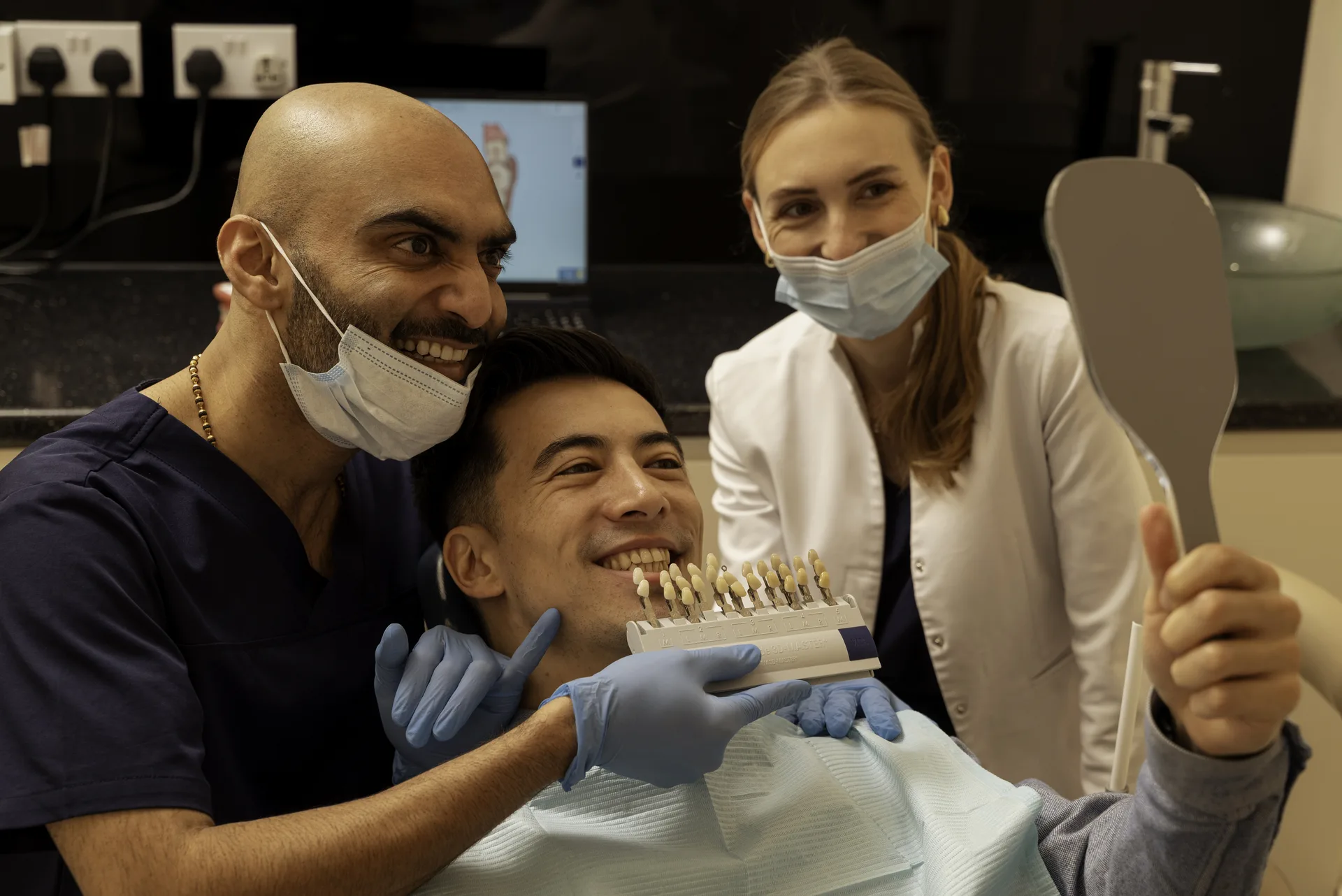
Why teeth crowd, when it actually matters, and the honest treatment ladder.
Crowded teeth occur when the jaw has too little room for all the teeth to sit in a smooth arch, so they overlap or rotate. It is common and often mild. What helps depends on severity and on whether it affects cleaning or your bite: sometimes nothing, often Invisalign clear aligners, occasionally fixed braces. We assess the space discrepancy in person at our Islington clinic.
Visible Signs & Symptoms
Crowded teeth (clinically, dental crowding) describes teeth that have too little room to sit in a smooth curve. Some overlap, some rotate to fit, and the bite often does not close evenly. We grade crowding by the difference, in millimetres, between the space available in the arch and the space the teeth need: mild, moderate or significant.
Crowding is not one problem but a spectrum. At one end it is a personal aesthetic preference; at the other it is a measurable oral-health risk. Our job is to tell you plainly which is true for your mouth. A great deal of mild crowding is best left alone, and we will say so when yours falls into that group.
Signs and symptoms
- Front teeth that overlap or angle across one another
- A canine sitting high above the smile line, or pushed outward
- Lower front teeth twisted inward or stacked behind one another
- Spots where floss shreds, catches or never reaches cleanly
- Gums that bleed in the same tight areas, or tartar that builds there quickly
- A bite that feels uneven on closing
- Crowding that has crept in gradually during adult life, most often in the lower front teeth
How crowding differs from crooked or gappy teeth
Crowding is a shortage of space, and it is one of the common reasons teeth end up crooked. A mouth can be crooked without being crowded, for example after trauma. Spacing is the opposite problem, covered on our gappy teeth page. Crowding is common, and most of it is mild and carries no health penalty.
Clinical Root Causes
Crowding is almost always multifactorial. These are the contributing forces, in roughly the order they matter.
Inherited size mismatch
The commonest driver. Jaw size and tooth size are inherited semi-independently; when the teeth are larger than the arch can hold, crowding follows. This is why it runs in families.
Early loss of baby teeth
Baby teeth hold space for the permanent teeth behind them. If one is lost early to decay or a knock without the gap being maintained, neighbours drift in and leave too little room for the adult tooth.
Thumb sucking or dummy use beyond early childhood
Sustained pressure reshapes a developing arch, narrowing the upper jaw and pushing front teeth forward, often producing crowding and a bite problem together.
Mouth breathing during development
This one is underappreciated. The tongue is meant to rest against the palate and broaden the arch from within. Chronic mouth breathing, from enlarged tonsils, adenoids or persistent congestion, drops the tongue low; the palate narrows and crowding develops. See our page on mouth breathing and jaw development.
Tongue posture and swallowing habits
In adults, resting tongue posture and swallowing patterns can maintain or quietly worsen existing crowding.
Age-related drift, and the wisdom-tooth myth
Lower front crowding tends to increase gradually through adult life. Wisdom teeth were long blamed for this, but the modern evidence is more sober: the drift happens whether or not wisdom teeth are present, and removing them does not reliably prevent it. We do not recommend extracting wisdom teeth to stop crowding. Gum disease and tooth loss, by contrast, do accelerate drift.
When crowding genuinely matters
The cosmetic question is personal and valid either way. The clinical question is narrower, and these are the points at which crowding stops being only about appearance.
- Hygiene access. Overlaps create areas a brush and floss cannot reach. Plaque collects there, and over years that shows as decay and gum inflammation in exactly those crowded zones. This is the most common clinical reason crowding is worth correcting.
- Uneven wear. Teeth that do not meet evenly share the load unequally. Some wear, chip or flatten faster than they should.
- Bite function. Severe crowding can make chewing less efficient and push someone onto one side, contributing to jaw fatigue and muscle imbalance over time.
- Long-term tooth retention. Severe crowding combined with poor cleaning access raises the risk of gum problems and tooth loss across decades.
Left untreated, significant crowding rarely improves on its own. The tight areas tend to stay tight, and the age-related drift described above usually adds to it rather than relieving it. That does not make treatment urgent, but it does mean the decision is better made with an accurate picture than by waiting to see.
When to be seen
Arrange an assessment if crowding is increasing, if your gums bleed in the tight areas, if a tooth is chipping or wearing faster than its neighbours, or if you simply want to know whether treatment is worthwhile. Teeth that have started to move or loosen in adult life should be checked promptly, as drift can be a sign of gum disease. For children, an earlier check is worthwhile where there is mouth breathing, a persistent thumb habit or early loss of baby teeth.
The four-tier treatment ladder
There is a tool for every level of crowding. The skill is matching the tool to the case, and choosing the gentlest option that reaches the goal.
Leave it alone
A legitimate and often correct choice. Mild crowding with good cleaning access and no functional problem carries no clinical obligation to treat. If you are content with how it looks, a good hygiene routine and regular reviews are the plan, with a hygienist helping you reach the tight areas.
Invisalign clear aligners
The mainstay of adult treatment, and where most crowding is best handled. A series of clear aligners moves teeth gradually in small planned steps, typically over four to 18 months or longer depending on severity. They come out to eat and clean, and are near-invisible while worn. Read more about Invisalign and our guide to crowding treatment.
Fixed braces
For certain complex rotations or severe cases, a bonded appliance still does some jobs more reliably than aligners. When that is true we say so and refer you to a specialist orthodontist rather than force the case into aligners.
Camouflage, used honestly
For very mild crowding that is purely an aesthetic concern, composite bonding can soften the visual line without moving anything; veneers do similar where colour or shape also need attention. Both have a hard limit: they mask the impression of crowding but do not improve cleaning access, and they should never be presented as alignment.
What happens at DWL
Crowding is assessed and planned by Dr Vishal Patel, an Invisalign Diamond II provider with an MSc in Aesthetic & Restorative Dentistry. We take photographs and an iTero scan, measure the space discrepancy, check gum health, and show you a ClinCheck preview of the planned movements before you commit. If you are local, see our page on Invisalign in Islington.
How we choose
Our default is arch expansion where possible and a non-extraction method: developing the arch to find room rather than removing healthy teeth. A broader arch supports the lips and cheeks from within and tends to give a fuller, more natural smile. Where extra space is needed we often use interproximal reduction (IPR), polishing a fraction of a millimetre of enamel from between selected teeth. Extraction is not ruled out; occasionally it is genuinely the best route, and we will explain why. We take a long-term smile view, thinking about how the teeth clean and wear at fifty and seventy. For children with mouth breathing or tongue-posture habits, we may recommend referral for myofunctional therapy alongside monitoring, because correcting a habit early can guide arch development before crowding sets. If a narrow arch is part of the picture, our page on a narrow smile explains how expansion can help.
Cost
- Invisalign consultation with iTero scan: free
- Dental examination: £65
- Invisalign Express (mild crowding): £2,200
- Invisalign Moderate: £3,400
- Invisalign Unlimited (significant crowding): £4,500–£4,900
- Composite bonding: £175 simple, £350 complex, per tooth
- Hygiene: £85
What each fee includes is set out in your written plan before you commit. 0% APR finance over 12 months is available. Results vary.
We are at 222 Essex Road, Islington, N1, two minutes from Essex Road station, with buses 38, 56, 73, 341 and 476 on Essex Road. Many patients cycle or use Lime and Forest e-bikes.
Further reading
Frequently asked questions
If your question isn't here, call reception on 020 8127 4567 or book a free discovery call.Text Link
View all FAQs →Will my teeth become crowded again after treatment?
Without retainers, yes — teeth gradually drift back toward their original positions through life. With consistent retainer wear (full-time for the first 6 months, then nights-only long term), most patients maintain alignment lifelong. Retainers are part of the treatment, not optional aftercare.
Do I need to extract teeth to fix crowded teeth?
Less commonly than historically. Modern aligner therapy combined with IPR (small enamel reductions between specific teeth) handles many cases that previously required extraction. Severe cases may still require extraction; the decision is made carefully on a case-by-case basis at the planning stage.
How long does it take to fix crowded teeth?
Treatment time depends on severity. Mild crowding: often 4-6 months with Invisalign Express. Moderate: commonly 6-12 months with Express or Moderate. Significant: 12-24 months, usually with Unlimited. Composite bonding camouflage of mild aesthetic crowding can often be completed in a single visit. Results and timelines vary, and are confirmed after your iTero scan and ClinCheck plan.
Do I need extractions for crowded teeth?
Not always. At DWL we favour arch expansion over extraction where the case allows. Severe crowding sometimes requires extraction; mild-moderate crowding often doesn't. Assessed at consultation.