Is mouth breathing in children normal? — the honest answer
Every child breathes through their mouth sometimes. A blocked nose during a cold, a bout of hay fever, a burst of effort during play — these push a child temporarily onto mouth breathing, and none of it is a problem.
The picture that matters clinically is different: the child who breathes through the mouth most of the time — at rest, watching television, concentrating, and crucially, asleep at night. Persistent, habitual mouth breathing is not a cosmetic quirk to wait out. It's a sign worth understanding, because in a growing child the way the airway is used helps shape the way the face grows.
Why mouth breathing matters more in children than in adults
The single most important fact: a child's face is still being built, and the airway is one of the tools building it.
The clinical evidence here is substantial — far stronger than the popular claims about adults. Sustained nasal breathing, with the lips closed and the tongue resting against the roof of the mouth, provides gentle outward and upward force that helps the upper jaw develop a broad, well-formed arch. Sustained mouth breathing does the opposite: the tongue drops to the floor of the mouth, the jaw hangs open, and the developing face tends toward a narrower upper arch, a longer lower-third of the face, and more crowded teeth. The classic experimental work here dates to Harvold and colleagues in the early 1980s, with a wide body of orthodontic and ENT literature since.
This is why mouth breathing deserves more attention in a five-year-old than in a forty-year-old. The forty-year-old's face is already built. The five-year-old's is not. None of this means a single open-mouthed nap is reshaping your child's face — it means a sustained pattern, left unexamined for years, can have a developmental cost that's largely avoidable when caught early.
What causes persistent mouth breathing in children
Enlarged adenoids or tonsils. The most frequent cause in young children — adenoid tissue can swell enough to block nasal airflow, particularly at night. A medical question for a GP and, where needed, an ENT specialist.
Allergies and chronic congestion. Allergic rhinitis, dust-mite sensitivity, and persistent congestion keep the nose blocked — often manageable once identified, with a GP's input.
A deviated septum or narrow nasal passages. Structural reasons the nose moves less air.
Tongue-tie. A restrictive lingual frenulum can stop the tongue resting at the palate, encouraging low posture and mouth breathing.
Habit, after the cause has resolved. Sometimes a child keeps mouth breathing even after the original blockage clears — where myofunctional retraining can help, once the airway itself is confirmed clear.
Because the causes span dentistry, ENT, and allergy medicine, mouth breathing in children is a team question, and the first members of that team are your GP and, where appropriate, an ENT specialist. A dentist's role is the developmental and airway-posture side, working alongside, not instead of, medical assessment.
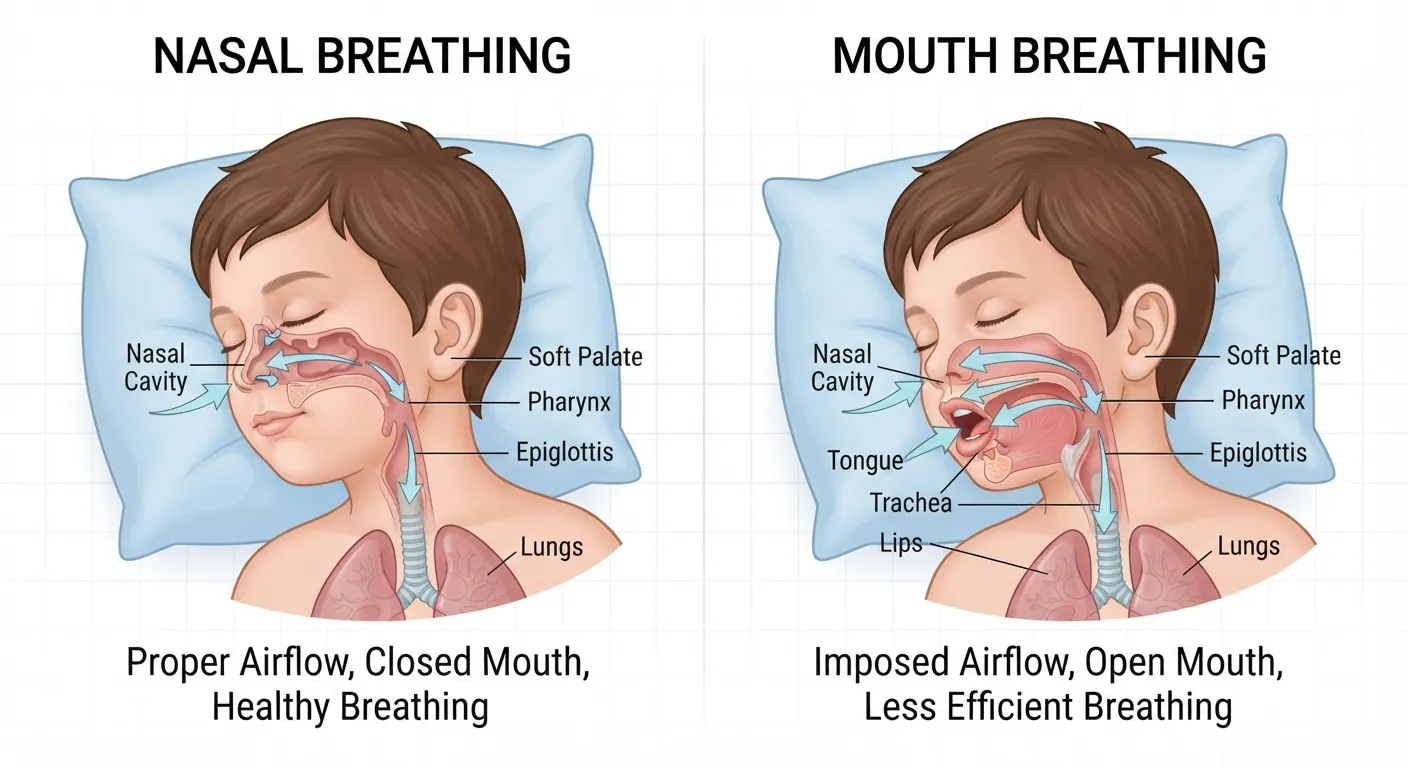
Signs to watch for — the parent's checklist
During the day: the mouth rests open when relaxed or concentrating; chapped lips and frequent thirst; a "long" open-mouth resting face; nasal or muffled speech; daytime tiredness or irritability that doesn't fit the child otherwise.
At night: sleeping with the mouth open every night; snoring or noisy breathing; restless, thrashing sleep; bedwetting beyond the expected age; waking unrefreshed; dark circles under the eyes.
Dental signs your dentist may spot: a narrow upper arch or crowded teeth developing early; an anterior open bite; gum inflammation at the front from drying.
The night-time signs matter most. Breathing should be quiet — loud or laboured breathing during a child's sleep is never something to normalise; it's the clearest prompt to speak to your GP.
When to watch, and when to act
Watch — and do nothing beyond observing — when: mouth breathing is occasional, tied to an obvious temporary cause, and resolves when the cause does. This is normal.
Act — book a professional assessment — when any of these are true: mouth breathing is the child's default day and night; it persists for weeks beyond any cold; the child snores most nights; you've witnessed pauses, gasping, or choking in their sleep; or you're seeing a cluster of the signs above.
Witnessed pauses in breathing, choking, or gasping during sleep are a medical priority — speak to your GP promptly, and use NHS 111 out of hours if worried. Those signs can point to paediatric sleep-disordered breathing, which is a medical assessment, not a dental one. We do not diagnose or treat sleep apnoea in children; that pathway runs through your GP and, where indicated, a paediatric sleep service. Our role is complementary — the developmental, jaw, and airway-posture side — and we're clear about where it begins and ends.
What a professional assessment involves
The consultation is considered, conservative, never rushed. We look at how the child breathes at rest, the shape and width of the developing arch, the tongue's resting position, the tonsils where visible, and the overall pattern of facial growth for the child's age. We ask about sleep, energy, concentration, and any history of colds, allergies, or ENT input.
We're looking to answer one question: is the airway the problem, and is it being addressed by the right person? If a child needs adenoids or tonsils assessed, that's a GP and ENT conversation, and we'll say so. If the nose is clear and the pattern is now postural or habitual, myofunctional therapy — gentle retraining of the tongue, lips, and breathing — may support a return to nasal breathing. Where the developing bite and arch are involved, early, growth-guided orthodontic thinking has a role.
A new-patient enquiry includes a free 20-minute initial chat; a detailed consultation is £65.
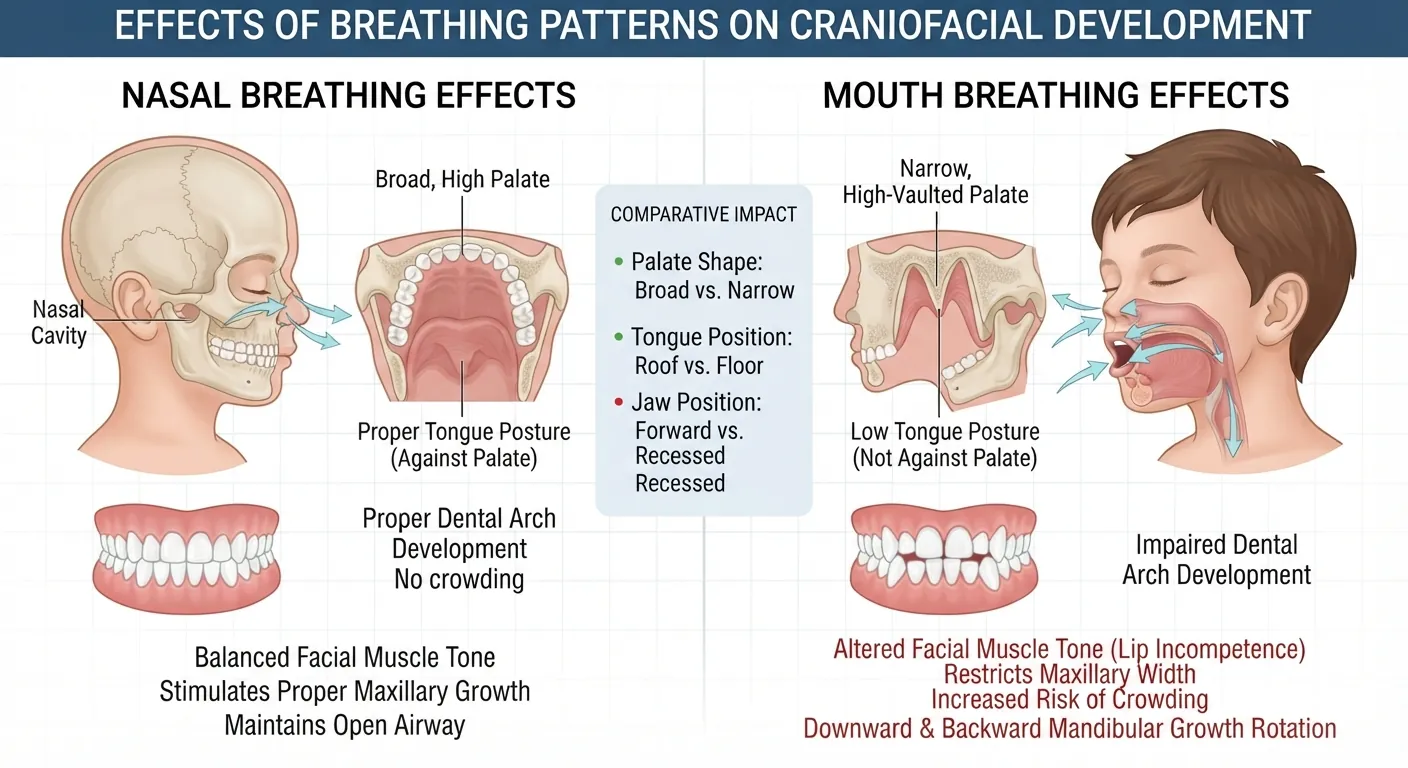
How mouth breathing in children is helped
Clearing the nose. If adenoids, tonsils, allergies, or congestion are the cause, addressing those via GP and ENT is the foundation — nothing dental works while the nose is blocked.
Myofunctional therapy. Once the airway is clear, retraining the tongue, lips, and breath may support a lasting shift, and works best in childhood.
Growth-guided orthodontics. Where the upper arch is narrow, early widening can create more room for the tongue and a clearer airway.
Tongue-tie release, where a restrictive frenulum is the underlying obstacle.
Treat the system, not just the symptom, in connection with the other professionals involved in the child's care. Our approach is complementary, not alternative — it sits alongside medical care, never in place of it.
FAQs
Is mouth breathing bad for my child?
Occasional mouth breathing during a cold is harmless. Persistent, habitual mouth breathing is worth assessing, because in a growing child the airway helps shape facial development, sleep quality, and the developing bite.
At what age should I worry?
There's no single cut-off, but earlier is better — if the pattern is persistent from toddlerhood onward, it's reasonable to have it assessed while the face is still growing.
Can mouth breathing change my child's face?
The evidence for childhood developmental influence is substantial — far stronger than the equivalent adult claims. Sustained mouth breathing is associated with a narrower upper arch, a longer facial pattern, and more crowding.
My child snores — should I be concerned?
Quiet breathing is the healthy default during sleep. Loud or laboured snoring most nights warrants a GP conversation. Pauses, gasping, or choking during sleep need prompt GP attention or NHS 111 out of hours.
Does the NHS treat mouth breathing in children?
The underlying causes — enlarged adenoids and tonsils, allergies, sleep-disordered breathing — are firmly within NHS GP and ENT care. Dental airway assessment and myofunctional therapy are complementary and typically private, working alongside the medical pathway.
How do I stop my child mouth breathing?
You don't stop the breathing directly — you find and address the reason the nose isn't being used. Clear any blockage via GP/ENT, and where the pattern persists after the nose is clear, consider gentle retraining via myofunctional therapy.
Will my child grow out of it?
Sometimes, when the cause is temporary. A pattern persisting for months with night-time signs shouldn't simply be waited out — the developmental window doesn't wait with it.