Narrow Smile — Causes, Health Implications and Modern Treatments
Reviewed By
Last Updated
October 1, 2026
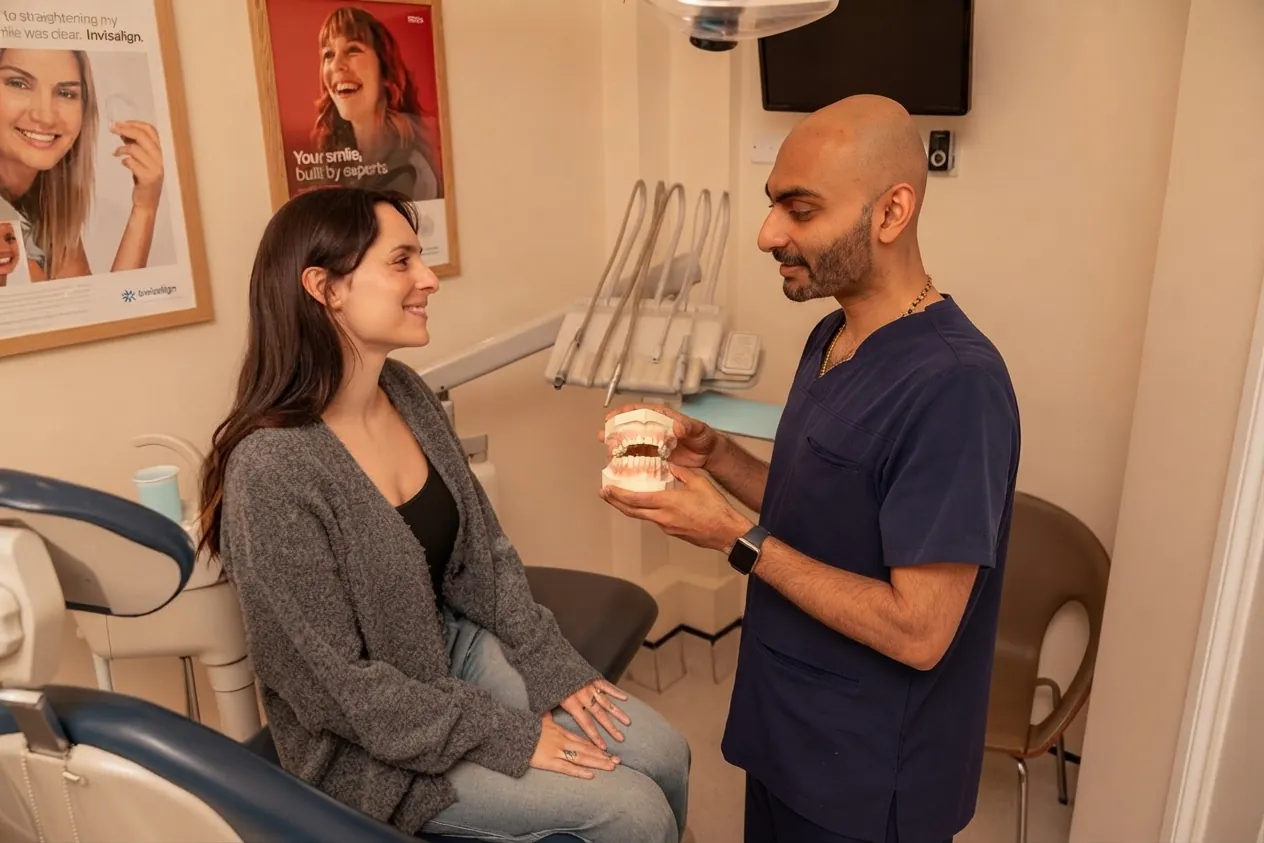
Arch width is a developmental matter before it is a cosmetic one.
A narrow smile means the visible width of your smile is narrower than the face around it, usually because the upper dental arch did not develop to full width in childhood. Genetics, mouth breathing, low tongue posture, thumb-sucking and earlier extractions all contribute. At our Islington clinic we assess arch width first, then discuss aligner-based arch development, cosmetic camouflage with bonding or veneers, or both.
Visible Signs & Symptoms
The dental arch is the curve the teeth follow across the jaw. Its width is set during childhood and early adolescence, principally by growth at the midpalatal suture in the upper jaw and by the balance of forces acting on it: the tongue pressing outward from inside, the cheeks and lips pressing inward from outside. Where that balance is disturbed, or where growth does not reach its potential, the arch ends up narrower than the face it sits within.
What a narrow smile looks like
The most visible sign is buccal corridors: the dark triangular spaces between the outer edges of the back teeth and the corners of the mouth when you smile. A well-developed arch fills the smile frame. A narrow one leaves shadow at the corners, and the smile does not quite reach the width of the face.
- Only four or five teeth visible on each side in a full, relaxed smile, with dark space at the corners
- A high, vaulted palate (the roof of the mouth feels deep and narrow)
- Crowding or overlapping of the front teeth, because a shorter arch has less room
- Back teeth that meet edge to edge or in crossbite, where the upper teeth sit inside the lower ones
- A habit of breathing through the mouth, or a tongue that rests low rather than against the palate
The mirror test, and its limits
Stand in good light and give a full, relaxed smile. Seeing six or more teeth on each side, with the smile filling out to the corners, suggests a broader arch; seeing fewer, with noticeable shadow, suggests a narrower one. It is an observation, not a diagnosis. Lip length, lip mobility and the angle you are looking from all change what you see, and some people with genuinely narrow arches show plenty of teeth. Arch width is properly assessed with intraoral measurement, photographs taken to a protocol, a digital scan and, where needed, radiographs.
Underneath the appearance sits the palate. The roof of the mouth and the floor of the nose are the same structure, which is why we do not treat arch width as a purely cosmetic measurement.
Clinical Root Causes
A narrow smile rarely has a single cause. In most of the patients we see, two or more of the following have worked together over the growth years.
Genetics
Palatal form is strongly heritable. Narrow arches, high palatal vaults and the associated facial pattern run in families, in the same way jaw size and tooth size do. For some patients this is simply the arch they were built with.
Mouth breathing and low tongue posture
This is the mechanism we find most often and the one least discussed. At rest the tongue should sit against the palate, where it provides gentle, constant outward support while the upper arch is growing. A child who habitually breathes through the mouth, because of enlarged adenoids or tonsils, chronic congestion, allergy or established habit, has to hold the tongue low and forward to keep the airway open. The palate loses its internal support while the cheeks keep pressing inward, and the arch narrows. The association between habitual mouth breathing and narrow upper arches is well described in orthodontic literature. We explain it further on our page about mouth breathing and jaw development and on tongue posture.
Earlier extractions and orthodontic compromise
For a generation, crowding was commonly resolved by removing premolars and retracting the front teeth into the space. It straightened teeth reliably. In some cases it also left narrower arches, flatter smile arcs and wider buccal corridors than the patient started with. Adults who had premolars removed in their teens and now feel their smile looks narrow are often describing something real.
Prolonged thumb-sucking or dummy use
Sustained sucking applies inward pressure to the upper arch at exactly the age it should be widening, and it tends to push the tongue down at the same time. The two effects compound one another.
Other contributors
- A restricted tongue (tongue-tie) that cannot rest comfortably against the palate; see tongue-tie in adults
- Early loss of baby teeth, which can shorten the arch before the adult teeth arrive
- Crowding, which tends to reinforce narrowing over time; see crowded teeth
The airway link — and where the boundary sits
Many people with narrower arches have entirely healthy mouths, and a narrow smile is not in itself a reason for treatment. It is worth understanding, though, because it tends to travel with other things.
- Crowding. Less arch width means less room for the same number of teeth, so narrow arches often present alongside crowded or crooked teeth, which are harder to clean.
- Bite mechanics. Where a narrow upper arch meets a lower arch of normal width, the back teeth can meet in crossbite and wear or load in ways they are not shaped for.
- Tongue space. A narrow arch gives the tongue less room, so it tends to rest lower and further back, which is the posture associated with mouth breathing.
- Facial support. The upper arch supports the middle third of the face, and as soft tissue thins with age that support matters more.
The airway link, and where the boundary sits
The upper arch forms the floor of the nasal cavity, and narrow arches, mouth breathing and disturbed sleep do tend to appear together, particularly in children. What is not true is that widening an adult arch treats sleep apnoea. Dentists do not diagnose or treat sleep apnoea; it is diagnosed and managed by your GP and a sleep physician. If you snore loudly, someone has noticed pauses in your breathing, or you wake unrefreshed and are sleepy during the day, please see your GP first. Our snoring and sleep apnoea page sets out what a dentist can and cannot do.
When to be seen
Book an assessment if your back teeth meet in crossbite, if crowding is worsening, if you notice uneven wear or jaw discomfort, or if the width of your smile simply bothers you. Children who mouth-breathe habitually are best assessed early, while growth can still be guided.
Modern treatments
There are two broad ways to address a narrow smile: change where the teeth sit, or change how the visible teeth look. Sometimes the best result uses both, in that order.
Arch development with clear aligners (most adults)
For adults, Invisalign and other clear aligner systems can produce meaningful dental arch development, moving the back teeth outward within their supporting bone to broaden the visible smile and reduce buccal corridors. This is dental expansion, not skeletal expansion: it does not split the palate. Within that limit it is often enough to change how a smile looks and how the arch functions, and it is the route most of our adult patients with narrow arches take. The extent depends on your starting anatomy and on gum and bone health, which is why we confirm it with a digital scan and a ClinCheck simulation before you commit.
When aligners are not the right tool
True skeletal expansion is achievable in children and adolescents before the midpalatal suture fuses, and some adult cases need surgical support to widen the jaw itself. These are specialist orthodontic and surgical treatments. Where we think they would serve you better, we explain why and refer you to a specialist orthodontist or surgeon.
Cosmetic camouflage
Some adults do not want orthodontic treatment, and that is a legitimate choice. Composite bonding or veneers can broaden the apparent width of a smile by building out the visible surfaces of the premolars and canines, reducing the dark corridors optically. It changes the appearance without changing the arch, and we will always tell you which of the two we are doing.
Combined treatment
The more lasting results often come from developing the arch first, then refining the visible surfaces once the teeth are where they should be. Bonding onto teeth that are about to move is work done twice.
What happens at DWL
Your assessment is with Dr Vishal Patel, our principal dentist, who holds an MSc in Aesthetic & Restorative Dentistry and is an Invisalign Diamond II provider. We take an iTero scan, photographs and a breathing and habits history. Our starting preference is arch development and a non-extraction approach where that is realistic, because developing the arch preserves smile width and tongue space. Extraction is sometimes necessary, and when it is we explain the reasoning in writing. We plan with a long-term view: faces change with age, and an arch that looks adequate at twenty-five can look hollow at fifty-five. Results vary, and we tell you when we are uncertain. If you are local, see our page on Invisalign in Islington.
Cost
- Invisalign consultation with iTero scan and ClinCheck: free
- Dental examination: £65
- Invisalign Express £2,200 · Moderate £3,400 · Unlimited £4,500–£4,900 (see Invisalign cost)
- Composite bonding: £175 simple / £350 complex per tooth
- Composite veneers: £350–£500 per tooth; porcelain veneers: £750–£1,500 per tooth
Every plan is itemised in writing before you agree to anything. 0% APR finance over 12 months is available.
Getting here. We are at 222 Essex Road, Islington, N1, two minutes from Essex Road station (Great Northern, one stop from Highbury & Islington or Old Street). Buses 38, 56, 73, 341 and 476 stop on Essex Road. Many patients cycle or use Lime and Forest e-bikes; Dalston is around ten minutes by bike.

Frequently asked questions
If your question isn't here, call reception on 020 8127 4567 or book a free discovery call.Text Link
View all FAQs →What causes a narrow smile?
Most often a dental arch that did not develop to full width during childhood. The main contributors are genetics, habitual mouth breathing with low tongue posture, prolonged thumb-sucking, and premolar extractions during earlier orthodontic treatment. Frequently more than one is involved.
Can a narrow smile be widened in adults?
To a degree, yes. Clear aligners and fixed appliances can achieve dental expansion in adults — moving the back teeth outward within their supporting bone. True skeletal expansion is not achievable without surgery in adults, because the palatal suture has fused.
Can Invisalign widen my smile?
In many cases, yes. Aligner treatment can be planned specifically to develop arch width, and reducing buccal corridors is a common objective in adult cases. The extent depends on your starting anatomy, gum and bone health, determined at assessment.
Is a narrow smile a health problem?
Not necessarily. Many people with narrower arches have entirely healthy mouths. Narrow arches are, however, associated with crowding, reduced tongue space, and crossbite in the back teeth.
Does a narrow smile mean I have sleep apnoea?
No. A narrow palate is one of several anatomical features that appear commonly in people with sleep-disordered breathing, but it does not diagnose anything on its own. Sleep apnoea is diagnosed by sleep medicine specialists on the basis of a sleep study.
Will mewing widen my palate?
Not in adults, on the evidence as it stands. Resting tongue posture genuinely influences palatal development in growing children, whose sutures are still open. Adult palatal sutures are fused, and claims of meaningful adult skeletal change from tongue posture alone are weakly evidenced.
What are buccal corridors?
The dark triangular spaces visible between the outer surfaces of the back teeth and the corners of the mouth when someone smiles broadly. Wider corridors read visually as a narrower smile.
Can veneers fix a narrow smile?
They can change how it looks. Veneers and composite bonding build out the visible surfaces of the premolars and canines so the smile appears to fill the frame more fully. What they don't do is change where the teeth sit or how much room the tongue has.
Do I need teeth removed if my arch is narrow?
It is not our starting assumption — a narrow arch is precisely the situation in which we look hardest at developing width instead. Removing teeth from an already narrow arch can compound the appearance the patient came in about. Extraction is sometimes clinically necessary and we explain plainly when it is.
How long does arch development take?
Typically 9 to 18 months with clear aligners for an adult case involving meaningful width change, and longer where the bite also needs correcting. We give a case-specific estimate after assessment.