The thing the "quick laser gum lift" adverts leave out
Gum contouring is marketed as a fifteen-minute laser fix: too much gum, zap it away, done. For a narrow set of cases that is genuinely true, and the result is excellent. But "a gummy smile" is not a diagnosis — it is a symptom, and it has at least six distinct causes. Gum contouring reshapes gum tissue. It does nothing about a high lip, a low-set upper jaw, or teeth that are simply in the wrong place. Treat the symptom without naming the cause and you get one of two outcomes: a result that does not match what the patient pictured, or gum that grows back because the real driver was never addressed.
So the first half of any honest gum contouring consultation is not about the procedure at all. It is working out why the gum shows — because that determines whether reshaping the gum is the whole answer, part of the answer, or the wrong answer entirely. I would rather spend that time and occasionally talk a patient out of the procedure than reshape a gum line that was never the problem.
What gum contouring is — and the four things it is not
Gum contouring reshapes the gum tissue around the teeth to create a more balanced smile. It corrects three appearances: a gummy smile, where more than the typical one-to-two millimetres of gum shows; an uneven gum line, where neighbouring teeth carry visibly different gum heights; and short-looking teeth, where excess gum overlaps the crown and hides the tooth's true length. It is usually done across the visible smile zone — canine to canine on the upper arch — and sometimes on a single tooth to match its neighbours.
It is worth being just as clear about what it does not do. It does not move teeth, so a crooked smile needs Invisalign or braces, not gum contouring. It does not whiten — it may reveal more enamel, but colour is a separate treatment. It does not treat gum recession; that is the opposite problem and needs grafting or root coverage. And it does not change your bite. Confusing these is the most common reason a gum lift disappoints, which is why the consultation separates them deliberately.
The six causes of a gummy smile — and which ones contouring can fix
This is the framework I work through in assessment. Each cause points to a different treatment.
- Altered passive eruption. The gum never finished migrating to its adult position in the teens, so it still overlaps the teeth. This is the textbook case for gum contouring — contouring addresses it directly and the result is stable.
- Short clinical crowns from wear. The visible tooth is genuinely short, often from grinding. Sometimes gum contouring alone helps; often it is paired with composite bonding to rebuild the lost length and restore proportion.
- A high or hyperactive upper lip. The lip simply lifts further than average when you smile, exposing gum. The gum is not the problem here — the lip movement is. The appropriate option is a muscle-relaxing treatment to the lip-elevator muscles, assessed and prescribed under consultation, not gum contouring. Sometimes the two are coordinated; the lip is never reshaped with a gingivectomy. See gummy smile treatment with botulinum toxin.
- Vertical maxillary excess. The upper jaw sits slightly low, so the lip rides high. Mild cases respond to gum contouring; significant ones are an orthodontic or orthognathic question, and the honest move is a specialist referral, not a cosmetic shortcut.
- Drug-induced gum overgrowth. Certain medicines (some anti-seizure drugs, calcium-channel blockers, ciclosporin) enlarge the gums. Contouring can improve appearance, but the tissue tends to return while the medication continues — so the patient deserves to know that before, not after.
- Inflamed, unhealthy gums. Gum disease swells the tissue. Treat the disease first, and the gum line often improves on its own without any surgery at all.
Six causes, six different right answers. Only two of them are "reshape the gum." That ratio is the whole argument for a cause-first consultation.
How it is done — technique, and the line where we refer out
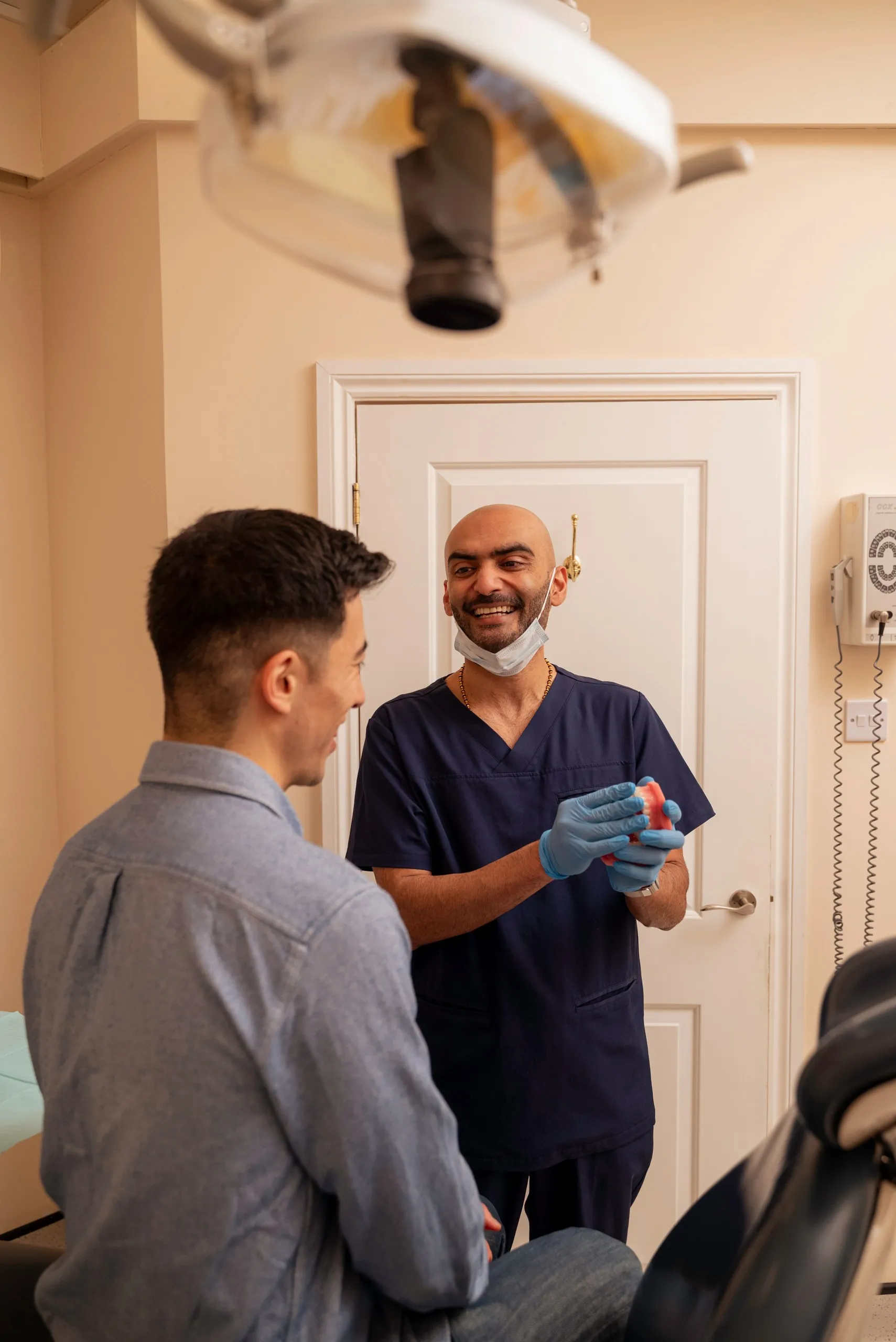
For straightforward cosmetic cases we use a surgical technique, chosen for accuracy. It lets us remove excess tissue precisely and place the new gum margin exactly where it was planned, and healing usually settles over one to two weeks.
Two procedures sit beyond simple contouring, and honesty about the boundary matters. Crown lengthening reshapes the underlying bone as well as the gum, for cases where bone position — not soft tissue — is the limiting factor. Complex aesthetic gum surgery, sometimes with grafting, is for severe or multi-factor cases. Both of these we refer to specialist periodontist colleagues rather than stretch our scope. Knowing where our contouring stops and a periodontist's surgery begins is part of doing this responsibly.
Where gum contouring sits in a smile, not on its own
Gum contouring is rarely the whole job. More often it is one move in a sequence, and sequence is everything for the final look.
Before composite bonding, contouring sets the gum margin first so the bonding is built at the correct anatomical position rather than over excess tissue — the standard order when both gum line and tooth shape need work. The same logic applies before porcelain veneers: reshape the margin, then place the restoration to it. With whitening, the order runs hygiene, then whitening, then contouring, then any final refinements. And after Invisalign, a small gum refinement can polish a finished smile where the alignment is right but the gum heights still do not quite match.
This sequencing is where the restorative training earns its place. An MSc in Aesthetic & Restorative Dentistry trains you to read a smile as how your teeth support your smile over decades, not as a single procedure — to plan for optimal aesthetic and optimal function together, and to design with your future in mind rather than for the next photograph. Conservative contouring that respects the gum's long-term behaviour is part of how a smile remains youthful with time; over-aggressive removal that risks recession at fifty is the opposite of an anti-ageing smile protocol. Every cosmetic decision here is also a long-term smile view decision with long-term functional outcomes in mind.
Cost of gum contouring in London
Gum contouring is from £195; the final fee depends on how many teeth are involved and is set out in writing after assessment. Crown lengthening that involves bone is referred to a specialist periodontist. Where contouring is combined with composite bonding, the whole plan is quoted per case. Dental examination £65.
The quote reflects real variables rather than salesmanship: how many teeth are involved, whether the case is gum-only or needs bone work, and whether contouring is standalone or folded into a wider smile plan. Where it is part of a coordinated makeover — contouring plus composite bonding (£175 simple, £350 complex, per tooth) and whitening, say — it is costed within the overall plan, and the plan is written down. We publish the consultation fee, what it covers and what sits outside it, before you commit, in line with price-transparency rules; 0% APR finance over 12 months via Tabeo is available, subject to status.
When we say no
We decline gum contouring fairly often, and the reasons are worth stating plainly. Active gum disease must be treated first — operating on inflamed tissue is poor practice. Severe vertical maxillary excess is a skeletal problem that contouring only masks. Some "uneven gum lines" are actually uneven tooth positions and resolve with alignment, not surgery. Cases limited by bone position need crown lengthening from a periodontist. And patients with a thin gum biotype and a recession history may be made worse by surgical contouring, so conservative selection wins. The £65 consultation exists to give you that honest direction — sometimes a different treatment, sometimes none at all.
Frequently asked questions
Is gum contouring painful?
The procedure is comfortable because the area is fully numbed with local anaesthetic. Afterwards, discomfort is usually mild and settles within one to three days with paracetamol or ibuprofen. Most patients describe the recovery as easier than they had expected.
How long does it last, and can the gum grow back?
For most people the reshaped gum line is stable for the long term. A small amount of settling — half a millimetre or so — is normal in the first six weeks, after which the result holds. The exceptions are honest ones: gum overgrowth driven by medication can return while the drug continues, and chronic inflammation from poor hygiene can change the tissue. In a healthy mouth with good hygiene, the contour stays.
Is it available on the NHS or covered by insurance?
Cosmetic gum contouring is not an NHS treatment, and most dental insurance treats it as cosmetic and excludes it. Where gum work is part of treating gum disease, the medically necessary element may be covered, but the cosmetic refinement is self-funded. 0% APR finance over 12 months via Tabeo is available at DWL, subject to status.
What is the difference between a gum lift, gum contouring, and a gingivectomy?
They describe the same family of treatment. "Gum lift" and "gum reshaping" are the everyday terms, "gingivectomy" is the clinical one, and "gum contouring" sits in between. The procedure is the same; only the label changes with context.
Can a gummy smile be fixed without surgery?
Sometimes, yes — and that is exactly why the cause matters. If the driver is a high or hyperactive upper lip, an anti-wrinkle treatment to the lip-elevator muscles, assessed under consultation, may be the better route. If it is inflamed gums, treating the gum disease can be enough. If it is altered passive eruption, contouring is the right tool. The consultation tells you which of these you have before anything is reshaped.
Book a gum contouring consultation
If a gummy smile, an uneven gum line, or short-looking teeth bother you, the right first step is a consultation with Dr Vishal Patel. We photograph the smile, work out which of the six causes is driving it, and tell you honestly whether contouring alone, a coordinated plan, or a different treatment entirely is the right answer — in writing, before you commit.
Dental examination £65. Call 020 8127 4567 or WhatsApp +44 7974 910222 (8am–7pm). Appointments Monday–Friday 8am–7pm by appointment at 222 Essex Road, Islington, London N1 3AP. Rated 4.7★ across 300+ reviews.
Reviewed by Dr Vishal Patel · BDS Liverpool · MSc Aesthetic & Restorative Dentistry (Manchester) · GDC 103127 · AACD Member · Invisalign Diamond II Provider. Complex crown-lengthening and aesthetic gum surgery are referred to specialist periodontist colleagues. This article is general information, not a diagnosis. Last reviewed 2026-06-04.