What lip filler migration is
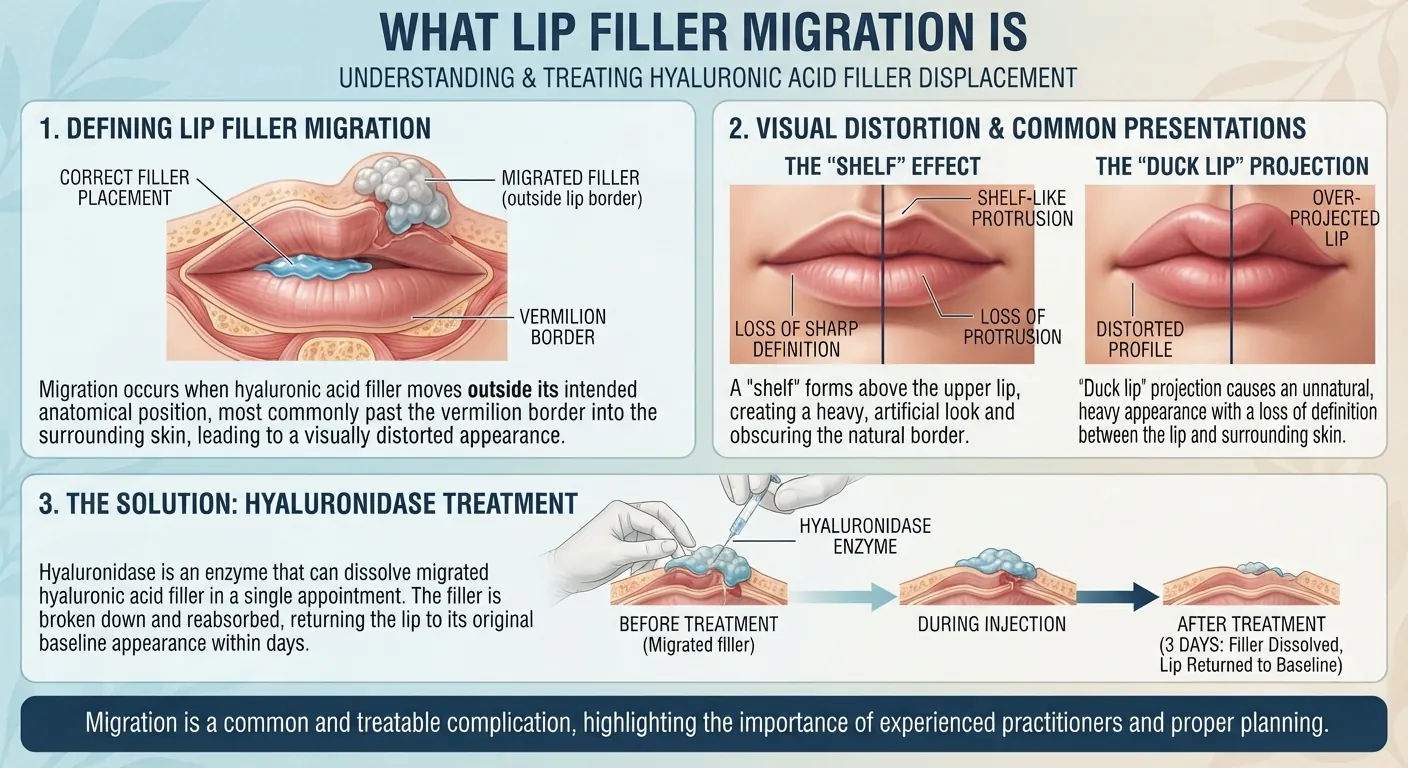
Lip filler migration describes the situation where hyaluronic acid filler injected into the lip has moved outside its intended anatomical position — most commonly outside the lip border into the surrounding skin above or below the vermilion. The result is a visually distorted lip: a "shelf" above the upper lip, a "duck lip" projection, or a general loss of the sharp definition between lip and surrounding skin.
Migration is not a rare complication — it's one of the most common presentations at aesthetic medicine clinics offering filler correction, because it's one of the most visible and distressing outcomes of poorly-planned or poorly-delivered treatment.
The good news: HA filler migration is treatable. Hyaluronidase — an enzyme that breaks down HA gel — can dissolve migrated filler in a single appointment, returning the lip to baseline within days. Our lip filler treatment page explains how we plan and place filler conservatively.
How to spot migration — 4 signs
1. Fullness above the upper lip border ("moustache" appearance). HA gel that's moved above the vermilion border creates a visible cushion of fullness in the philtrum or upper lip skin.
2. Loss of the vermilion border definition. The natural edge between lip and skin becomes blurred.
3. "Duck lip" projection. The lip projects outward horizontally rather than sitting at a natural position, often with increased visibility of the wet-dry line.
4. Asymmetry between the two lip halves. Migration is often uneven, producing an asymmetric result that becomes more apparent as initial swelling resolves.
Why migration happens — 4 causes
1. Over-volumising. Placing too much filler is the most common cause — the lip tissue can only accommodate a certain volume before excess is pushed into surrounding areas. Signs: no natural Cupid's bow indentation, lost philtral column visibility, a visible shelf within days.
2. Superficial placement. HA gel placed too close to the skin surface, rather than the deeper submucosal layer, is more likely to migrate.
3. Wrong technique or product for the area. A stiffer HA at the vermilion border can push tissue outward; a soft HA there can spread. Matching product to position is a technique variable experienced injectors get right.
4. Poor case selection. Some patients have anatomy more prone to migration — thin vermilion tissue, loss of upper lip support, or existing displaced tissue from previous filler. Recognising these patterns is part of the consultation.
The "shelf" / "duck lip" effect
The shelf — a horizontal prominence above the upper lip, visible in profile, caused by HA gel migrating superiorly into the philtral area. Once established, it can only be corrected by dissolving the filler and restarting.
Duck lip — a horizontal projection where the lip extends forward more than natural anatomy allows, often with loss of the lip's natural resting position and visible discomfort closing the lips fully.
Both are signature outcomes of over-treatment without appropriate anatomical restraint, and both are preventable with considered technique.
Prevention — what skilled injectors do
1. Conservative dosing. Most first-time patients receive 1ml or less; some receive 0.5ml. Volume is never pushed for its own sake.
2. Correct anatomical depth. Placement into the submucosal layer at appropriate points — not superficial, not on the border where it can migrate.
3. Right product for the right position. Softer HAs in the lip body; more structural HAs only where clinically appropriate at defined support points — never a stiff HA at the vermilion border.
4. Patience across appointments. For substantial volume change, splitting treatment across 2-3 appointments spaced 4 weeks apart lets tissue adjust and reduces migration risk.
5. Assessment of previous filler. Where a patient has had multiple previous treatments, we assess whether retained filler would compromise the new plan — sometimes dissolving old filler first is the right step.
How to fix migrated filler
Hyaluronidase injection. Injected into migrated areas, it dissolves misplaced filler over 24-72 hours — typically one appointment, occasionally a repeat if migration was extensive.
Correction plan. Once dissolved, the lip returns to baseline. Most patients wait 4-6 weeks after dissolution before starting a new plan.
Cost consideration. Hyaluronidase is charged separately; dissolving starts from £180, and our dermal filler page lists current filler prices. At DWL, patients who had their original filler with us receive hyaluronidase without additional fee within 30 days of the original treatment.
Choosing your injector — red flags and green flags
Green flags: GDC/GMC/NMC-registered practitioner with visible credentials; sole prescriber identity clear; MSc or advanced aesthetic training visible; a proper consultation with real assessment; transparent pricing; willingness to say no; emphasis on natural enhancement; CQC-registered premises; 24h cancellation policy.
Red flags: no visible prescriber identity; pressure to book same-day; "packages" locking in volume commitments; marketing showing maximum-volume results as standard; no mention of contraindications or reversal; premises not CQC-registered; suspiciously cheap pricing.
The dentist-injector advantage at DWL
Aesthetic medicine at DWL is delivered by Dr Vee Patel — sole prescriber, MSc Aesthetic & Restorative Dentistry, GDC 103127, twenty years of clinical dental practice. The dentist-injector model brings facial anatomy expertise that reduces migration risk: deep familiarity with vermilion border anatomy, the underlying muscle plane, vascular supply, and the natural resting position of the lip relative to surrounding features.
Considered, conservative, never rushed. We say what works and we don't oversell.
Book a consultation or correction appointment
Call 020 8127 4567 · WhatsApp +44 7974 910222 · Visit 222 Essex Road, Islington N1 3AP. Consultation £65, redeemable in full against treatment. 24h cancellation policy.
FAQs
Is lip filler migration common?
More common than the industry likes to acknowledge — not universal, but not rare.
Does all lip filler migrate eventually?
No — well-placed filler in reasonable doses stays in position throughout its lifespan.
How soon can I tell if my filler has migrated?
Typically visible 2-6 weeks post-treatment as swelling resolves.
Can migrated filler damage my lips permanently?
In most cases no — dissolution returns tissue to baseline. Repeated migration/dissolution cycles can slightly affect tissue quality over years.
Does hyaluronidase hurt?
Mild sting during injection, some swelling for 24-48 hours after.
How long does hyaluronidase take to work?
Visible dissolution within 24-72 hours; full resolution within a week.
Can I have new filler immediately after dissolution?
Wait 4-6 weeks for tissue to recover.
Is migration always the injector's fault?
Usually related to technique or dose, though patient anatomy can make it more likely — recognising this is the injector's job.