Inman Aligners vs Invisalign — When Each Is the Right Answer
Reviewed By
Dr Vishal Patel
BDS Liverpool · MSc Aesthetic & Restorative Dentistry Manchester · GDC 103127 · AACD Member · Invisalign Diamond II Provider · IFAAS (International Fellowship in Advanced Aesthetic Science) · Facial anatomy & cadaver course, Dr Ali Pirayesh, University of Amsterdam · Harley Academy foundation training in injectable aesthetics · IBSA-trained (Profhilo) · NeoStrata-trained (skin peels) · Lynton Lasers trained, incl. ONDA
Last Updated
October 2, 2026
A different tool, not a shortcut
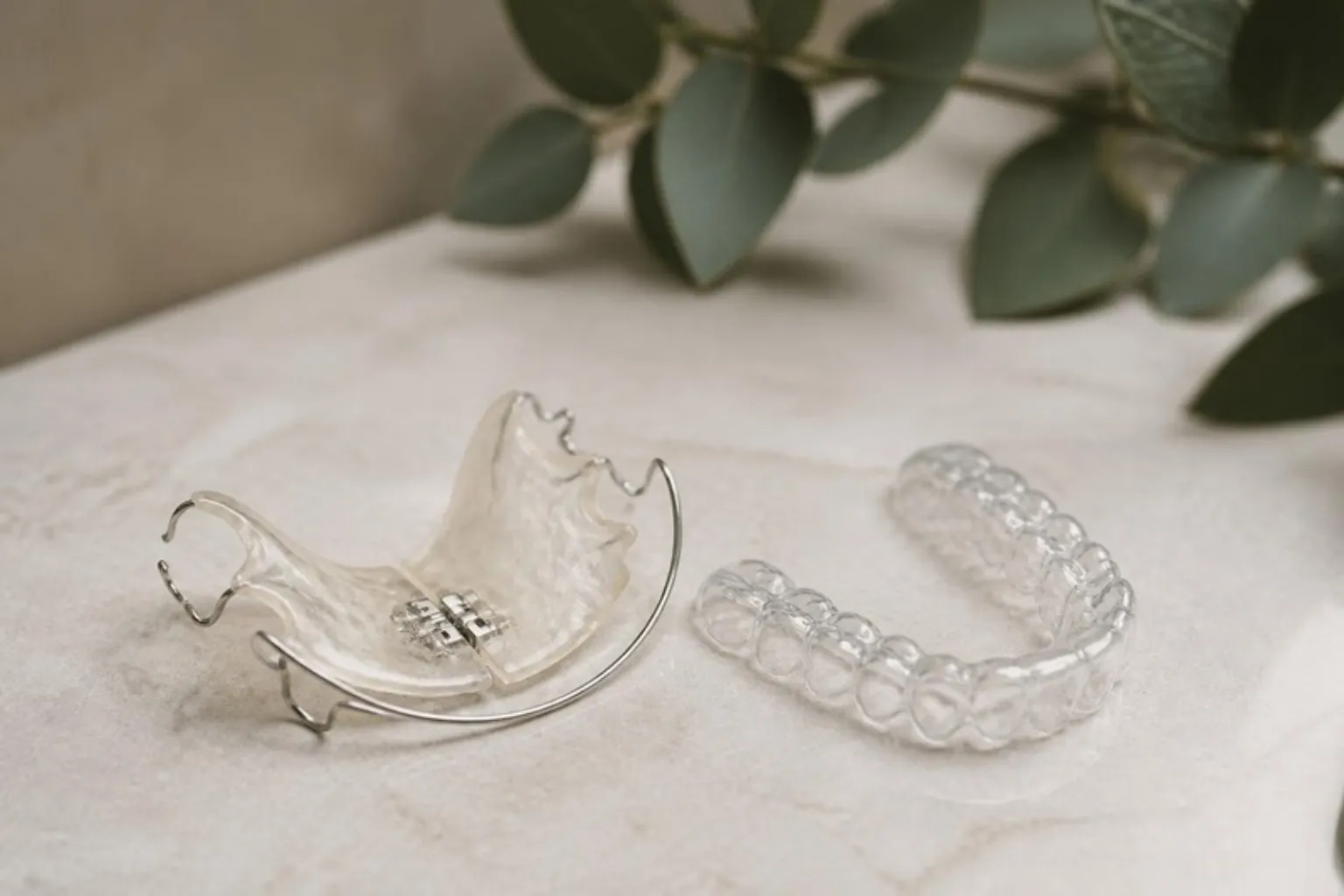
When patients hear that an Inman Aligner can straighten front teeth in a matter of weeks, it is natural to assume it is a faster, simpler version of Invisalign. It is not. It is a different appliance with a deliberately narrow job, and treating it as a shortcut is how people end up with a quick result on a case that needed breadth.
What each treatment is
The Inman Aligner is a single removable appliance with a slim metal frame and calibrated nickel-titanium coil springs. The springs press a bar against the front of the teeth while a second bar pushes from behind, gently squeezing mildly crowded or drifted front teeth into line. Because the force is constant and concentrated, movement can be quick. It treats the front teeth only and does not set out to change the bite.
Invisalign uses a sequence of thin clear aligners, each changed every one to two weeks, to move teeth in small planned steps. Treatment is designed digitally from an iTero scan with a ClinCheck simulation, so you can see the proposed movement before committing. It can treat a few front teeth or both full arches, including how the upper and lower teeth meet. At Dental & Wellness London it is planned by Dr Vishal Patel, an Invisalign Diamond II provider.
The key difference
The Inman Aligner trades scope for speed: fast, but only for mild front-teeth problems, and with a visible bar across the front during treatment. Invisalign trades speed for scope: it takes longer for larger cases because it can do more, and it is far less noticeable.
How to read this page
The table sets out the differences factor by factor, followed by who tends to suit each and how we decide in practice. If your concern is mostly crowding, our page on crowded teeth gives useful background.
For the full picture, including how this compares with the alternatives, see our guide to teeth straightening. Another short-term option is covered in Six Month Smiles vs Invisalign.
The Inman Aligner is a removable spring-powered appliance that corrects mild crowding or relapse of the front teeth, often in around six to sixteen weeks. Invisalign uses a series of clear aligners to move any teeth, including correcting the bite, typically over several months to a year or more. Inman is quicker but narrow and more visible; Invisalign is broader and more discreet. The case decides which is right.
The verdict at a glance
| Inman Aligner | Invisalign | |
|---|---|---|
| How it works | Removable appliance with coil springs pushing a front bow against a rear bar to align the front teeth | A series of removable clear aligners moving teeth in planned stages, often with small bonded attachments |
| Teeth treated | Front teeth only | Any teeth in either arch |
| Best suited to | Mild crowding of the front teeth and slight relapse after earlier orthodontics | Crowding, spacing, rotations and bite problems, from minor to comprehensive cases |
| Not suitable for | Bite correction, back teeth, significant rotations, larger spacing or complex cases | Some severe rotations or complex movements better controlled with fixed appliances; patients unable to wear aligners consistently |
| Typical treatment time | Often around six to sixteen weeks | From a few months for minor cases to around a year or more for comprehensive cases |
| Visibility | A thin metal bar is visible across the front teeth | Very discreet clear trays with tooth-coloured attachments |
| Daily wear | Most of the day, typically around 16 to 20 hours | 20 to 22 hours a day |
| Comfort and speech | Firm pressure as the springs work; the appliance can affect speech at first | Pressure for a day or two with each new tray; speech usually adapts quickly |
| Risks and considerations | Limited scope; teeth may need some reshaping to create space; slower progress if not worn | Slower progress if wear slips; refinement aligners sometimes needed |
| Retention afterwards | Long-term retainers needed | Long-term retainers needed |
| Cost at DWL | Quoted in writing after assessment | Invisalign Express £2,200 · Moderate £3,400 · Unlimited £4,500–£4,900; consultation free |
| Offered at DWL? | Yes, for suitable front-teeth cases | Yes, with Dr Vishal Patel, Invisalign Diamond II provider |
Which one is right for you
The Inman Aligner can be an efficient, proportionate answer for a specific kind of problem. It tends to suit you if:
- your concern is mild crowding of the front teeth, and the back teeth and bite are healthy;
- your front teeth have drifted a little after previous braces or aligners, often because retainers were not worn;
- you want a quicker result and accept a visible appliance for a few weeks;
- you can wear a removable appliance for most of the day and keep it clean;
- a broader aligner plan would be more treatment than the problem needs.
Creating a little space between the front teeth by gently polishing their contact points is sometimes part of Inman treatment, and we explain this before you decide. As with any orthodontic movement, a retainer is needed afterwards, so the result holds once the springs have done their work. We review progress at short, regular visits throughout.
Invisalign is the better choice whenever the case needs breadth rather than speed. It tends to suit you if:
- the way your upper and lower teeth meet needs correcting, which the Inman Aligner is not designed to address;
- teeth beyond the front of the mouth need to move, or the arch form needs developing, which we prefer to do without extractions where possible;
- there are rotations, larger spaces or crowding beyond what spring force on the front teeth can manage;
- you want an appliance that is very discreet and removable in meetings, on calls and in photographs;
- you want to see a digital simulation of the planned movement before committing.
Invisalign plans range from Express for minor cases to Unlimited for comprehensive treatment; our Invisalign cost page sets out the differences. Consistent wear of 20 to 22 hours a day is what makes it work, and progress is reviewed at regular visits.
For a small amount of crowding or relapse confined to the front teeth, the Inman Aligner is frequently the right tool in my practice: quicker and more proportionate than a full aligner course. For anything broader, such as bite correction, movement of the back teeth or more significant crowding, Invisalign offers greater predictability across the whole arch and a better long-term functional outcome.
Most adults who come to us about straighter teeth turn out to need more than the front teeth alone, so most of our orthodontic patients are Invisalign cases. That is a finding of the examination, not a preference for one system. Where Inman genuinely fits, we are glad to offer it, and where neither is warranted, we will say so.
Whichever route suits you, retention is planned from the start, because teeth tend to drift after any orthodontic treatment. Our guide to retainers after treatment explains why.
The first step is a free Invisalign consultation with iTero scanning, or a dental examination (£65) if you would like a full risk assessment first. You will find us at 222 Essex Road, Islington, London N1 3AP, two minutes from Essex Road station. Buses 38, 56, 73, 341 and 476 stop on Essex Road, and many patients cycle or arrive by Lime or Forest e-bike. We are open Monday to Friday, 8am to 7pm (Tuesday from 9am), by appointment; call 020 8127 4567 or contact us to arrange a time.
Frequently
asked questions
Wellness dentistry combines traditional dental care with whole-body health — treating the mouth as a window to overall wellbeing.
View all FAQs →Is the Inman Aligner better than Invisalign?
Neither is better in general; they suit different problems. The Inman Aligner is efficient for mild crowding or relapse of the front teeth. Invisalign is more versatile, can correct the bite and treat any teeth, and is more discreet. The right choice depends on what your teeth and bite need, which we establish at an examination.
Can the Inman Aligner fix my whole smile?
No. It treats the front teeth only and does not set out to change the bite or move the back teeth. For whole-smile alignment, or anything involving how the teeth meet, Invisalign or fixed braces are needed. We will tell you plainly if your case falls outside what the Inman Aligner can achieve.
How long does Inman Aligner treatment take?
For suitable cases, treatment is often around six to sixteen weeks, depending on how much movement is needed and how consistently the appliance is worn. Invisalign for a comparable minor case may take a few months, while comprehensive Invisalign usually takes longer. We give you an estimated timescale for your own case at consultation.
Is the Inman Aligner cheaper than Invisalign?
Not always. At DWL, Invisalign Express is £2,200, Moderate £3,400 and Unlimited £4,500 to £4,900, and Inman treatment is quoted in writing after assessment. For a minor front-teeth case the difference is often modest, so the decision should rest on suitability rather than price.
Does the Inman Aligner hurt?
Most patients describe firm pressure rather than pain, particularly in the first few days as the springs begin to work. Speech can feel different until the tongue adapts to the appliance. Invisalign usually causes a day or two of tightness with each new aligner. Ordinary pain relief is generally enough for either.
Will I need a retainer after the Inman Aligner?
Yes. Teeth that have been moved quickly are especially prone to drifting back, so a retainer is part of treatment, not an optional extra. The same applies after Invisalign. We fit retainers at the end of treatment and explain how often to wear them over the long term.
Can I switch to Invisalign if the Inman Aligner does not give the result I want?
Yes. Inman treatment is self-contained, and Invisalign can follow if more movement turns out to be needed. We review progress, discuss the options openly and only proceed with further treatment if it is genuinely warranted for your teeth. A new scan and plan would be needed first.
Not sure which fits your case?
Book a consultation and we'll assess honestly — no default recommendation.
Book free consultation