Composite bonding suits patients wanting a reversible, lower-cost cosmetic step that preserves natural enamel. Porcelain veneers suit patients wanting maximum longevity, the strongest stain resistance, and more dramatic shape change at higher cost with enamel removal. The right answer depends on your case, not a price list. If you are in or near Islington, see composite bonding in Islington.
Why this decision matters more than it should
Patients arrive at this question with a fixed expectation about half the time. Either they've decided on bonding because of cost, or they've decided on veneers because of longevity claims. Neither reflexive answer is wrong — but neither is necessarily right for the case in front of me. The honest comparison takes ten minutes in consultation and saves years of regret either way.
The eight-axis comparison
Cost
Composite bonding at DWL: £175 for simple work to £350 for complex work, per tooth. A full upper six teeth typically £1,050–£2,100. Porcelain veneers at DWL: £750–£1,050 per tooth standard porcelain · £1,050–£1,500 per tooth Emax premium. A full upper six teeth typically £4,500–£9,000 depending on material. The cost difference per tooth is 3–6×. Over a 15-year ownership horizon, the maths reverses — bonding refreshes at year 7 add cost, while well-placed veneers run their full course. The cheapest answer at year 1 isn't always the cheapest at year 15.
Lifespan
Bonding averages 5–7 years before needing polish or partial refresh; well-placed veneers can last 15–20 years. The lifespan gap is real and significant. But it's not the only number that matters — see repairability below.
Reversibility
Bonding is reversible in most cases because we don't remove enamel. Veneers require permanent enamel removal of typically 0.3–0.5mm per tooth before they're bonded on. If you change your mind about veneers in five years, you can't go back to the original tooth — you can only replace them with new veneers or crowns. This is the most under-discussed difference between the two treatments.
Enamel removal
Bonding: usually none. Veneers: yes, irreversible. For younger patients especially, this matters. Removing enamel from a 32-year-old's healthy teeth is a decision that commits them to lifelong restoration. Many of the most experienced cosmetic dentists I know are increasingly reluctant to place veneers on patients under 40.
Stain resistance
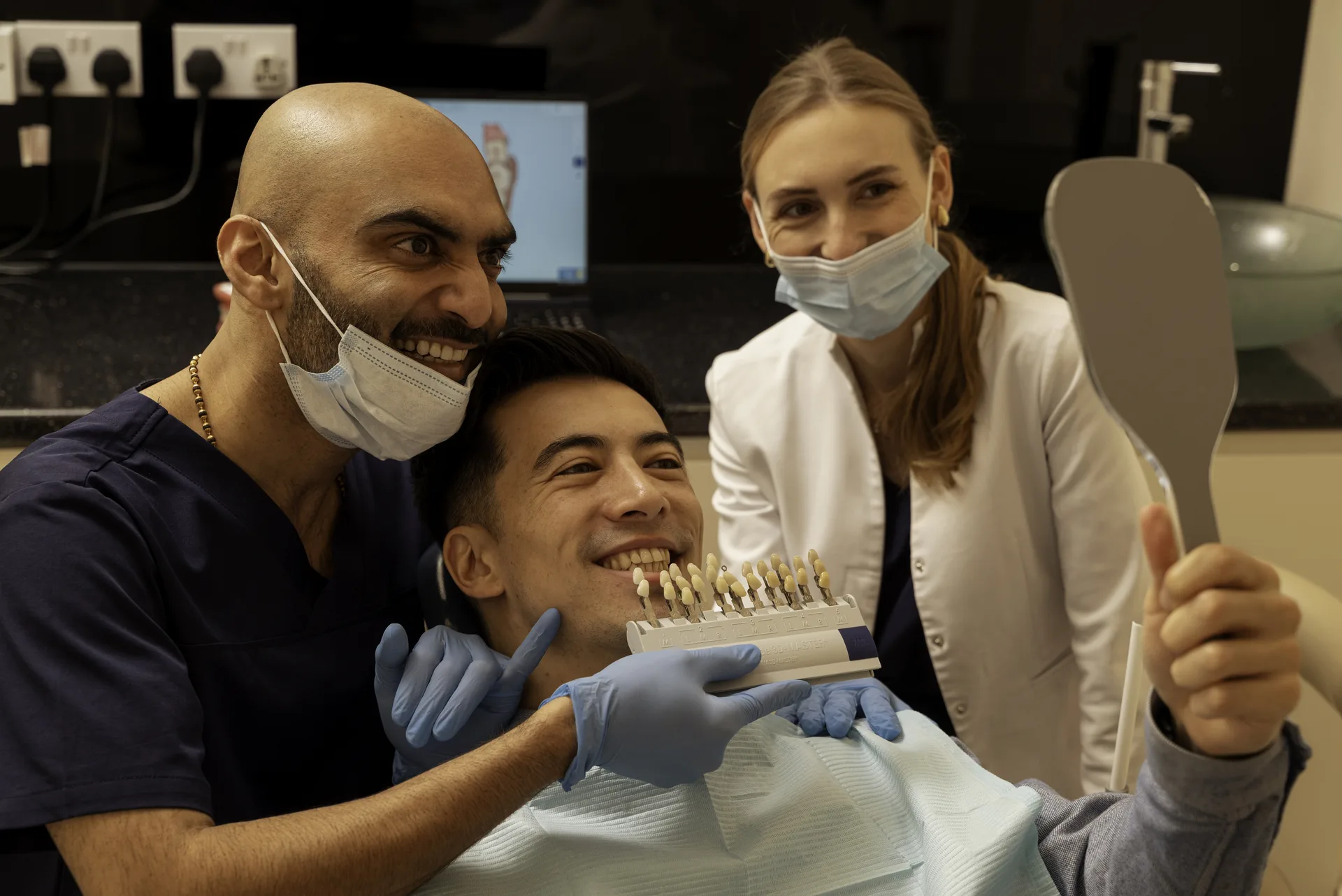
Veneers are porcelain — they don't stain meaningfully over decades. Composite resin is porous; surface staining accumulates from coffee, wine, tea, turmeric. Polish at 12–18 months handles surface staining for bonding; veneers don't need this. If you drink several coffees a day or smoke, veneers hold colour better in the long run.
Repairability
Bonding can be repaired in 30 minutes if a chip occurs — we add resin to just the affected area. Veneers, when they chip or debond, must usually be replaced as a whole unit. Bonding's repairability extends its functional lifespan substantially; veneers' replacement-only model means small problems become full-replacement decisions.
Treatment time
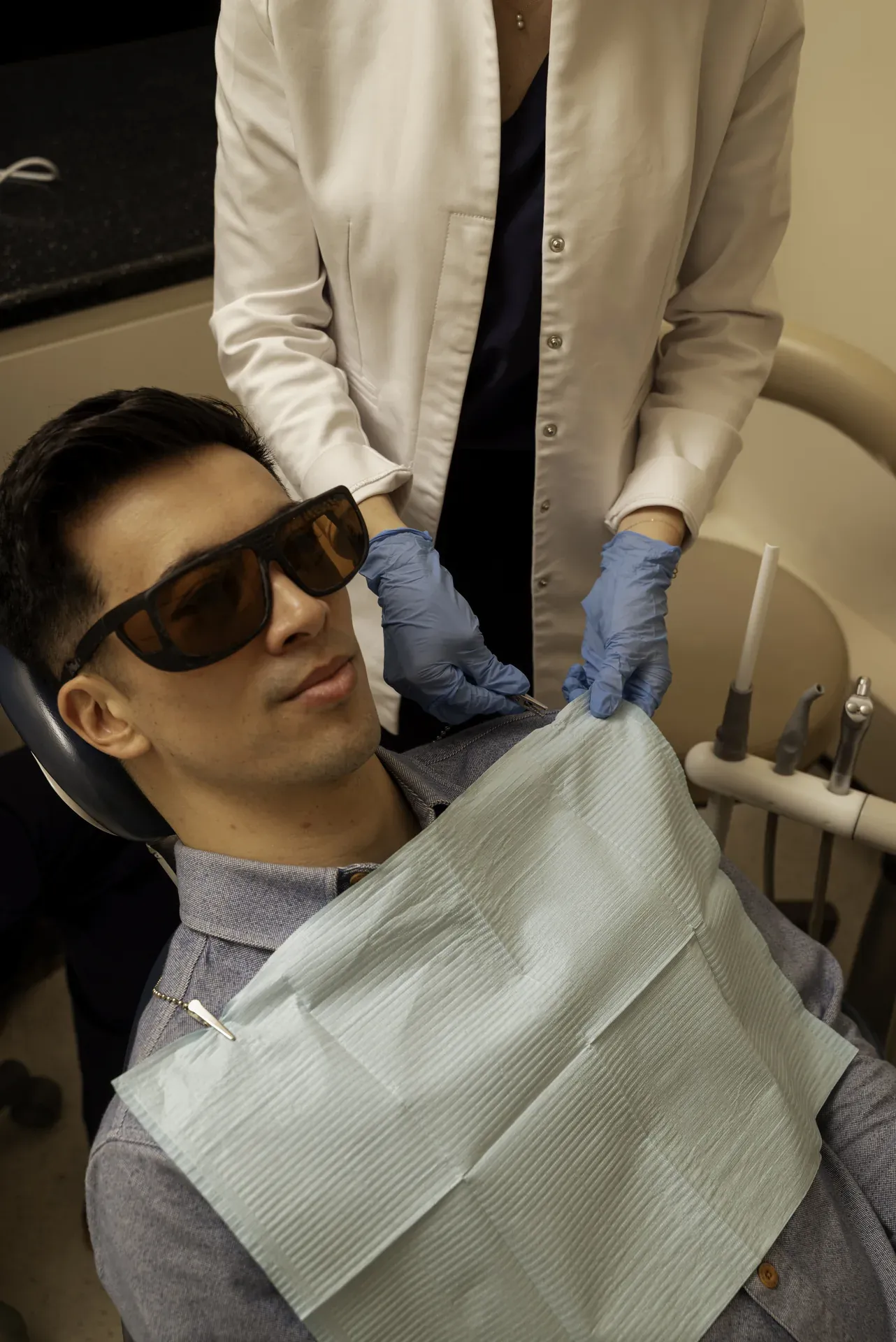
Bonding placement is one or two appointments. Veneers require: consultation, impressions, two-week wait for the lab, fit appointment, sometimes a try-in. Three to four appointments over four to six weeks total.
What it can change
Bonding can change colour mildly, close small gaps, repair chips, reshape edges. Veneers can change colour dramatically (mask severe tetracycline staining, for example), close larger gaps, change the entire silhouette of the front teeth. For dramatic transformation, veneers win on capability; for subtle improvement, bonding suits.
When bonding is the right answer
In consultation, I recommend composite bonding when one or more of these apply:
- The cosmetic concern is single-tooth or affects 1–4 teeth, not the whole smile
- The patient is under 40 and wants to preserve enamel for life ahead
- The patient wants a reversible step before committing to veneers
- Cost is a meaningful factor in the decision (not a deal-breaker but a real consideration)
- The underlying tooth shape is healthy; we're refining not transforming
- The case involves edge repair, chip restoration, or small-gap closure
- The patient grinds and is willing to wear a Davies-technique splint (£495) — the bonding-plus-splint combo extends bonding lifespan substantially
- The patient wants to test a cosmetic direction before permanent change
When veneers are the right answer
I recommend veneers when:
- The cosmetic concern affects the whole smile, not selected teeth
- Maximum longevity is the patient's top priority and the investment is comfortable
- The colour change needed is dramatic — tetracycline staining, severe fluorosis, or post-trauma discolouration
- The shape change is significant — multiple teeth needing length, width, or contour transformation
- The patient has already had bonding once or twice and wants the upgrade
- The patient is over 50 with stable enamel and the next 15–20 years of stability outweighs preservation
- A patient has assessed the irreversibility honestly and accepted it
When neither is the right answer
Sometimes the conversation ends without either treatment. This happens more often than patients expect. The most common "neither" cases I see:
- The actual issue is tooth position, not shape or colour — orthodontics first
- The teeth are healthy and patient discomfort is aesthetic-perfectionism not aesthetic-defect — leave them alone
- Severe gum recession or active periodontal disease — treat the foundation first
- Active bruxism without splint acceptance — neither bonding nor veneers will hold
- Underlying tooth structure too compromised for either restoration — crowns or onlays instead
I will tell you in consultation when this applies. We say no often. The honest "do nothing" or "do something else first" is what builds long-term smile health and protects how your teeth support your smile across decades.
The framework I use in consultation
When a patient asks me "bonding or veneers?" I work through this sequence:
- Examine each tooth in question — health of the enamel, existing restorations, alignment, colour
- Photograph at rest and in animation to see how the smile presents
- Ask about life-stage and timeframe — what they want their smile to be in 5, 10, 20 years (the long-term smile view drives the answer)
- Cost discussion — what's in budget and what's not, no judgment
- Reversibility conversation — explicit, with the consequences of each path
- Recommend per-tooth, not whole-mouth — sometimes bonding on two teeth and veneers on two others is the right plan
- Smile-design preview before committing — wax-up or digital mockup of the proposed result
This sequence usually produces a clear recommendation. Where it doesn't, we book a second consultation rather than rush the decision. Design with your future in mind is not a slogan; it's the literal sequence we follow.

What this means for you
If you've come into this question because you've seen Instagram before-afters and want a smile transformation, the honest first step is consultation. Photos online don't show what's possible for your specific teeth — your enamel quality, your bite, your colour baseline, your life stage all factor in. The £65 cosmetic consultation includes a written summary so you leave with the recommendation in your hand, whether you proceed with us or not.
Frequently asked questions
Is bonding always cheaper than veneers?
Per tooth and per session, yes — bonding £175–£350 vs veneers £750–£1,500. Over the full life of the restoration, the picture is more complex. Bonding needs polish every 12–18 months (£85) and refresh at year 5–7; veneers run 15–20 years. The 10-year total cost of ownership often runs closer than the headline per-tooth difference suggests. We give you the maths for your specific case at consultation.
Do veneers always last longer?
On average, yes. Well-placed veneers from an experienced cosmetic dentist routinely last 15–20 years; composite bonding averages 5–7. But "on average" hides important nuance. Bonding can be partially refreshed indefinitely; veneers must be replaced. And bonding placed on a non-grinder with good hygiene routinely hits 10 years, while veneers placed without proper bite protection on a grinder can fail at year 5. Lifespan depends on the patient as much as the material.
Can bonding look as good as veneers?
For single-tooth or small-case work, often yes — particularly in the hands of an experienced cosmetic dentist. For whole-smile dramatic transformation, veneers consistently produce more uniform colour and shape. The honest answer is: bonding looks excellent for what it does, veneers look excellent for what they do. They're different tools for different cosmetic problems.
Will I be upsold to veneers when I want bonding?
At DWL, no. I personally recommend composite bonding more often than veneers because it preserves natural tooth structure. If you've been considering bonding and we recommend veneers in your specific case, it'll be because of a clinical reason — severe staining, structural compromise, or your explicit goal that bonding can't deliver. The reverse is more common: patients arrive expecting to need veneers and I recommend bonding. High ethics in practice means optimal aesthetic and optimal function are designed together, not one used to sell the other.
Is bonding reversible if I change my mind?
Yes, in most cases. Because no significant enamel is removed for bonding, the resin can be removed and the underlying tooth returns to its natural state. There may be slight surface roughness where the enamel was etched for adhesion, but no permanent shape change. Veneers are not reversible — enamel removed for veneer placement is gone. This irreversibility is the single most important factor patients should consider before veneers.
Can I have bonding on some teeth and veneers on others?
Yes, and this is sometimes the right plan. Where one tooth has a structural issue that needs the strength of porcelain and adjacent teeth need only cosmetic refinement, a mixed plan can outperform a same-treatment-everywhere plan. We discuss this in consultation if your case suggests it — proportionate treatment per tooth, not whole-mouth defaults.
Book a consultation
The bonding-vs-veneers question is the most-asked cosmetic question in dentistry. The answer is genuinely case-specific. The £65 consultation produces a written assessment with the recommendation for your teeth — whether you proceed with us or take it elsewhere.
Cosmetic consultation £65 (redeemable against treatment within 90 days). Call 020 8127 4567 or WhatsApp +44 7974 910222. Appointments Monday-Friday 8am-7pm by appointment.
Reviewed by Dr Vishal Patel · BDS Liverpool · MSc Aesthetic & Restorative Dentistry (Manchester) · GDC 103127 · AACD Member · Invisalign Diamond II Provider · 20 years cosmetic dentistry · 15,000+ cases. Last reviewed 2026-06-03.