What Emax veneers actually are
Emax (also written E-max or IPS e.max) is a brand of lithium disilicate ceramic made by Ivoclar Vivadent. It has become the most-requested premium porcelain veneer choice because of two properties that usually sit in tension: high strength and high translucency.
Traditional dental porcelain is beautiful but fragile. Zirconia is strong but tends to look opaque and bright. Emax sits between them — strong enough to function as a long-term restoration at around 400 MPa flexural strength, against 80–150 MPa for feldspathic porcelain, yet translucent enough to mimic the way light scatters through natural enamel.
Emax veneers are thin shells, typically 0.3–0.7mm, bonded to the front of the teeth. The bonding is adhesive rather than mechanical, which means the cement, the ceramic, and the underlying tooth become one integrated unit. That integration is a large part of why Emax lasts: the veneer is not simply glued on, it is chemically and mechanically united with the tooth.
The four-property framework — what separates Emax from ordinary porcelain
Four properties decide everything that matters in daily use.
Strength. Feldspathic porcelain runs 80–150 MPa; Emax is around 400 MPa — roughly three to five times stronger. That margin is what resists biting force and chipping at the veneer edge over years of normal function.
Translucency. Despite the strength, Emax keeps light-scatter close to natural enamel. Light passes in, bounces off the tooth beneath, and creates the depth of colour that separates a real tooth from a flat, opaque restoration. Even modern "esthetic" zirconia cannot match Emax for translucency in the front-tooth zone.
Thickness. Emax can be fabricated as thin as 0.3mm, which permits more conservative preparation. A traditional feldspathic veneer often needs 0.5–0.7mm of enamel removed; Emax can sometimes be placed at 0.3mm, or in select cases as a near "no-prep" veneer. Less enamel removed is a clinical good in itself.
Surface and finish. Emax is fully glazed in a final firing, producing a stain-resistant surface that holds up to coffee, red wine, and tea over many years. Feldspathic porcelain, hand-built layer by layer, can reach slightly higher artistry in expert hands but is more variable tooth to tooth.
Reading those four properties against a specific mouth — the bite, the enamel, how the teeth meet — rather than defaulting to the most premium material on the shelf is where restorative planning earns its place. The goal is optimal aesthetics and optimal function at once, designed for the long-term smile view.
Emax veneer cost — UK and London ranges
RegionPer tooth6-tooth smile10-tooth smileCentral London (premium)£1,200–£1,500£7,200–£9,000£12,000–£15,000London (standard)£1,050–£1,250£6,300–£7,500£10,500–£12,500South-East England£900–£1,100£5,400–£6,600£9,000–£11,000Midlands and North£850–£1,000£5,100–£6,000£8,500–£10,000
The London premium of roughly 15–20% above the UK average reflects clinic operating costs and the concentration of MSc-trained cosmetic dentists in the city. The ceramic itself is a small fraction of the total cost — the rest pays for the master ceramist's fabrication time, the clinical preparation and bonding visits, and the case planning that decides shape, shade, and bite.
At Dental & Wellness London, Emax veneers are typically £1,050–£1,500 per tooth depending on case complexity. That figure includes consultation with photography and a digital mock-up where appropriate, the preparation visit with temporaries, master-ceramist fabrication, the bonding visit, the post-bonding review, and any minor adjustments in the first six weeks. The consultation is £65. The quote is written and itemised — a "from" price, what is included, and what is not — so there is nothing to discover mid-treatment.
Lifespan, durability, and the cost-per-year that surprises people
Documented research and clinical follow-up of Emax veneers shows 5-year survival of 94–97% in well-conducted studies, 10-year survival of 85–92% with good case selection and bonding, and 15-year survival of 75–85% in patients who protect them with a night guard. The common failure modes are debonding — usually fixable by rebonding — and chipping at the incisal edge under heavy bite force. Catastrophic fracture is rare; the strength margin is substantial for normal function.
The patients who reach the upper end of that range tend to do the same things: wear a night guard if there is any grinding history, keep six-monthly hygiene, avoid biting pens, ice, and fingernails, and have any bite problem sorted at the planning stage rather than after the veneers are on.
Here is the figure that reframes the decision. Emax at £1,200 a tooth over eighteen years works out at about £67 per tooth per year. Composite bonding at £350 a tooth, replaced every six years, works out at about £58 per tooth per year. The lifecycle maths is far closer than the headline prices suggest — which is why the sticker price alone should never decide it. The question is how the smile reads, and how it functions, at fifty and seventy, not only in next week's photo.
When to choose Emax — and when not to
The honest decision tree used in the chair:
Composite bonding is the better answer when cost is the main constraint; reversibility matters and preserving enamel is a priority; the case is small chips, a modest reshape, or gap closure; a result that can be refined over time is wanted; or this is a first attempt at cosmetic dentistry and a lower-commitment start makes sense.
Emax veneers are the right answer when there is severe discolouration — tetracycline staining, a root-canal-darkened tooth — that whitening and composite cannot reach; significant shape change is needed for worn teeth, peg laterals, or congenital shape issues; fifteen to twenty years from the treatment is the goal rather than five to seven; stain resistance matters because of heavy coffee or red wine; or multiple teeth across the smile zone are being treated, where the cost-per-year maths starts to favour porcelain.
Composite is recommended over Emax in roughly four of five cosmetic cases at this clinic — porcelain is declined when the conservative option delivers the same result with less enamel removed. Emax is the right material in the cases where it is right, not the default for everyone, however good the brand name has become.
Talk it through properly
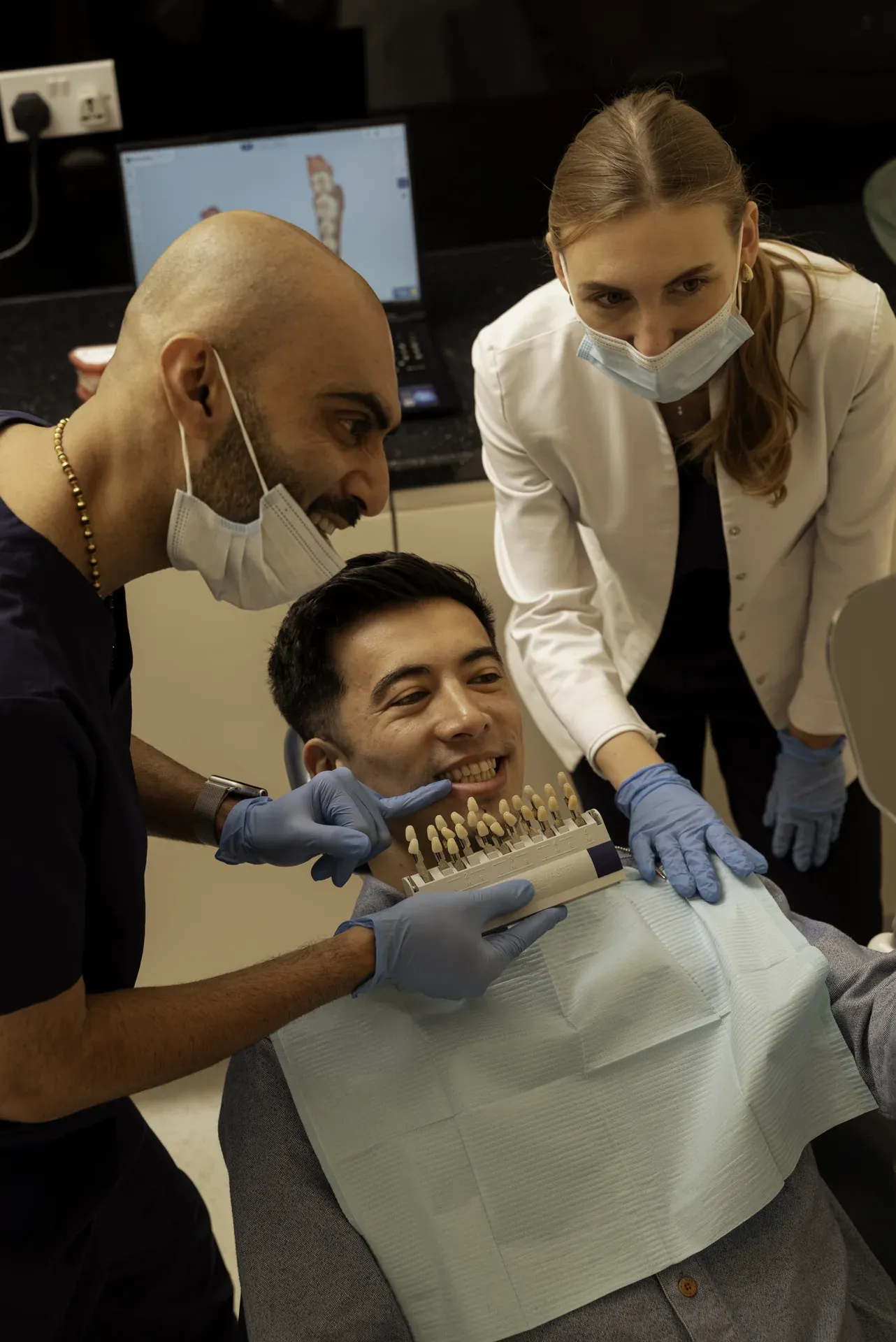
Whether Emax veneers are the right fit for your case, or composite bonding would serve you just as well for less, is worth an honest consultation rather than a guess from a photo. Consultations at Dental & Wellness London are £65.
Call 020 8127 4567 or message on WhatsApp at +44 7974 910222 (8am–7pm). Patients are seen Monday to Friday, 8am–7pm, by appointment at 222 Essex Road, Islington, London N1 3AP.