Direct answer. A single implant replaces one missing tooth with one implant and one crown. An implant bridge uses two or three implants to support a bridge that restores three or four missing teeth — more cost-efficient per tooth when several teeth in a row are missing. The right choice depends on which teeth are gone, the bone available, your budget, and your long-term plan.
The question behind the question
Most people arrive having already decided this is a price comparison: which restoration costs less. It is a fair instinct, but it is the wrong starting point, because the two options are not really competing for the same job. A single implant and an implant bridge answer different anatomical situations. Asking which is "better" in the abstract is like asking whether a key or a lock is better — the answer depends entirely on what you are trying to open.
So before any number, the honest first question is not "which is cheaper" but "what is actually missing." One isolated gap and a row of three consecutive gaps call for different engineering. We would rather walk you through that logic than quote you a figure that turns out to answer the wrong question. Our dental implants in Islington page describes the process from scan to crown.
This decision is restorative dentistry at its core, and restorative dentistry is a long-term discipline. A background in Aesthetic and Restorative Dentistry means we do not design for today — we design with your future in mind, weighing how the restoration will function and look not just next year but across the decades it is meant to last. That long-term view shapes everything that follows.
What each one actually is
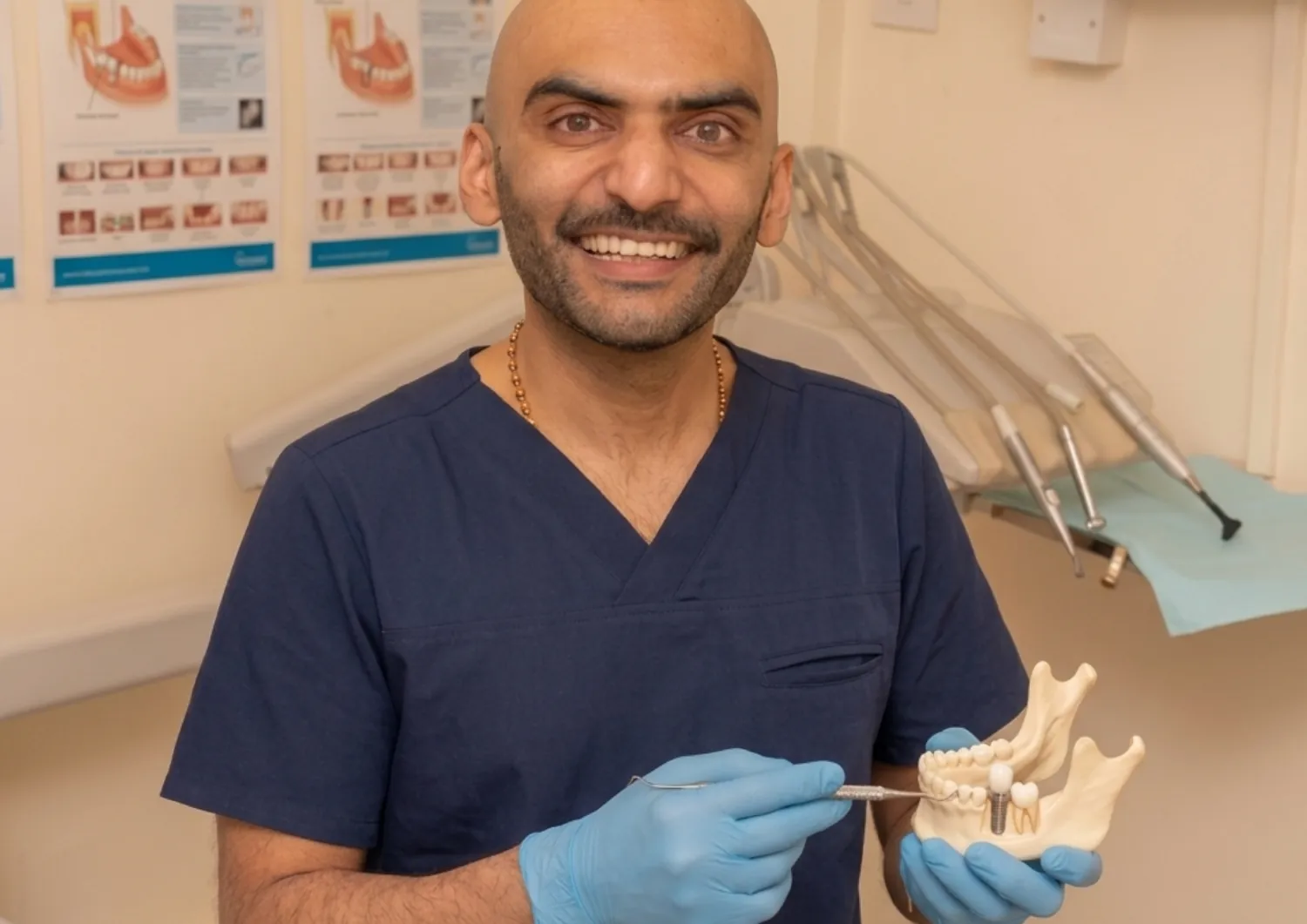
A single implant is one titanium post placed in the jawbone where a tooth root used to be, topped — after healing — with a single crown. It stands alone. It does not touch the teeth on either side. It is the most faithful reproduction of a natural tooth that modern dentistry offers, because it replaces the root as well as the crown.
An implant bridge is a span. Rather than placing an implant under every missing tooth, two or three implants act as anchors, and a bridge of joined crowns spans between them — restoring three, four, sometimes more teeth across fewer implants. The teeth in the middle of the span (the pontics) have no implant beneath them; they are carried by the anchors at each end.
The distinction matters because it drives the whole comparison: a single implant is a one-to-one replacement, while a bridge deliberately restores more teeth than it places implants. Tooth-supported options are covered on our bridges in Islington page.

The four-axis decision framework
When a patient is genuinely choosing between several single implants and an implant bridge — which only happens when more than one tooth is missing — we weigh four things, with a CBCT scan on the screen.
Which teeth are missing
This axis usually settles the decision on its own. One isolated gap points to a single implant; there is nothing to bridge to. Several consecutive gaps open the door to a bridge, because you have anchor sites at each end of a continuous span. Gaps scattered around the mouth with healthy teeth between them point back toward individual implants, since a bridge needs its missing teeth in a row. The pattern of loss does most of the deciding. Our tooth replacement guide covers the wider options.
The bone available
Implants need bone to hold them, and how the missing teeth come about and how long they have been gone shapes how much bone remains. A single implant needs sound bone at one site; an implant bridge needs adequate bone at its two or three anchor sites but, usefully, none under the pontics in between. That can be an advantage where the bone in the middle of a gap has resorbed — the bridge spans the weak zone rather than demanding an implant there. Where bone is short at an anchor site, a graft may be needed first; we map this on a scan rather than guessing, and where placement angles allow we plan to avoid grafting where we honestly can.
Cost per tooth
Here is the concrete axis. A single implant at our Islington clinic starts from £2,200, including the crown, restoring one tooth. An implant bridge restoring three teeth on two implants is quoted in writing after a consultation and CBCT scan. Run the per-tooth maths and the logic of the bridge appears: three separate implants would be three times the single-implant fee, whereas the bridge restores the same three teeth using fewer implants and one connected restoration. For consecutive missing teeth, the bridge is the more cost-efficient route per tooth replaced. For a single gap, the single implant is simply the only sensible answer — there is no efficiency to capture.
The long-term plan
This is the axis cheaper conversations skip. Single implants preserve the most flexibility: each tooth is independent, so if you lose another tooth years from now, you address it in isolation without disturbing the others. An implant bridge commits a section of your mouth to one connected restoration — excellent when the situation is stable, but worth thinking through if further loss is likely. We talk openly about which scenario fits you, because a restoration designed only for today is a restoration that ages badly. Designing with your future in mind is the whole point. For one missing tooth, our comparison of an implant versus a bridge may help.
Cleaning, feel, and the day-to-day
Two practical differences matter once the restoration is in.
Cleaning. Single implants can be flossed individually like natural teeth, which many patients find simpler. An implant bridge has a connected span, so cleaning under the pontics needs a floss threader or interdental brush — a small technique to learn, not a hardship, but worth knowing before you choose.
Feel. Both restore strong, stable chewing because both are anchored in bone rather than resting on the gum. Most patients report that neither feels like a foreign object once healed. A bridge can feel marginally different across the connected span; a single implant most closely mimics a natural standalone tooth. Neither compromises function — this is about preference at the margins, not about one working and one not.
How we plan it in consultation
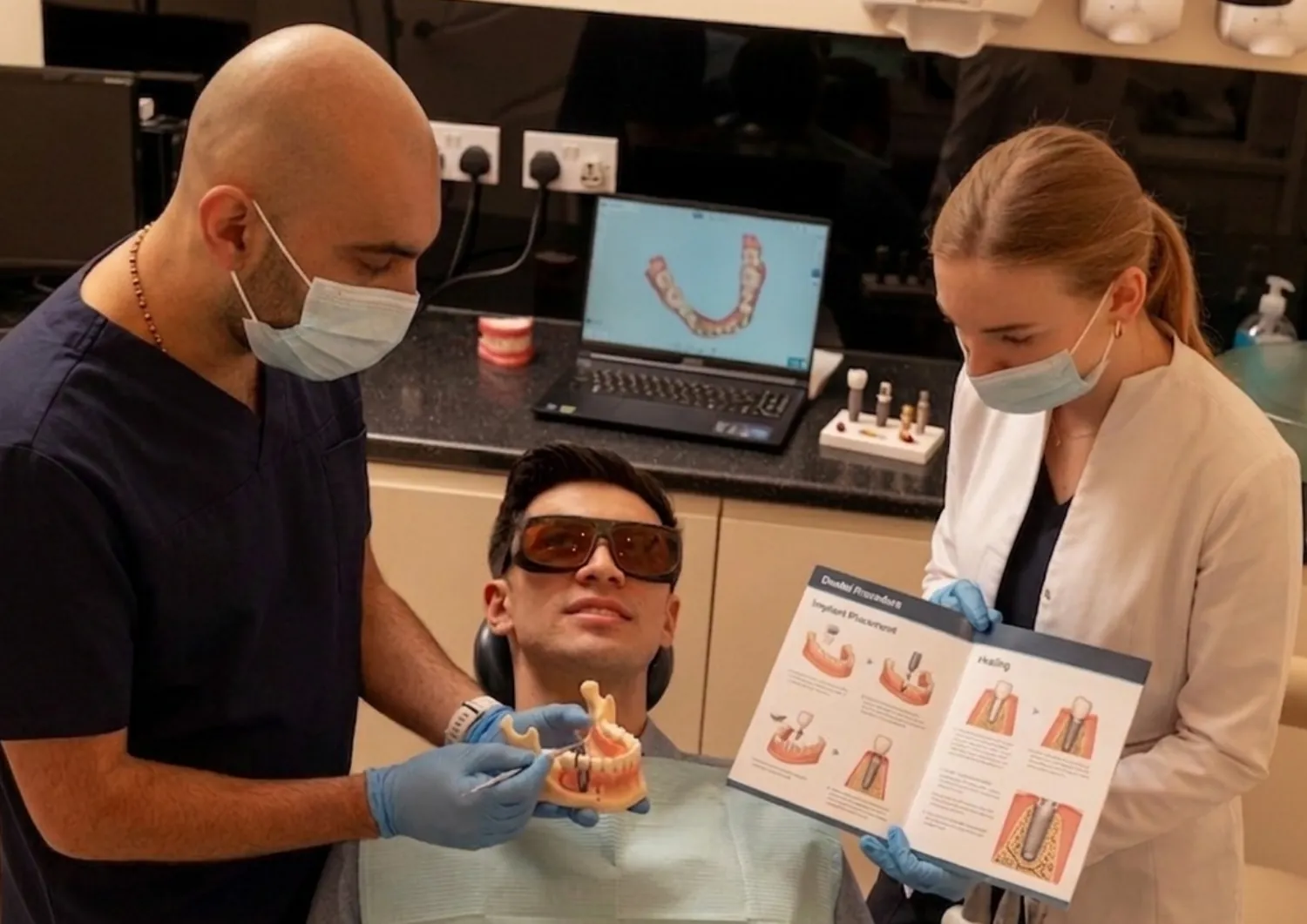
Every one of these decisions is made with a CBCT scan rather than from a photograph or a guess. The scan shows bone height and width at each potential implant site, the position of nerves and the sinus, and the three-dimensional shape of what we are working with. A clinician trained in oral surgery, who reads vital facial structures, blood vessels, nerves and the way the muscles of the face and jaw function, plans implant position around all of it — not just where a tooth used to be, but how the finished restoration supports your bite, your lips, and your face over time. How your teeth support your smile is part of the engineering, not an afterthought.
We will also tell you plainly when neither option on this page is right. If many or all of the teeth in an arch are missing, the better conversation is a full-arch solution — our All-on-4 page covers that route. And where bone is genuinely insufficient at the sites you need, we will talk through bone grafting honestly rather than over-promise placement we cannot safely deliver.
Cost, transparency, and finance
For clarity in line with price-transparency expectations: a single implant starts from £2,200 including the crown, and an implant bridge is quoted in writing after a consultation and CBCT scan that confirm what your specific case needs. Those headline figures cover the implant work and restoration; any preparatory treatment such as a bone graft or sinus lift, where required, is quoted separately and never folded silently into the price. 0% APR finance over 12 months via Tabeo is available, subject to status, and our guide to dental implant costs in London explains what the price covers. The cost can be spread rather than met in one payment.
What we will not do is quote a final number before we have seen a scan. Implant dentistry is a year's-worth of restoration meant to last decades; a responsible figure follows the assessment, not the other way round.
Frequently asked questions
How much does an implant bridge cost per tooth compared with single implants?
A three-tooth implant bridge restores three teeth on two implants and is quoted in writing after assessment. Three separate single implants from £2,200 each would be considerably more for the same three teeth. For consecutive missing teeth, the bridge is the more cost-efficient route; for one gap, a single implant is the only sensible option. The bridge quote follows a consultation and a CBCT scan.
Will an implant bridge feel different from single implants?
Both feel stable and strong because both are anchored in bone. A single implant most closely mimics a standalone natural tooth; a bridge can feel marginally different across its connected span. Most patients adapt quickly and report neither feels like a foreign object once healed.
Can I have an implant bridge if I might lose more teeth later?
This is exactly the long-term question worth raising. Single implants keep each tooth independent, so future loss is handled in isolation. A bridge commits a section to one connected restoration. If further loss is likely, we will talk that through honestly before recommending a bridge — designing with your future in mind, not just for today.
Is one easier to clean than the other?
Single implants can be flossed individually, like natural teeth. An implant bridge needs a floss threader or interdental brush to clean beneath the connected span — a small technique to learn. Neither is difficult once shown; the difference is worth knowing in advance.
Does insurance cover one but not the other?
Coverage varies entirely by policy, and many UK plans treat implant work as a major or excluded category regardless of which option you choose. We would suggest checking your specific policy wording; we can provide the treatment detail your insurer asks for, but we cannot promise what any given plan will reimburse.
How long does each last?
Both are long-term restorations. The implants themselves, well cared for, can last decades; the crowns or bridgework on top may need attention sooner than the posts beneath them. Longevity depends far more on gum health, cleaning, and not smoking than on which of the two designs you choose — which is why we screen those factors before treating, not after.
An honest plan, with the scan in front of us
If you are missing one tooth or several and want to know which restoration genuinely fits — single implants, an implant bridge, or a different route entirely — book a consultation. We will take a CBCT scan, show you what it shows us, and give you a recommendation we would stand behind for the long term, not just for the quote.
Dental & Wellness London · 222 Essex Road, Islington, London N1 3AP · phone 020 8127 4567 · WhatsApp +44 7974 910222 (8am–7pm) · Monday to Friday, 8am–7pm by appointment. We do not offer Saturday or walk-in appointments. Implant treatment is assessed and placed by our implant dentist, Dr Rishil Patel, BDS (Hons), MClinDent Implantology, GDC 154292.
Reviewed by Dr Vishal Patel · BDS, MSc Aesthetic & Restorative Dentistry, GDC 103127. Last reviewed 5 June 2026.