What are temporary veneers?
Temporary veneers — sometimes called "provisional veneers" — are thin, tooth-shaped coverings your dentist makes and fits while your permanent porcelain veneers are being crafted in a dental laboratory. The laboratory needs one to two weeks to build them to the exact shade, shape and fit agreed at your design appointment. In the meantime, teeth gently prepared for veneers need protecting and the smile needs to look and function normally — that's the temporary's job.
A clinical temporary is made from dental-grade resin, shaped chairside or from a template of your planned result, and held in place with a soft temporary cement your dentist removes cleanly at the fitting appointment. It's a working part of planned treatment, not a product you buy and apply yourself — a distinction that matters because the same words are used online to market a very different category of product.
Clinical temporary veneers vs DIY snap-on veneers
| Clinical temporary veneers | DIY "snap-on"/"clip-on" veneers | |
|---|---|---|
| Made by | Your dentist, for your mouth | A factory, from a generic or self-taken mould |
| Fitted by | A dentist, over prepared teeth | You, at home |
| Purpose | Protect teeth and test the result for 1–2 weeks | A removable cosmetic cover-up over natural teeth |
| Fit | Custom, sealed at the margins | Bulky, often loose or tight |
| Lifespan | Planned 1–2 weeks (max ~4) | Marketed as months to years |
| Hygiene | Cleaned normally, removed by dentist | Traps plaque and food against the gum line |
| Cost | Included in your written veneer treatment plan | ~£100–£500 per set |
| Oversight | GDC-registered dentist | None |
A clinical temporary is a staging post in proper veneer treatment. A snap-on kit is a standalone consumer product with no dental involvement. They are not two versions of the same thing.
Why we use temporary veneers in the treatment process
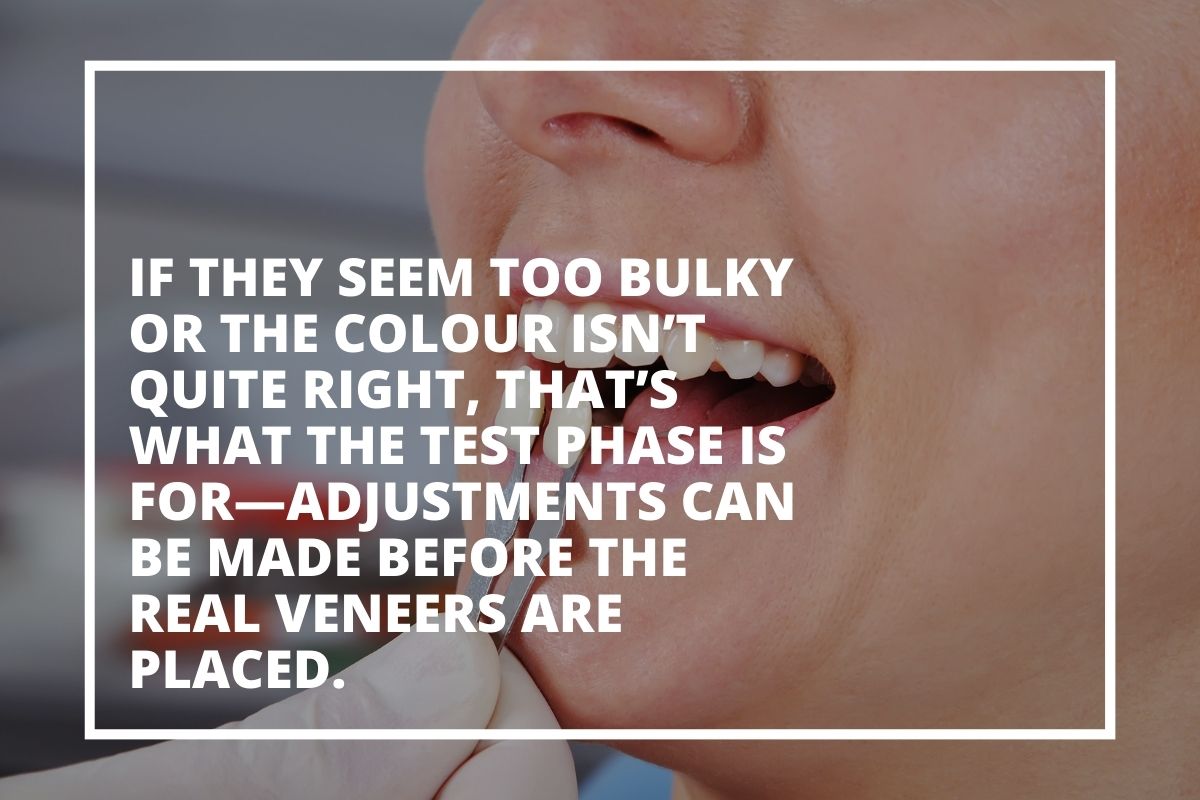
When porcelain or composite veneers are placed, a small amount of enamel is sometimes reshaped so the veneer sits flush and natural. Those prepared surfaces are more exposed and can feel sensitive until permanent veneers arrive. Temporaries protect and seal the prepared teeth; hold the teeth in position so nothing drifts; and let you live with your new smile for a week or two before anything is made permanent — speaking, smiling, eating, seeing it in your own photographs.
That trial period is genuinely useful. If you want edges softer, length shorter, or shade adjusted, this is the moment to say so — far better to refine a temporary than hear a concern after the final veneers are bonded.
How long temporary veneers last
Usually one to two weeks, occasionally up to about four for a complex laboratory case. The resin is softer than porcelain, the cement is deliberately gentle so it releases cleanly at fitting, and the shade can pick up staining faster than final veneers will. None of that matters over a fortnight — it would matter a great deal over months, which is one reason DIY kits marketed for indefinite wear sit in a riskier category.
Caring for temporary veneers — a five-point guide
1. Eat softer foods and avoid the hardest things — skip nuts, crusty bread, toffee, ice. 2. Be careful with sticky foods — chewing gum and toffee can lift a temporary off. 3. Brush gently and floss carefully — slide floss out sideways rather than snapping it. 4. Go easy on staining drinks — coffee, tea, red wine. 5. Call us if one comes loose — not an emergency, but let us re-cement it promptly.
Snap-on / clip-on veneers — the honest verdict
Snap-on and clip-on veneers are removable acrylic shells, bought online, that clip over your natural teeth. They're inexpensive and need no appointment — but we don't recommend them. A snap-on shell is made to a generic shape or a self-taken mould, so it rarely fits your gum line precisely. A device sitting loosely over your teeth all day traps plaque, food, and moisture against the enamel and gums — exactly the conditions that drive decay and gum inflammation. Because it covers biting surfaces, it can also change how your teeth meet, straining the jaw over time. As a costume piece for one evening, low-stakes; worn daily in place of dental care, a genuine risk.
The risks of DIY veneer kits
The Oral Health Foundation and the British Dental Association have both publicly cautioned against DIY veneers and mail-order moulding kits, and the General Dental Council warns that cosmetic dental work should be carried out by a registered professional. The practical risks: decay from plaque and sugars trapped against enamel at the gum margin; gum disease from the same trapped bacteria, potentially leading to inflammation, bleeding, recession, and bone damage; and bite and jaw problems from added bulk changing how teeth meet.
There's also a quieter risk: a cover-up hides problems rather than treating them. A snap-on placed over a chipped or discoloured tooth conceals the very thing a dentist would want to examine.
Better alternatives if cost is the concern
Composite bonding is the one we most often suggest — tooth-coloured resin shaped directly onto the tooth in a single visit to repair chips, close small gaps, and improve shape and shade, often without removing healthy enamel. At DWL, composite bonding is £175 per tooth for a simple edge repair and £350 per tooth for more complex work.
For some patients the right answer is simpler still — professional teeth whitening, reshaping, or treating a single tooth rather than a whole smile makeover. A reversible, dentist-placed option will almost always serve you better than an unsupervised device worn over your natural teeth.
Temporary veneer cost at DWL
As part of a planned veneer treatment, temporary veneers are included in your written treatment plan, which sets out the full cost after a consultation. Porcelain veneers are £750–£1,500 per tooth and composite veneers £350–£500. A cosmetic dental consultation is £65.
FAQs
What are temporary veneers?
Short-term coverings your dentist fits over teeth prepared for permanent veneers, protecting them and letting you preview your new smile during the 1-2 weeks the lab needs.
How long can you wear temporary veneers?
Designed for one to two weeks, occasionally up to about four for complex cases.
How much do temporary veneers cost in the UK?
Temporaries are part of planned veneer treatment and are included in your written treatment plan, rather than priced as a standalone product.
Are snap-on veneers the same as temporary veneers?
No. Snap-on veneers are removable acrylic shells bought online and self-fitted; clinical temporaries are made by your dentist as part of planned treatment.
Are DIY snap-on veneers safe?
We don't recommend them — worn daily, they can trap plaque and change how your teeth meet. The Oral Health Foundation and BDA have both warned against DIY veneer kits.
Can I eat with temporary veneers?
Yes, but favour softer foods and avoid nuts, toffee, crusty bread and ice.
Do temporary veneers look natural?
They're made to resemble your planned final result, slightly less refined than permanent veneers and can stain faster — rarely noticeable over a week or two.
Is composite bonding a good alternative to DIY veneers?
Often yes — a safe, dentist-placed option improving shape, shade and small chips in a single visit, from £175 per tooth.
Book a consultation
Call 020 8127 4567 · WhatsApp +44 7974 910222 · 222 Essex Road, Islington N1 3AP. Rated 4.7★ across 300+ reviews. Cosmetic dental consultation £65.