Direct answer. Invisalign results depend on case complexity and tier. Express delivers mild front-tooth correction, Moderate handles broader alignment, and Unlimited achieves full-arch correction. Outcomes are shaped by wear-time compliance, biology, and retention. Most mild-to-moderate cases reach an excellent, predictable result. Severe skeletal cases may need fixed braces or surgical orthodontics for the best outcome.
Important compliance note
UK General Dental Council (GDC) guidelines restrict identifiable patient before-and-after images and treatment testimonials in dental marketing. This page describes typical result patterns by case complexity rather than showing individual patient outcomes. The only meaningful preview of your own result comes from a scan of your teeth at consultation, not from someone else's smile online.
The honest answer almost no advert gives
Search "Invisalign results" and you will find a wall of dramatic before-and-afters and a single implied promise: this is what you will get. It is the most common piece of dishonesty in orthodontic marketing, and it is dishonest by omission rather than outright lie. The truth is that Invisalign results follow the case. A small front-tooth correction and a full-arch bite rebuild are both "Invisalign", and they produce very different scales of change. The realistic outcome tracks how much your teeth need to move — not the brand on the box, and certainly not a stranger's photo.
So I have framed this page around result patterns by case complexity, because that is what actually predicts your outcome. As a Diamond II provider — top 1% in the UK, with fifteen thousand cases planned — the value I add is not a better promise. It is an accurate picture of what your specific case can reach, drawn from your ClinCheck plan, before you commit a penny.
Two things are true at once. Invisalign results are genuinely predictable when a case is planned properly, because the ClinCheck software simulates the projected end-position before you start. And they genuinely vary with biology and wear time, which is why no honest provider names a single outcome before scanning your teeth. A trustworthy clinic tells you both, not just the flattering half.
Typical results by tier
The outcome tracks the tier, because the tier reflects how far your teeth have to travel. These are typical patterns — your own projection comes from your ClinCheck preview.
Invisalign Express (£2,200) — mild correction. For minor front-tooth crowding, small gaps, or slight relapse after childhood braces. The result is a tidier, straighter front smile line. Express is not designed to change your bite, so the outcome is cosmetic refinement of the visible teeth rather than structural correction.
Invisalign Moderate (£3,400) — moderate alignment. For mild-to-moderate crowding or spacing with modest bite involvement. The typical result is a noticeably straighter arch, front teeth well aligned, minor bite issues improved. This is the outcome most adults picture when they imagine "having Invisalign".
Mid-complexity cases — substantial alignment. For mid-complexity cases needing more movement. The result is a fuller correction across more teeth, with rotations and crowding addressed beyond what the simpler plans reach.
Invisalign Unlimited (£4,500–£4,900) — full alignment. For complex cases: significant crowding, multiple rotations, dual-arch bite correction. The typical result is a fully aligned arch and a corrected bite. This tier does structural work, not just front-tooth tidying, so the scale of change is greatest.
Invisalign Unlimited multi-year cover — maintained result. Active treatment reaches whatever the case needs, and the Unlimited plan includes multi-year aligner cover, with full terms and conditions applying. The result here is not just the end-of-treatment smile but a maintained one — meaningful for patients who want their alignment to still look right at five and ten years.
A bigger result is not a better-treated case, and a smaller one is not a lesser job. A well-planned Express result and a full Unlimited correction are both clinical successes when matched to the right case. We say no often to over-treatment — if a simpler tier reaches your goal, that is what we recommend. Paying for Unlimited to fix an Express problem buys you nothing.
The four-factor framework: what actually affects your result
Four variables shape how close your outcome lands to the plan. Knowing them helps you reach the result you are paying for.
Compliance — the one you control. Invisalign produces its planned result only when worn around 22 hours a day, out only to eat, drink anything but water, and clean. This is the single biggest factor in your hands. Aligners left out for hours don't apply the planned forces; teeth fall behind, and the finish tracks short of the simulation. Patients who wear them faithfully arrive at the planned outcome; those who don't arrive somewhere less complete.
Case complexity. The further your teeth start out of position, the more there is to correct — and the more the result leans on accurate planning. Rotations, deep bites, and large gaps are harder movements than simple tipping, and a provider who reads that complexity correctly from the start plans a result that holds.
Biology. Teeth move at slightly different rates between people, and bone responds individually. Two identical starting cases can reach very similar end-positions on slightly different timelines. The end-position is predictable; the pace varies a little.
Retention. A result is not finished when the last aligner comes out. Without retainers — full-time briefly, then nightly for life — teeth drift back over years and the outcome you paid for slowly unwinds. Retention is how the result is kept, not optional aftercare.
The Diamond II value runs through all four: a projection that holds. Fifteen thousand cases of planning experience reads complexity and likely refinement need accurately from the start, so the result you preview is close to the result you get. And because we plan with arch expansion where possible and a non-extraction method where suitable, the finish supports the lips and shows how your teeth support your smile, designed with a long-term smile view so the smile remains youthful with time rather than just photogenic on removal day.
How accurate is the ClinCheck preview?
The ClinCheck plan is a 3D simulation of your projected end-position, generated before treatment begins. For typical mild-to-moderate cases it is well validated and a reliable guide to the result you will reach. It is a planning tool, not a guarantee — real teeth move through living bone, and the final detail is settled by clinical judgement and, usually, a refinement round.
Most adult cases need one round of refinement near the end to bring the result precisely onto the plan. This is normal and expected, not a sign anything went wrong. At DWL one refinement is included on Express and Moderate, and Unlimited covers refinements as the case requires, so closing the gap between simulation and result costs time, not extra money. We design with your future in mind and for optimal function and long-term functional outcomes, not the fastest possible finish — because a result built to last is the only result worth showing.
The honest limits of Invisalign
A fair page on results has to be honest about what Invisalign cannot do as well as what it can.
Severe skeletal cases. Where the jaws themselves are significantly misaligned — not just the teeth — Invisalign alone may not reach the best result. These cases sometimes need fixed braces, and occasionally combined orthodontic-surgical treatment, for a predictable outcome. Invisalign handles far more than it did five years ago, but it is not right for every case, and I will tell you plainly at consultation if yours sits outside its reliable range.
Certain difficult movements. Some rotations, large vertical movements, and complex root repositioning are harder for aligners than for fixed braces. A skilled provider plans around these with attachments and sequencing, but in a minority of cases a fixed appliance simply produces a cleaner result.
Cases needing restorative work first. Sometimes the right sequence is to address missing, worn, or gum-compromised teeth before alignment makes sense. Aligning teeth that need rebuilding first can compromise the finish. If the concern is chips or tooth shape rather than alignment, see composite bonding results.
Naming these limits is not a weakness of the treatment — it is how you avoid a disappointing outcome. The worst Invisalign results usually come from forcing a complex case into too simple a tier, or choosing aligners for a case that genuinely needed braces. Honest case selection is the foundation of a good result, which is why I would rather show you a modest result you will reliably reach than promise a dramatic one you might not.
For the fuller picture, see our Invisalign cost UK pillar and Invisalign London pages, with related reading on Invisalign before-and-after expectations, how long Invisalign takes, does Invisalign work, and is Invisalign worth it.
Seeing your own projected result
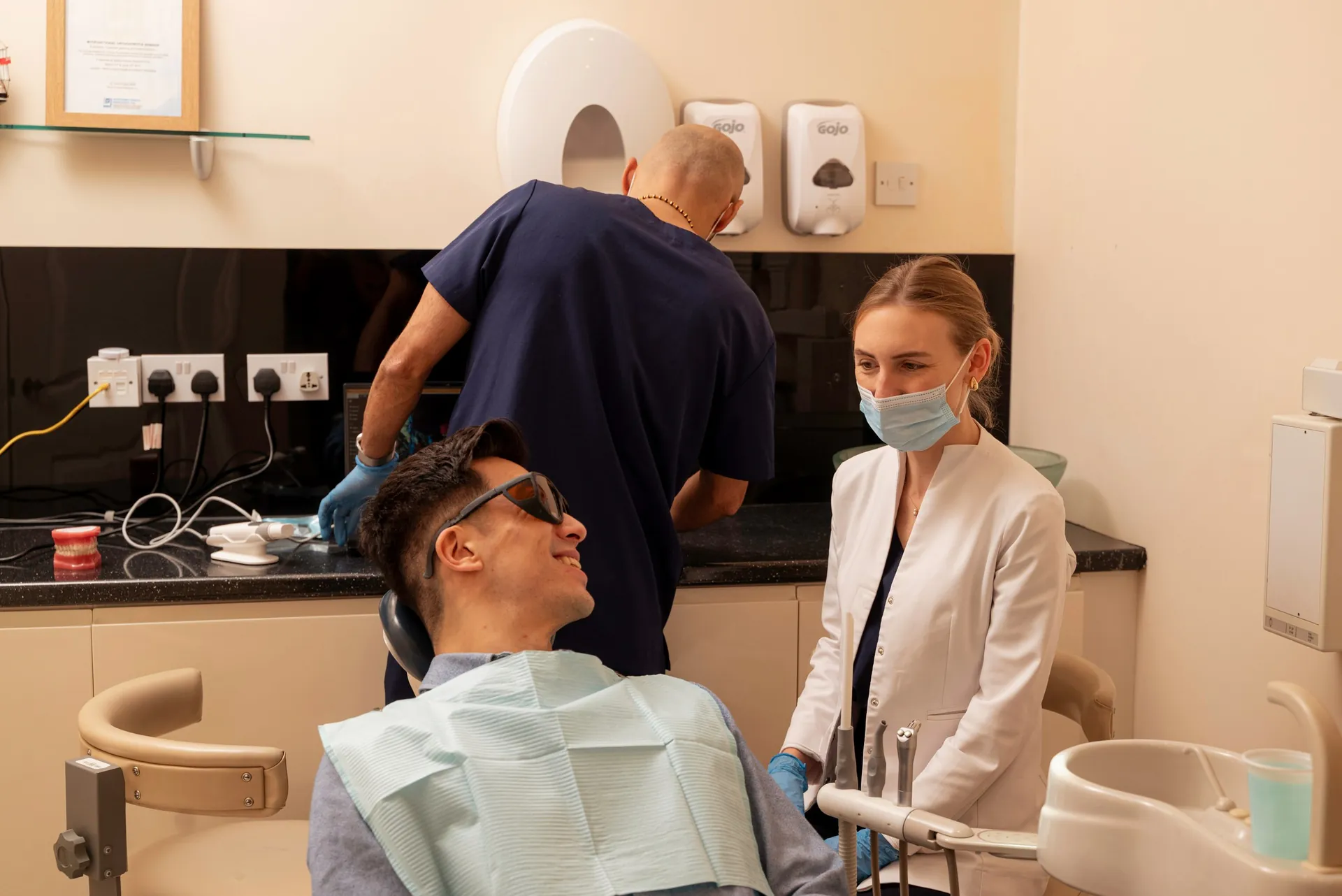
Because results follow the individual case, the only meaningful preview comes from a scan of your own teeth. At consultation we take an iTero 5D digital scan and generate a ClinCheck simulation of your projected end-position, so you see the realistic result for your case — not a stranger's — before you decide anything. We then recommend the tier that reaches your goal and write a costed plan. The honest framing on cost: you pay for the movement your case needs, nothing more, with refinement included and exactly what's covered set out in writing, in line with CMA pricing transparency.
Frequently asked questions
What results can I realistically expect from Invisalign?
It depends on your case complexity and tier. Express gives mild front-tooth correction, Moderate handles broader alignment, Unlimited achieves full-arch correction. Most mild-to-moderate cases reach an excellent, predictable result. The accurate preview for your case comes from your ClinCheck simulation, taken from a scan of your own teeth.
How soon do you see Invisalign results?
Most patients notice visible movement within the first month or two, because the largest movements are usually planned early. The full result builds across the tier timeline, with the final months doing finer detailing you may barely notice week to week but that completes the precision.
Are Invisalign results permanent?
The result is kept with retention, not by treatment alone. Without retainers — full-time briefly, then nightly for life — teeth drift back toward their original positions over years. Retention is how you keep the result you spent months achieving; it is part of treatment, not optional aftercare.
Can Invisalign results match fixed braces?
For mild-to-moderate cases, yes — outcomes are comparable. For severe skeletal cases or certain difficult movements, fixed braces, sometimes combined with surgery, may reach a cleaner result. We assess honestly at consultation and recommend braces where they genuinely produce the better outcome.
Why do Invisalign results sometimes fall short of the plan?
The most common reason is wear time — aligners worn under 22 hours a day leave teeth behind schedule. Other reasons include putting a complex case in too simple a tier, or skipping retention. Accurate planning and faithful wear are what bring the real result onto the simulated one.
Book an Invisalign consultation to preview your result
The only honest preview of your outcome comes from a scan of your own teeth. At consultation we take an iTero 5D digital scan, generate a ClinCheck simulation of your projected end-position, recommend the right tier, and write a costed plan before any commitment.
The Invisalign consultation is free (45 minutes with Dr Vishal Patel · iTero scan and ClinCheck preview included).
Call 020 8127 4567 or WhatsApp +44 7974 910222 during clinic hours. Appointments Monday–Friday, 8am–7pm, by appointment at 222 Essex Road, Islington, London N1 3AP. No Saturday or walk-in appointments. Rated 4.7★ across 300+ Google reviews.
Reviewed by Dr Vishal Patel · BDS Liverpool · MSc Aesthetic & Restorative Dentistry (Manchester) · GDC 103127 · Invisalign Diamond II Provider · AACD Member · twenty years in practice · fifteen thousand cases. Last reviewed 2026-06-04.