Clear Aligners vs Fixed Braces — Full Comparison
Reviewed By
Dr Vishal Patel
BDS Liverpool · MSc Aesthetic & Restorative Dentistry Manchester · GDC 103127 · AACD Member · Invisalign Diamond II Provider · IFAAS (International Fellowship in Advanced Aesthetic Science) · Facial anatomy & cadaver course, Dr Ali Pirayesh, University of Amsterdam · Harley Academy foundation training in injectable aesthetics · IBSA-trained (Profhilo) · NeoStrata-trained (skin peels) · Lynton Lasers trained, incl. ONDA
Last Updated
October 2, 2026
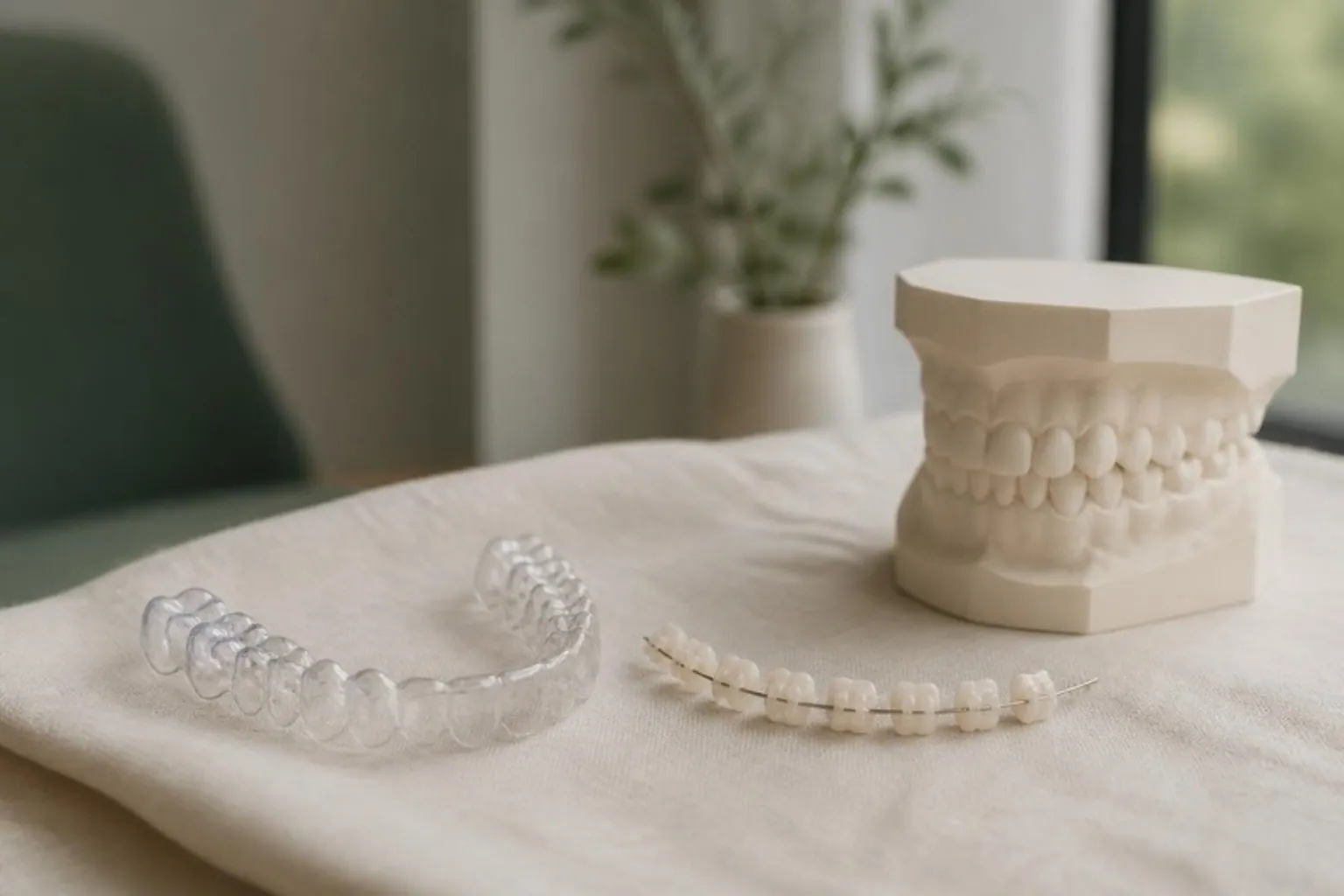
Two ways of moving teeth
Clear aligners are a series of thin, removable plastic trays, each shaped to move the teeth a fraction of a millimetre further than the last. At Dental & Wellness London our main aligner system is Invisalign, planned by Dr Vishal Patel, an Invisalign Diamond II provider, using an iTero digital scan and ClinCheck simulation. Small tooth-coloured attachments are often bonded to some teeth so the trays can grip and guide them. We also use Spark aligners, Inman Aligners and Six Month Smiles where a case suits them.
Fixed braces are brackets bonded to the front of the teeth and linked by an archwire that is adjusted at regular visits. Metal brackets are the traditional form; ceramic brackets are tooth-coloured and less noticeable. Lingual braces sit behind the teeth and are usually provided through referral to a specialist orthodontist.
The key difference
Both apply gentle, controlled force so that the bone around each tooth remodels and the tooth moves. The difference is who is in charge of that force day to day. With aligners, the patient is: the trays only work while they are worn. With fixed braces, the appliance works continuously, and the clinician makes the changes. That single fact explains most of the trade-offs that follow, from visibility and eating to which complex movements each handles best.
How to read this page
The table sets out the practical differences factor by factor. The sections that follow describe who tends to suit each approach, and how we decide in practice. None of it replaces an examination: crowding, spacing and bite problems that look similar in a mirror can need quite different plans. If you would like the wider background first, our guide to Invisalign versus braces and the clear aligners overview are useful companions.
This page is part of our wider guide to teeth straightening, which sets out every option we offer side by side. For a narrower comparison, see Six Month Smiles vs Invisalign.
Further reading
Clear aligners and fixed braces both move teeth reliably when matched to the right case. Aligners such as Invisalign are removable and discreet, and suit mild to moderately complex cases in patients who will wear them 20 to 22 hours a day. Fixed braces stay on the teeth, ask for no daily wear discipline and give finer mechanical control in some complex cases. An assessment of your bite decides which is sounder.
The verdict at a glance
| Clear aligners | Fixed braces | |
|---|---|---|
| How it works | Removable trays changed every one to two weeks move teeth in planned stages, often helped by small bonded attachments | Brackets bonded to the teeth with an archwire that is adjusted at regular visits |
| Best suited to | Crowding, spacing, mild to moderate bite problems and relapse after earlier orthodontics, in patients who will wear the trays consistently | Complex rotations, larger tooth movements and cases needing precise root control; patients who prefer not to manage a removable appliance |
| Less suited to | Some severe rotations, significant vertical movements and cases where daily wear is unlikely | Patients who need a discreet appliance for work or public roles, unless ceramic or lingual options suit |
| Visibility | Very discreet; attachments are tooth-coloured | Metal brackets are visible; ceramic are less noticeable; lingual are hidden behind the teeth |
| Daily commitment | Worn 20 to 22 hours a day, removed only to eat, drink anything other than water, and clean | No wear discipline; the appliance works continuously |
| Eating and cleaning | Eat normally with trays out; brush and floss as usual | Some hard and sticky foods are best avoided; cleaning around brackets takes more time and care |
| Typical treatment time | From a few months for minor cases to around a year or more for comprehensive cases | Often between about a year and two years, depending on complexity |
| Comfort | Pressure for a day or two with each new tray; smooth edges | Soreness after adjustments; brackets can rub the lips and cheeks at first |
| Risks and considerations | Slower or incomplete movement if wear slips; refinement trays are sometimes needed | Higher risk of plaque build-up and white marks around brackets if cleaning is difficult; occasional broken brackets |
| Retention afterwards | Retainers needed long term to hold the result | Retainers needed long term, often a bonded wire plus a removable night retainer |
| Cost at DWL | Invisalign Express £2,200 · Moderate £3,400 · Unlimited £4,500–£4,900; Invisalign consultation free | Quoted in writing after an orthodontic assessment |
| Offered at DWL? | Yes. Invisalign with Dr Vishal Patel; other aligner systems where a case suits them | Yes, metal and ceramic; lingual braces usually by referral to a specialist |
Which one is right for you
Clear aligners tend to suit adults and older teenagers who want treatment to fit quietly into working and social life. If you speak to clients, present, teach or are photographed often, an appliance that is barely noticeable matters more than many people expect.
They are a sound choice when:
- the case involves crowding, spacing or a mild to moderate bite problem that aligners can move predictably;
- you can commit to wearing the trays 20 to 22 hours a day and keeping them out only for meals and cleaning;
- you value eating normally and brushing and flossing without working around brackets;
- teeth have drifted after earlier braces and need a modest correction.
Aligners also let us show you a digital simulation of the planned movement before you commit, which many patients find reassuring. The Invisalign cost page explains how the Express, Moderate and Unlimited plans differ, and which kinds of case each is designed for.
Fixed braces remain the sounder engineering choice for a defined group of patients, and we say so when it applies. They tend to suit:
- cases with severe rotations, teeth that need significant vertical movement, or movements where precise control of the root is important;
- patients who know, honestly, that they would struggle to wear removable trays for most of the day;
- people who would rather not think about their appliance at all between visits;
- some younger patients, where families prefer an appliance that cannot be left in a bag or lost.
Ceramic brackets reduce how noticeable fixed treatment is, and lingual braces hide it almost entirely, although lingual treatment usually means a referral, a period of adjustment for speech and tongue comfort, and a higher fee. Fixed braces ask for more care with cleaning and diet during treatment, so we talk through home care in detail before starting, and arrange hygiene visits to keep the gums healthy throughout.
In my practice, most adults who come to us asking about straighter teeth turn out to be good aligner cases, largely because aligners fit the way they live and therefore get worn. That is not the same as saying aligners are always right. When a case needs movements that fixed appliances control more reliably, or when a patient tells me frankly that they will not keep trays in, I would rather recommend braces than start an aligner plan that is unlikely to finish well.
The decision rests on three things: what your bite needs, what you can realistically commit to day to day, and how much the appearance of the appliance matters to you during treatment. We assess the first with an examination, x-rays where needed and a digital scan; the other two come from a straightforward conversation. Whichever route we agree, retention is planned from the start, because any straightened tooth will tend to drift without it. Our page on retainers after treatment explains why.
The first step is a free Invisalign consultation with iTero scanning, or a dental examination (£65) if you would like a full risk assessment first. You will find us at 222 Essex Road, Islington, London N1 3AP, two minutes from Essex Road station. Buses 38, 56, 73, 341 and 476 stop on Essex Road, and many patients cycle or arrive by Lime or Forest e-bike. We are open Monday to Friday, 8am to 7pm (Tuesday from 9am), by appointment; call 020 8127 4567 or contact us to arrange a time.
Frequently
asked questions
Wellness dentistry combines traditional dental care with whole-body health — treating the mouth as a window to overall wellbeing.
View all FAQs →Are clear aligners as effective as fixed braces?
For many cases of crowding, spacing and mild to moderate bite problems, yes, provided the aligners are worn as prescribed. Fixed braces still give finer control for some complex movements, such as severe rotations or large vertical changes. Effectiveness depends on matching the appliance to the case, which is why we examine the bite before recommending either.
Which is faster, aligners or braces?
For comparable cases the timescales are often similar. Minor aligner cases can finish in a few months, while comprehensive treatment with either approach commonly takes around a year or more. Aligner treatment can lengthen if trays are not worn enough, and fixed treatment can lengthen with broken brackets or missed adjustments. We give you an estimated timescale for your own case at consultation.
Which costs more?
It depends on the complexity of the case and the plan it needs. At DWL, Invisalign Express is £2,200, Moderate £3,400 and Unlimited £4,500 to £4,900. Fixed braces are quoted in writing after an orthodontic assessment, so you can compare like for like. 0% APR finance over 12 months is available.
Which is more comfortable?
Both cause some pressure while teeth are actively moving. Aligners usually feel tight for a day or two with each new tray. Fixed braces tend to ache after adjustments, and brackets can rub the lips and cheeks until the soft tissues adapt. Most patients find either manageable with ordinary pain relief in the first days.
Can I switch from braces to aligners part-way through?
It is occasionally possible, but rarely the best plan, because it usually means rescanning and re-planning the remaining movement. We would much rather spend time at the start choosing the approach you can see through. If treatment is genuinely not working for you, we discuss the options openly.
Are clear aligners suitable for teenagers?
Often, yes, once the relevant adult teeth have come through and if the young person is willing to wear the trays consistently. Some families prefer fixed braces for younger patients because they cannot be removed or lost. We assess each case individually and discuss the practicalities with both the patient and their parents.
Do I need a retainer after either treatment?
Yes. Teeth tend to move back towards their original positions throughout life, whichever appliance straightened them. After aligners this usually means a removable retainer worn at night; after fixed braces it is often a thin bonded wire behind the front teeth plus a night-time retainer. Retention is part of the plan from the start.
Not sure which fits your case?
Book a consultation and we'll assess honestly — no default recommendation.
Book free consultation