Laser hair removal for all skin types
Reviewed By
Dr Vishal Patel
BDS Liverpool · MSc Aesthetic & Restorative Dentistry Manchester · GDC 103127 · AACD Member · Invisalign Diamond II Provider · IFAAS (International Fellowship in Advanced Aesthetic Science) · Facial anatomy & cadaver course, Dr Ali Pirayesh, University of Amsterdam · Harley Academy foundation training in injectable aesthetics · IBSA-trained (Profhilo) · NeoStrata-trained (skin peels) · Lynton Lasers trained, incl. ONDA
Last Updated
October 1, 2026
How we choose between the Lynton Nd:YAG laser and Lynton IPL for your skin type, including darker skin.
Laser hair removal can be safe and effective for most skin types, including darker skin, when the device and settings are matched to the skin. At Dental & Wellness London, Islington, we have both the Lynton Nd:YAG laser and Lynton IPL and choose by Fitzpatrick skin type, after a free patch test. Small areas are £45 to £75 per session.
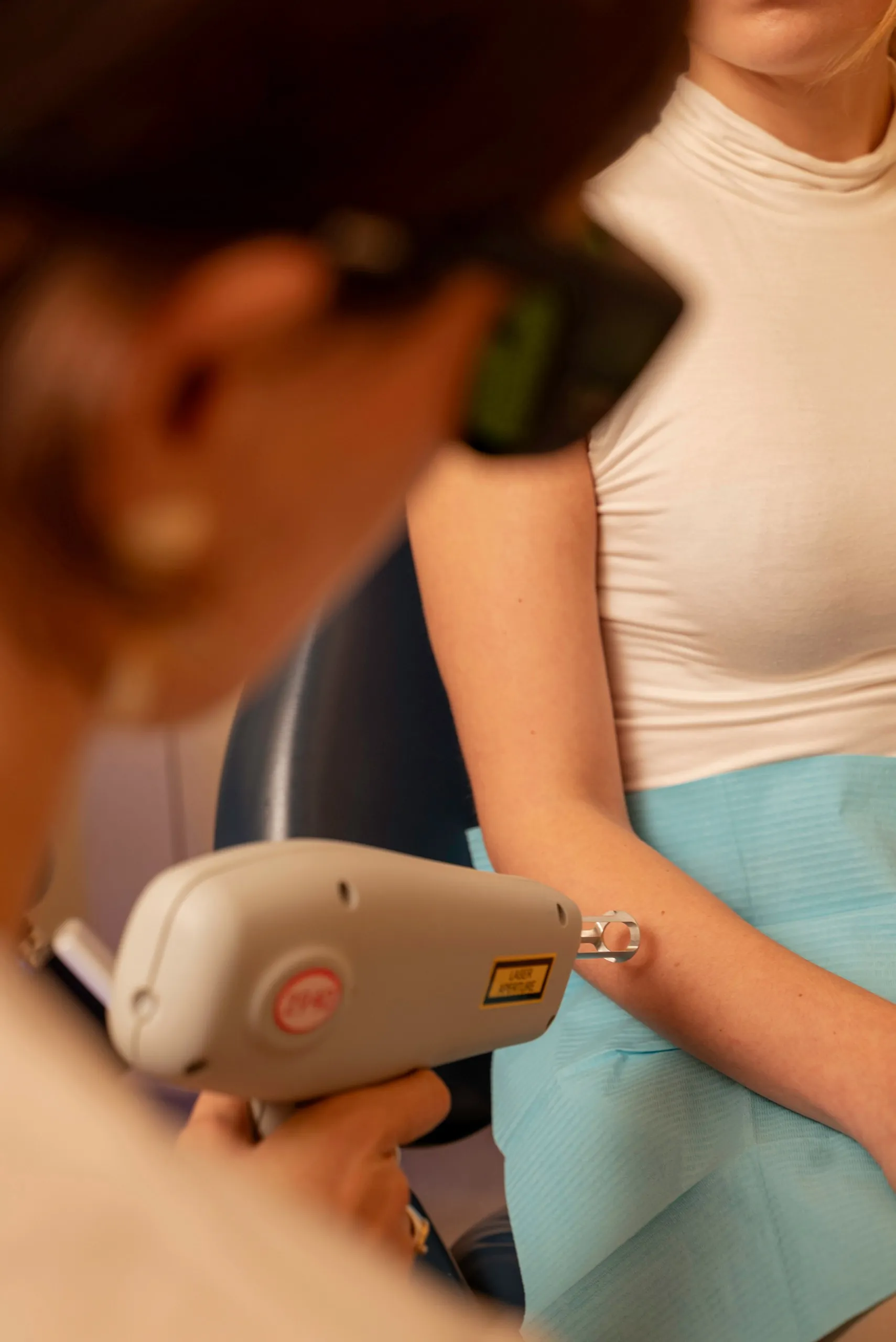
- Suitable for most skin types, including darker skin
- Lynton Nd:YAG laser or Lynton IPL, chosen by skin type
- Free patch test first
- Avoid sun and tan for two weeks before
- Small areas £45–£75 per session
Laser hair removal by skin type
Laser hair removal for every skin type
Light-based hair removal works by targeting the pigment in the hair. Energy is absorbed by the melanin in the hair shaft and carried down to the follicle, where the heat reduces its ability to grow a new hair. The challenge with darker skin is that the skin itself also contains more pigment, so the wrong device or settings can cause burns or pigment change. Safe treatment depends on choosing the right technology and settings for your skin.
That is why we do not start from a price list or a standard programme. We start from your skin. At our clinic on Essex Road in Islington, N1, every course of laser hair removal begins with an assessment of skin type, hair colour and hair thickness, followed by a free patch test, so that the device and settings are matched to you before a full session is ever carried out.
How we treat different skin types
At our Islington clinic we have both the Lynton Nd:YAG laser and Lynton IPL. We assess your skin type on the Fitzpatrick scale, which runs from very fair (type I) to deeply pigmented (type VI), and choose between them: IPL often suits lighter skin, while a laser is often the safer choice for darker skin. Every course starts with a free patch test.
Having both technologies in one room matters. A clinic with a single device has to fit every patient to that device. With two, we can fit the device to the patient, and we can change approach part-way through a course if your skin responds differently from what we expected.
The Fitzpatrick scale in plain terms
- Types I and II: very fair to fair skin that burns easily and tans little. Usually the most straightforward skin for light-based hair removal, provided the hair is dark enough to absorb the light.
- Types III and IV: light olive to olive or light brown skin that tans readily. Many people in this range are well suited to treatment, with settings adjusted to the depth of colour in the skin.
- Types V and VI: brown to deeply pigmented skin that rarely or never burns. Treatment is often possible, but it calls for the right device, more conservative energy and closer attention to how the skin responds.
Skin type is not decided by appearance alone. We ask how your skin behaves in the sun, whether it marks or darkens easily after a scratch or a spot, and whether you have a history of pigment change. Those answers often matter as much as the shade of your skin.
Why IPL and laser behave differently
IPL (intense pulsed light) delivers a broad spread of light, filtered for the treatment. It works well where there is a clear contrast between dark hair and lighter skin, and it can cover an area efficiently. A laser delivers a single, precise wavelength. That precision allows us to direct energy into the hair follicle more selectively, which is why a laser is often the more cautious choice when the surrounding skin carries more pigment. Neither is better in every case; each is better for some people. Our comparison of laser hair removal vs IPL sets out the differences in more detail.
Can I have laser hair removal with dark skin?
Yes, in most cases, with the right device and careful settings. Sessions may be slightly more conservative, so you may need a few more. If we think another clinic could treat your skin more safely, we will tell you.
The aim with darker skin is to protect the epidermis while still delivering enough energy to the follicle to be worthwhile. In practice this means a lower starting energy, a careful increase from session to session as the skin shows it is tolerating treatment, and close review of the patch test site before we go further. Darker skin is more prone to temporary darkening or lightening after any heat-based treatment, so we would always rather progress steadily than push early. If pigmentation is already a concern, our guide to melasma and laser explains how we approach it.
What else affects your result
Skin type decides how safely we can treat. Hair decides how well the treatment works.
- Hair colour: light-based treatment needs pigment in the hair. Dark brown and black hair responds best. White, grey, very fair and many red hairs carry too little pigment to absorb the energy, and we will tell you honestly if this applies to you.
- Hair thickness: coarse hair usually responds sooner than fine, downy hair.
- Area: some areas, particularly on the face, are strongly influenced by hormones and tend to need more sessions and occasional maintenance.
- Hormones: hormonal changes can stimulate new growth. If growth has changed recently or significantly, it is worth speaking to your GP, as treating the hair does not address the cause.
Consultation and your free patch test
Your first visit is a conversation and an assessment. We look at the area to be treated, ask about your medical history and any medicines, confirm your Fitzpatrick skin type and agree which of our two Lynton devices is appropriate. We then carry out a free patch test on a small part of the treatment area.
The patch test lets us see how your skin and hair respond to the settings we intend to use. We usually ask you to wait before your first full session so that any delayed reaction has time to show. For darker skin types, that wait is particularly important, because pigment change can take a little time to appear.
Before treatment
- Avoid sun, sunbeds and fake tan on the area for at least two weeks
- Shave the day before; do not wax, pluck or thread for four weeks
- Tell us about any medicines, as some increase light sensitivity
Tanned skin, including a fading holiday tan, carries more pigment than usual and raises the risk for every skin type. If you arrive with a tan, we will postpone rather than lower our standards. Our page on laser hair removal and sun exposure explains the timings. Shaving the day before matters because hair on the surface absorbs energy and heats the skin, while the root below needs to stay in place for the treatment to work. That is also why waxing, plucking and threading are avoided.
Some medicines increase sensitivity to light, including certain antibiotics and acne treatments, and some skin creams make the surface more reactive. Please bring a list of anything you take or apply, even if it seems unrelated.
What a session feels like
We clean the area, check it has been shaved closely, and give you protective eyewear. Each pulse feels like a brief, warm snap against the skin. Most people find it manageable, and we adjust cooling and pace as we go. Small areas such as the upper lip or underarms take only a few minutes; larger areas such as the legs take longer.
Afterwards the skin may look pink, with small raised bumps around the follicles, for a few hours. On darker skin we watch this response closely and record it, so that each session is guided by how your skin behaved last time.
Aftercare
- Keep the area out of the sun and use a broad-spectrum sunscreen on exposed skin throughout your course
- Avoid hot baths, saunas, steam rooms and vigorous exercise for a day or two
- Do not use exfoliating products or perfumed lotions on the area until it settles
- Expect treated hairs to shed over the following couple of weeks; this is normal
- Contact us if you notice blistering, crusting or any darkening or lightening of the skin
How many sessions you may need
Hair grows in cycles, and treatment works best on hairs in their active growth phase. Not every hair is in that phase at one time, so a course of several sessions, spaced some weeks apart, is needed. The number varies with your skin type, hair colour and thickness, the area and hormonal factors. For darker skin, where we use more conservative settings, you may need a few more sessions than someone with fair skin and dark hair. Results vary, and we will give you a realistic range at consultation rather than a promise.
Risks, and how we reduce them
The main risks of light-based hair removal are burns, blistering and changes in skin colour, either darkening or lightening. These are uncommon when the device and settings are right, and they are more likely in darker or tanned skin. We reduce them by choosing between laser and IPL for your skin type, patch testing before every course, starting conservatively, keeping a record of settings and responses at each visit, and postponing treatment if your skin is tanned, irritated or broken.
We do not treat during pregnancy, over active infection or broken skin, or over tattoos and some moles. If we have any concern about a mark on the skin, we will suggest you see your GP or a dermatologist first.
Prices
Small areas £45 to £75 per session, medium areas £95 to £165, large areas £195 to £295. See our laser hair removal prices. The patch test is free, and your price is the same whichever of our two devices suits your skin.
Why have it with us in Islington
Laser hair removal is overseen by Dr Vishal Patel, who is Lynton Lasers trained and has 10 years in facial aesthetics alongside around 20 years in dentistry. You can read more on Dr Patel’s profile. We would rather tell you that treatment is not right for you, or that another approach would serve you better, than treat skin we cannot treat safely.
The clinic is at 222 Essex Road, Islington, London N1 3AP, two minutes from Essex Road station and a short ride from Angel, Highbury, Canonbury, Hackney and Stoke Newington. Buses 38, 56, 73, 341 and 476 stop on Essex Road. Many patients cycle or use a Lime or Forest e-bike. We are open Monday to Friday, 8am to 7pm, by appointment.
Clinically reviewed by Dr Vishal Patel · BDS · MSc Aesthetic & Restorative Dentistry · GDC 103127. Last reviewed 1 October 2026.
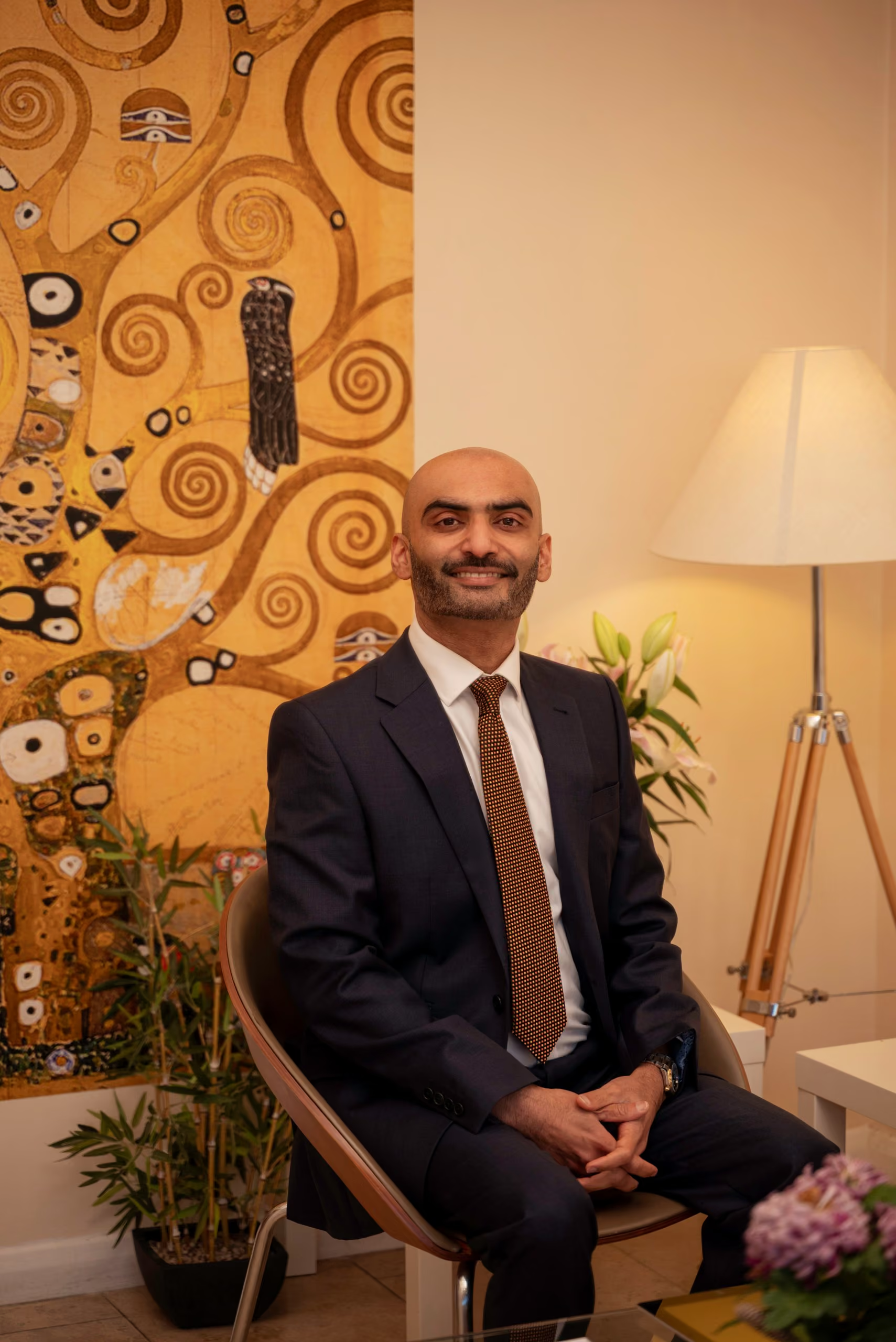
Dr Vishal Patel
Clinical lead · Lynton Lasers trained, including ONDA
BDS Liverpool · MSc Aesthetic & Restorative Dentistry (Manchester) · GDC 103127 · Lynton Lasers trained, including ONDA · International Fellowship in Advanced Aesthetic Science (IFAAS) · 10 years in facial aesthetics
We will tell you when a treatment is not the right answer. That honesty is part of the treatment.
Read Dr Patel’s profile →For the full picture, including how this compares with the alternatives, see our guide to laser hair removal.
Further reading
The Fitzpatrick scale
Classifies skin into 6 types based on response to sun exposure:
- Type I — very pale, always burns, never tans
- Type II — pale, usually burns, tans slightly
- Type III — medium, sometimes burns, tans gradually
- Type IV — olive, rarely burns, tans easily
- Type V — brown, very rarely burns, tans deeply
- Type VI — very dark brown to black
Laser hair removal safety and effectiveness varies across these types.
Skin-type-specific considerations
Types I-III (lighter skin)
Usually well suited to treatment, with the Lynton Nd:YAG laser or Lynton IPL chosen at assessment. Coarse dark hair responds best.
Type IV (olive skin)
We choose carefully between the Lynton Nd:YAG laser and Lynton IPL, with settings adjusted to the skin. A free patch test comes first.
Types V-VI (darker skin)
A laser is often the safer choice, used with conservative settings. The wrong device or settings carry pigmentation risk, so a free patch test and close review matter.
Why darker skin needs a different approach
Melanin in skin and melanin in hair both absorb laser energy. For darker skin types, more skin melanin means more potential for skin damage (burns, pigmentation changes, scarring) if the wrong device or settings are used.
A laser delivers a single, precise wavelength, which lets us direct energy into the follicle more selectively. IPL delivers a broad spread of light, so it is often less suited where the surrounding skin carries more pigment.
What we do at DWL
Skin-type assessment at consultation. Device selection (Lynton Nd:YAG laser or Lynton IPL) matched to skin type. Patch test for any case where pigmentation risk is elevated. Conservative initial settings with progression based on response.
We say no to laser hair removal when our equipment can't safely accommodate the patient's skin type. Honest referral to specialist providers.
Tan considerations
Any skin type with recent significant tan has elevated risk during treatment — the tan increases melanin absorption. We typically defer treatment for 4-6 weeks after substantial sun exposure.
The right device, for your skin.
Consultation — £65
A skin assessment with an honest view of what will help. The fee is redeemable in full against treatment.
Free patch test
We test a small area to check your skin’s response.
Your course
Usually 6 to 8 sessions, sometimes more for darker skin.
Start with a consultation
- Free patch test
- Lynton Nd:YAG laser or IPL
- Priced by area, in writing
Or call 020 8127 4567 · WhatsApp +44 7974 910222
222 Essex Road, Islington N1 3AP · Mon–Fri, 8am–7pm
Our happy patients,
in their own words
Transparent pricing
Prices are set out below. Your written plan confirms the fee before any treatment begins.
Clear prices, set out before you start.
Upper lip, chin
Underarms, bikini
Legs, back, arms
Included
- Free patch test
- A written course plan
Quoted separately
- Maintenance top-ups, priced per area
Questions
people ask
If your question isn't answered here, call reception on 020 8127 4567 or email reception.
Can I have laser hair removal with dark skin?
Yes, in most cases. A laser is often the safer choice for darker skin, with careful settings and a free patch test first.
What if I have a tan before laser hair removal?
We postpone treatment until the tan has faded, usually at least two weeks, because tanned skin is more likely to react.
How do you assess my skin type?
We use the Fitzpatrick scale, your history of burning and tanning, and a free patch test.
What if my skin type is not suitable for your equipment?
We will tell you honestly and suggest a clinic that can treat you more safely.